Trump Signals India Is Nearing End of Russian Oil Imports, Hints at Major Visit in 2026

Trump Signals India Is Nearing End of Russian Oil Imports, Hints at Major Visit in 2026
By
Leah Rosenfeld
Last updated:
November 7, 2025
First Published:
November 30, 2025

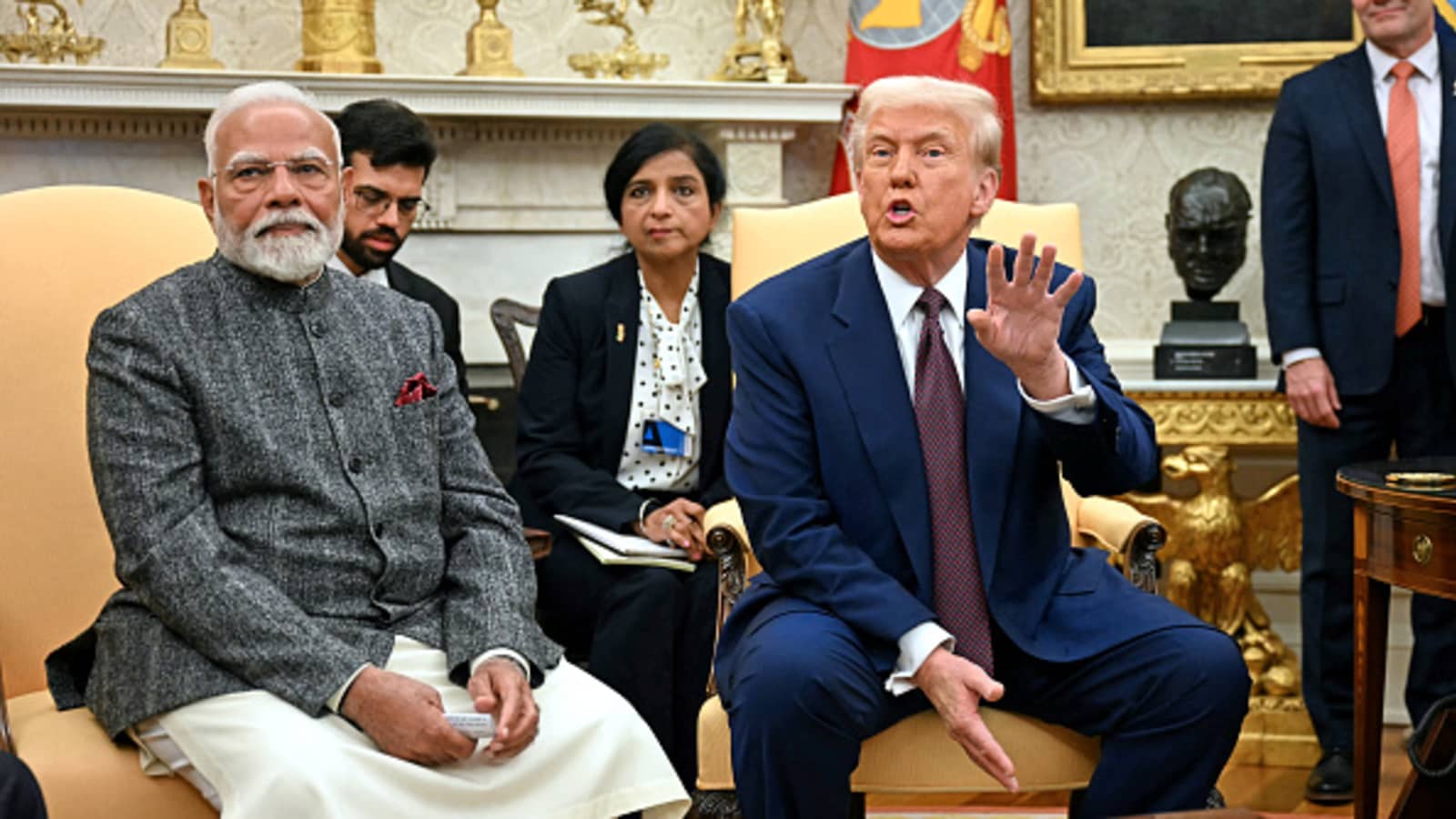
US President Donald Trump speaks with the press as he meets with Indian Prime Minister Narendra Modi in the Oval Office of the White House in Washington, DC, on Feb. 13, 2025. | Jim Watson | AFP | Getty Images
U.S.–India Negotiations Gain Momentum
U.S. President Donald Trump said that trade discussions with India are progressing positively and suggested he may travel to the country in 2026 if invited by his “friend” Narendra Modi. At a White House briefing, he noted that India “has largely stopped buying oil from Russia,” marking what he described as a significant breakthrough in bilateral talks.
This comes at a time when the two nations are working to resolve a host of trade-friction issues, including steep U.S. tariffs on Indian exports and energy-supply disagreements. According to the U.S. administration, India’s move on Russian oil purchases could unlock a broader trade deal and lower the high 50 % tariff imposed on Indian goods.
India’s Russian Oil Imports: Numbers and Pressure
India has long been one of the largest buyers of Russian seaborne crude — importing around 1.7–1.9 million barrels per day in recent months, roughly 36–40 % of Russia’s export streams in the 2025 first nine months.
Despite the U.S. claims of a steep reduction, shipping-data from firms such as Kpler indicate India’s Russian oil imports actually edged up to about 1.48 million bpd in October from 1.44 million bpd in September, signaling that any cut-back may still be nascent.
The U.S. sanctions on Russia’s oil majors (such as Rosneft and Lukoil) are scheduled to come fully into force from November 21, which is seen as the moment when many Indian refiners may actually begin winding down Russian purchases.
Why Are The Tariffs So Harsh?
The U.S. has imposed a 50 % tariff on many Indian exports — one of the highest U.S. has ever applied to any single country. Half of that penalty is explicitly linked to India’s purchase of Russian crude. Trump has warned that the tariffs will stay in place unless India cuts off its Russian oil imports and aligns more closely with U.S. trade and energy policy.
The pressure is two-fold: Washington wants India to reduce its reliance on discounted Russian crude (which indirectly supports Russia’s war-effort) and simultaneously hopes to reset trade across sectors such as agriculture, manufacturing and energy.
Will India Really Stop Buying Russian Oil?
On the surface, the U.S. announcement of India’s “large stop” is significant — but digging deeper, the picture is more nuanced. Indian officials have publicly said they are not aware of any commitment from Prime Minister Modi to halt Russian imports entirely, and long-term contracts plus price-advantage make a full cessation unlikely in the near term.
Industry sources suggest refiners may begin reducing their orders from December onwards, but a complete phase-out appears unrealistic without jeopardising India’s energy supply and cost stability. A sharp shift could raise India’s crude-cost, inflate domestic energy prices, and affect export competitiveness of Indian refined products.
What This Means for Stakeholders
For India:
- Reducing Russian oil imports could lead to better trade terms with the U.S., e.g., a tariff cut to 20 % or less from the current 50 %.
- It would require switching to more expensive crude sources, raising the import bill modestly (estimates suggest under a 2 % increase annually).
- Maintaining energy security is key — Indian consumption remains heavily import-dependent (over 80 % of its crude).
For the U.S.:
- A visit by Trump to India would signal a reopening of high-level diplomacy and a potential reset of U.S.–India trade relations.
- It highlights the U.S. strategy of using energy and trade leverage to influence Russia’s revenue streams.
- A trade deal would open new U.S. energy exports to India and strengthen bilateral ties.
For the global market:
- Russia could see its oil discount deepen if India cuts back — forcing more crude into shadow markets or less-favoured buyers.
- Energy flows and pricing could shift notably across Asia as refiners adjust sourcing.
- U.S.–India trade developments could impact global supply chains, especially in refining, fuels and manufacturing.
The Road Ahead
The next few months will be critical. If India begins to visibly scale back Russian oil imports starting December or January, it could mark the beginning of a trade breakthrough with the U.S. If not, the stalls may persist. Meanwhile, a Trump visit in 2026 — provided an invitation from Modi arrives — could symbolise a new chapter in bilateral relations.
Either way, the intersection of energy policy, trade tariffs and geopolitics has rarely been more in focus — and India’s decisions will matter not just for its relationship with the U.S., but for the global oil map.
.webp)
Popular articles



Subscribe to unlock premium content
Driven by Desire in London

Hyper-Niche Gold

The Rise of Private Robotics Tutors for Children

Driven by Desire in London
Hyper-Niche Gold
Driven by Desire in London