BYD’s Early 2026 Sales Slide Signals Intensifying Competition in China’s Electric Vehicle Market

BYD’s Early 2026 Sales Slide Signals Intensifying Competition in China’s Electric Vehicle Market
By
Rachel Steinberg
Last updated:
March 6, 2026
First Published:
March 6, 2026

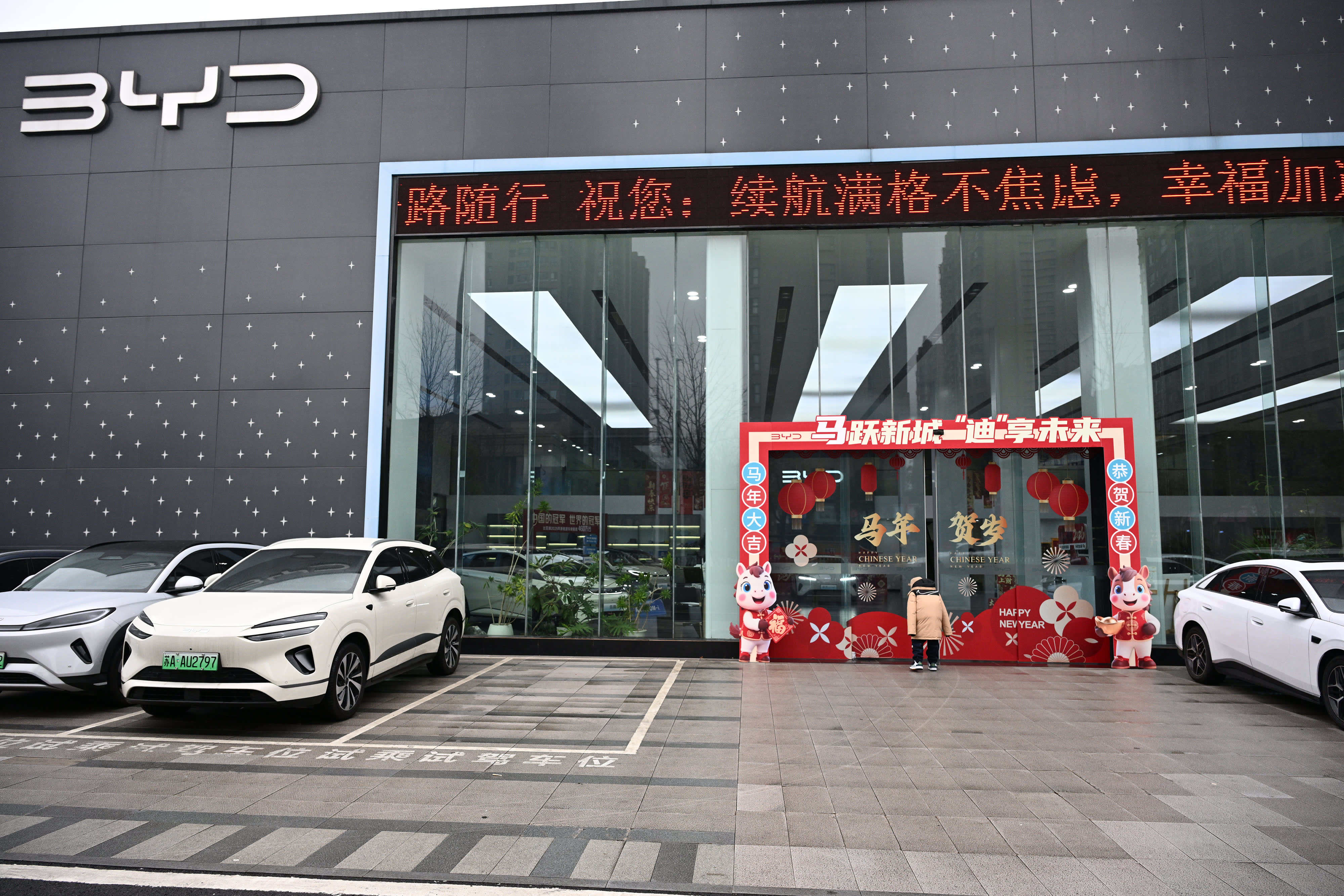
NANJING, CHINA - MARCH 2, 2026 - New energy vehicles parked outside a BYD store in Nanjing, Jiangsu Province, China on March 2, 2026. (Photo credit should read CFOTO/Future Publishing via Getty Images)
Cfoto | Future Publishing | Getty Images
BYD Faces Slower Start to 2026
China’s electric vehicle leader BYD entered 2026 with a noticeable slowdown in momentum, as domestic competitors gained ground in the world’s largest EV market.
During the first two months of the year, BYD’s combined sales for January and February dropped sharply compared with the same period a year earlier. Even after adjusting for the seasonal disruption caused by the Chinese New Year holiday — which typically slows automotive purchases for several weeks — the company’s deliveries still declined by roughly 36% year over year.
The decline marks a rare moment of vulnerability for the Shenzhen-based automaker, which has spent the past several years dominating China’s rapidly expanding new energy vehicle (NEV) sector that includes battery electric vehicles and plug-in hybrids.
While BYD remains the largest EV producer globally by volume, the early 2026 numbers suggest the competitive gap between the company and its domestic rivals is beginning to narrow.
Rivals Accelerate as Market Competition Intensifies
While BYD’s deliveries declined, several Chinese automakers reported strong growth during the same period, signaling a shift in competitive dynamics across the EV industry.
Startup automaker Leapmotor recorded 60,126 vehicle deliveries across January and February, representing a 19% increase compared with the previous year. Meanwhile, technology giant Xiaomi, which entered the automotive sector recently, sold more than 59,000 vehicles during the same two-month period, marking a 48% year-over-year surge.
Other companies posted even stronger growth figures. Nio, known for its premium electric vehicles and battery-swapping technology, saw deliveries rise by approximately 77%, while Zeekr, the luxury EV brand under automotive conglomerate Geely, recorded an impressive 84% jump in combined sales over the same timeframe.
Not all companies experienced growth. Xpeng, another major Chinese EV manufacturer, reported one of the steepest declines, with total deliveries dropping around 42% year over year to 35,267 vehicles. Li Auto, which focuses on extended-range hybrid SUVs, also experienced a modest slowdown with deliveries slipping nearly 4% to 54,089 units.
Despite these mixed results, the broader trend indicates that China’s EV market is becoming far more competitive, with new models and aggressive pricing strategies attracting consumer attention.
A Shrinking Lead in China’s Massive EV Market
BYD’s declining sales share suggests that the once-dominant EV maker is facing increasing pressure from competitors that are rapidly improving their product offerings.
For much of 2024 and 2025, BYD controlled an estimated 26% to 34% share of China’s new energy vehicle market, giving it a commanding lead over rivals. However, analysts say companies such as Geely, Leapmotor, and emerging technology-backed brands are gradually capturing parts of BYD’s core mid-range market.
Industry experts describe the competition as a form of “involution,” a strategy where automakers aggressively pack advanced technology and premium features into vehicles while maintaining competitive pricing.
Chinese consumers are increasingly benefiting from this trend, gaining access to vehicles equipped with advanced driver assistance systems, larger battery ranges, and premium interiors at lower price points.
As a result, differentiating between EV brands is becoming more difficult.
Market analysts note that the rapid pace of technological innovation across the industry means that features once considered premium are now quickly becoming standard across many vehicles.
Xiaomi’s New Models Disrupt the Market
One of the most significant disruptions to the Chinese EV market has come from Xiaomi, the consumer electronics giant that launched its first electric vehicle only recently.
The company’s YU7 SUV became the best-selling passenger vehicle in China in January, outperforming several established competitors. Sales of the model were reportedly more than double those of Tesla’s Model Y, which had been the country’s top-selling EV model in the previous month.
Xiaomi’s rapid rise reflects the increasing overlap between technology companies and automotive manufacturers. Many tech-focused brands are leveraging their expertise in software, connectivity, and ecosystem integration to attract younger buyers.
This shift is adding further pressure on traditional automakers, including BYD, to innovate faster and enhance their digital capabilities.
Policy Changes Create Demand Slowdown
Beyond rising competition, policy changes are also contributing to softer EV demand in China.
At the end of 2025, Chinese authorities reinstated a 5% purchase tax on new energy vehicles, ending several years of tax exemptions designed to accelerate EV adoption. Previously, EV buyers had been exempt from the full 10% vehicle purchase tax, which significantly reduced the cost of ownership.
The policy shift appears to have triggered a temporary surge in purchases late in 2025, as consumers rushed to buy vehicles before the new tax rules took effect. Analysts say this created a “demand vacuum” at the beginning of 2026, contributing to weaker sales figures during the first two months of the year.
For higher-priced vehicles, the tax increase can represent a substantial additional expense. For example, a vehicle priced at $200,000 would incur roughly $10,000 in extra taxes, potentially discouraging some buyers from upgrading.
Chinese Regulators Push for Industry Self-Reliance
The reintroduction of EV purchase taxes reflects a broader strategy by Chinese policymakers to normalize the electric vehicle market after years of heavy government incentives.
For more than a decade, subsidies, tax breaks, and infrastructure investments helped China build the world’s largest EV ecosystem. Today, the country accounts for over half of global EV sales, with millions of vehicles sold annually.
However, regulators are now encouraging automakers to become more financially independent and competitive without relying on large government incentives.
Analysts say this transition could slow the pace of growth in the short term, as companies adjust to a market environment with fewer subsidies and greater pricing pressure.
BYD Expands Globally to Offset Domestic Pressure
Facing growing competition at home, BYD has increasingly turned its attention to international markets as a key growth strategy.
In 2025, the company surpassed 1 million vehicle exports for the first time, selling cars in Europe, Southeast Asia, Latin America, and parts of the Middle East. The company has been rapidly expanding its overseas distribution network while building manufacturing partnerships in several countries.
In February 2026, BYD reportedly reached another milestone: its export volumes exceeded domestic deliveries for the first time in a single month, highlighting the growing importance of international markets for the company’s future growth.
This global expansion provides BYD with an advantage over some domestic competitors that remain heavily dependent on China’s local market.
New Technologies Could Drive the Next Growth Cycle
Despite the early slowdown, BYD is preparing to introduce several new technologies that could help restore momentum later in the year.
One of the company’s most anticipated developments is the next generation of its Blade Battery, a lithium iron phosphate battery technology designed to improve safety, durability, and energy density.
The upcoming Blade Battery 2.0 is expected to deliver longer driving ranges and faster charging capabilities, potentially strengthening BYD’s competitiveness in the EV market.
The company is also working on second-generation ultra-fast charging technology and upgrades to its advanced driver assistance systems, building on last year’s rollout of the “God’s Eye” autonomous driving feature.
That earlier technology launch helped boost demand without triggering a large-scale price war in the industry.
Analysts believe a similar product-driven strategy could help BYD regain momentum in 2026 as consumers increasingly prioritize performance, battery range, and intelligent driving features.
Financing Deals Aim to Stimulate EV Demand
To counter slowing demand, several automakers in China have begun introducing aggressive financing incentives to attract buyers.
Some companies are offering long-term low-interest loans, while others are rolling out zero-interest financing packages to make EV purchases more affordable.
Tesla, for example, recently introduced five-year loans with zero percent interest rates, as well as seven-year financing options with very low borrowing costs.
Xiaomi has launched a similar program, offering seven-year low-interest financing packages to reduce the upfront burden for customers.
These incentives reflect the increasingly competitive environment in China’s EV market, where automakers are searching for new ways to stimulate demand.
A More Competitive EV Era Begins
The early 2026 sales data suggests China’s electric vehicle industry is entering a new phase.
While BYD remains the dominant player, the rapid rise of new competitors, evolving government policies, and shifting consumer expectations are reshaping the market landscape.
Instead of a single dominant leader, the industry may increasingly resemble a crowded battlefield of innovative companies competing on technology, pricing, and global expansion.
For BYD, the challenge will be maintaining its leadership position while navigating a market that is becoming more dynamic — and far more competitive — than ever before.
.webp)
Popular articles



Subscribe to unlock premium content
Driven by Desire in London
Hyper-Niche Gold
The Rise of Private Robotics Tutors for Children

Driven by Desire in London
Hyper-Niche Gold
Driven by Desire in London