Canada and China Cut EV and Canola Tariffs in Major Reset of Trade Relations

Canada and China Cut EV and Canola Tariffs in Major Reset of Trade Relations
By
Rachel Steinberg
Last updated:
January 19, 2026
First Published:
April 25, 2026

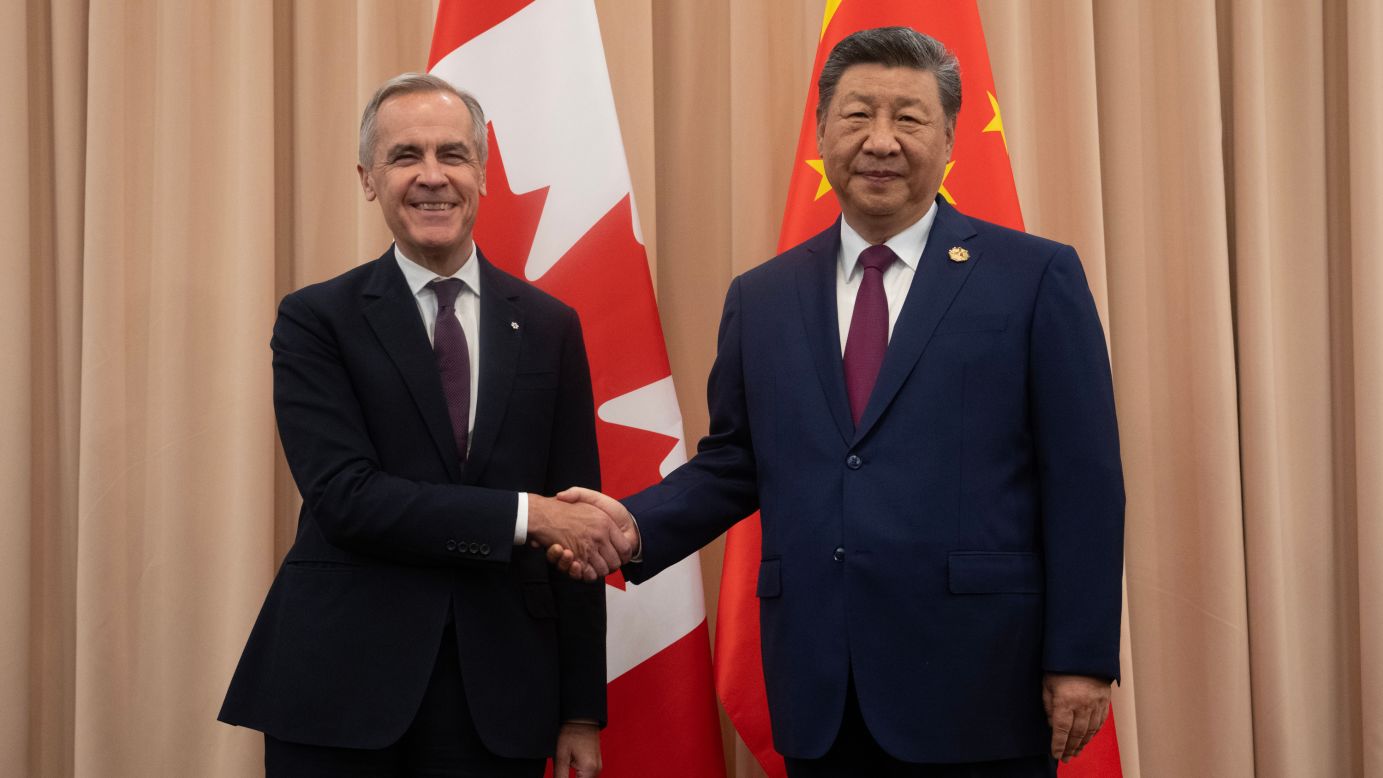
Photo: CNN
Canada and China have reached an initial trade understanding that sharply lowers tariffs on electric vehicles and agricultural products, marking a significant thaw in relations between the two countries after years of escalating trade and diplomatic tensions.
The agreement was announced during Prime Minister Mark Carney’s visit to China, the first by a Canadian prime minister since 2017, and signals a strategic effort by both sides to rebuild economic ties amid shifting global trade dynamics.
A New Framework for Electric Vehicles
Under the deal, Canada will allow imports of up to 49,000 Chinese-made electric vehicles under a reduced tariff rate of 6.1 percent, applied on a most-favored-nation basis. Carney said the policy takes effect immediately and represents a dramatic reversal from the 100 percent tariff imposed in 2024 under former Prime Minister Justin Trudeau.
In 2023, China exported just over 41,000 EVs to Canada, meaning the new quota initially aligns closely with recent trade volumes. Carney added that the quota will expand gradually, rising to roughly 70,000 vehicles annually within five years as the framework matures.
The shift reflects a change in Ottawa’s industrial strategy. Rather than relying on protectionist barriers, Carney argued that Canada’s ambition to build a globally competitive EV sector depends on learning from advanced manufacturers, integrating into global supply chains, and expanding domestic demand.
The move places Canada at odds with current U.S. policy, which continues to impose steep tariffs on Chinese EVs. Some members of U.S. President Donald Trump’s cabinet criticized the decision ahead of a scheduled review of the U.S.-Canada-Mexico trade agreement. Trump himself, however, publicly backed Carney’s approach, calling it a sensible step and encouraging countries to pursue deals with China where possible.
Political Pushback at Home
Not everyone in Canada welcomed the announcement. Ontario Premier Doug Ford, whose province anchors Canada’s auto manufacturing industry, warned that the policy could expose domestic producers to unfair competition.
He argued that opening the market to lower-cost Chinese vehicles without firm commitments on local investment or supply-chain development risks undermining Canada’s auto sector. Federal officials countered that the agreement creates long-term opportunities by lowering costs for consumers and accelerating EV adoption.
Relief for Farmers and Food Exporters
Agriculture was the other major pillar of the deal. In retaliation for Canada’s earlier EV tariffs, China imposed duties in 2025 on more than $2.6 billion worth of Canadian farm and food products, including canola oil, canola meal, and canola seed. Those measures contributed to a double-digit drop in China’s imports of Canadian goods last year.
Carney said Canada now expects China to sharply reduce tariffs on canola seed by March 1, cutting the combined rate to around 15 percent from as high as 84 percent. Anti-discrimination tariffs on canola meal, lobsters, crabs, peas, and other products are also expected to be suspended from March through at least the end of the year.
The announcement immediately lifted Canadian canola futures, reflecting expectations of renewed access to one of the world’s largest agricultural markets. Carney estimated the agreements would unlock close to $3 billion in new export orders for Canadian farmers, fish harvesters, and food processors.
China’s Commerce Ministry confirmed it would adjust anti-dumping and anti-discrimination measures on Canadian agricultural and aquatic products in response to Canada’s decision to lower EV tariffs.
Broader Economic Cooperation
Beyond tariffs, both governments signaled a wider reset in economic engagement. China said the two countries would restart high-level economic and financial dialogue, expand trade and investment, and deepen cooperation in agriculture, oil and gas, and green energy.
Carney highlighted Canada’s plans to double its electricity grid capacity over the next 15 years, noting opportunities for foreign investment in areas such as offshore wind. He also reiterated Canada’s ambition to scale up liquefied natural gas exports to Asia, targeting annual production of 50 million tonnes by 2030, all destined for Asian markets.
China also committed in principle to granting visa-free access for Canadian travelers, though detailed timelines and conditions were not disclosed.
A More Predictable Partner?
Carney suggested that recent dealings with Beijing have become more stable, especially as Canada navigates a more complicated trade relationship with the United States. Washington has imposed tariffs on certain Canadian goods, and Trump has repeatedly floated the idea of Canada becoming the 51st U.S. state, remarks that have strained relations.
China, facing its own trade pressures from the United States, appears eager to strengthen ties with a Group of Seven economy traditionally aligned with Washington. Analysts say the rapprochement could subtly reshape the broader context of U.S.-China rivalry without fundamentally altering Canada’s strategic orientation.
Experts caution that while Ottawa is unlikely to pivot away from the United States on security or intelligence matters, the renewed engagement with China gives Canada greater economic flexibility at a time of global trade fragmentation.
Taken together, the EV and canola deal represents one of the most significant resets in Canada-China relations in nearly a decade, with immediate implications for automakers, farmers, and consumers, and longer-term consequences for how middle powers navigate an increasingly polarized global economy.
.webp)
Popular articles



Subscribe to unlock premium content
The Market for Renting Private Libraries Where Only Rare, Unpublished Manuscripts Exist

Living Underwater in the Heart of the City

Frozen Luxury in Europe

The Market for Renting Private Libraries Where Only Rare, Unpublished Manuscripts Exist
Living Underwater in the Heart of the City
The Market for Renting Private Libraries Where Only Rare, Unpublished Manuscripts Exist