TSMC Signals Even Bigger U.S. Expansion as Arizona Becomes a Core Hub for AI Chips

TSMC Signals Even Bigger U.S. Expansion as Arizona Becomes a Core Hub for AI Chips
By
Junia Wells
Last updated:
January 16, 2026
First Published:
January 16, 2026

TSMC Prepares to Deepen Its U.S. Commitment
Taiwan Semiconductor Manufacturing Co. is preparing to significantly ramp up its already massive U.S. investment, reinforcing Arizona’s role as a critical pillar in the global semiconductor supply chain. Buoyed by strong earnings, accelerating AI demand, and improving operational performance in the U.S., the world’s largest contract chipmaker has made it clear that its American expansion is far from complete.
TSMC has already committed $165 billion to the U.S., a figure that places it among the largest foreign investors in American manufacturing. Executives now indicate that spending will rise further as the company races to meet exploding demand for advanced chips used in artificial intelligence, data centers, and high-performance computing.
AI Demand Drives Capital Spending Surge
Speaking with CNBC, Chief Financial Officer Wendell Huang said TSMC is stepping up capital expenditures both in Taiwan and the United States, citing what he described as a powerful and durable AI-driven growth cycle.
The company expects capital spending in the coming year to rise by more than 30% at the midpoint compared with 2025 levels. While TSMC has not disclosed the exact dollar amount allocated to U.S. projects, the increase signals tens of billions of dollars in additional investment globally, with Arizona positioned as a major beneficiary.
Executives emphasized that the strategy is not only about adding capacity, but also accelerating timelines wherever possible to close the gap between demand and supply for leading-edge chips.
Arizona Set to Become a “Gigafab Cluster”
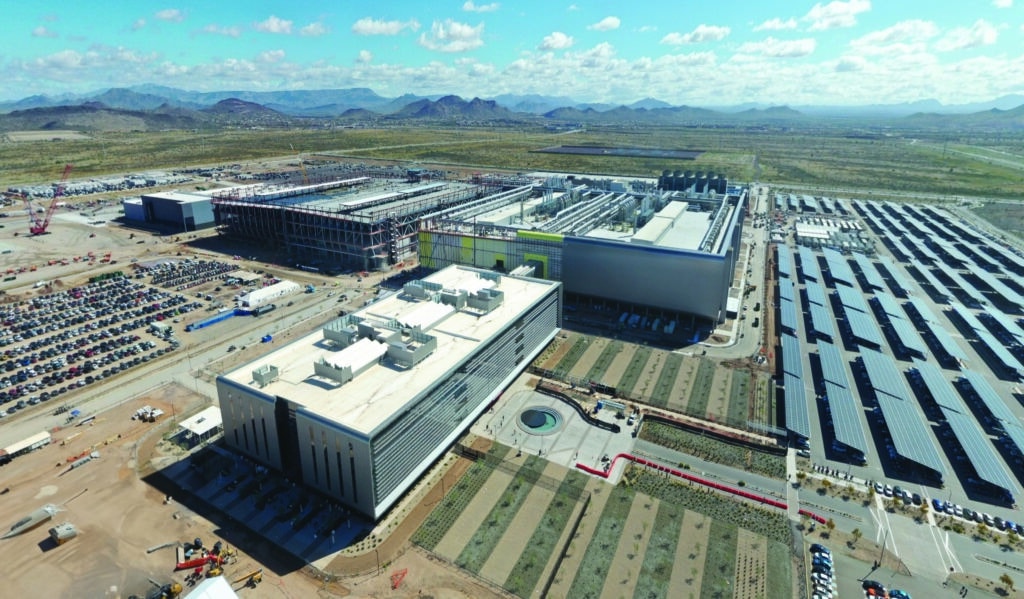
Chief Executive Officer C.C. Wei revealed during TSMC’s latest earnings call that the company has purchased additional land in Arizona and plans to develop what he described as a “gigafab cluster.” This marks a shift from a single-facility approach toward a dense manufacturing ecosystem similar to TSMC’s flagship sites in Taiwan.
TSMC originally acquired around 1,100 acres in Arizona with plans to build six wafer fabrication plants, two advanced packaging facilities, and a dedicated research and development center. As expansion ambitions grew, that footprint proved insufficient, prompting the purchase of an additional 900-acre parcel.
Some facilities originally planned for the first site will now be constructed on the newly acquired land, while the remaining space is being reserved for future flexibility as demand evolves.
Trade Deal Provides Additional Tailwinds
The Arizona expansion comes alongside a newly signed U.S.–Taiwan trade agreement that reduces tariff uncertainty for Taiwanese exporters. Under the deal, U.S. tariffs on Taiwanese goods are capped at 15%, down from 20%, without layering additional duties on top of existing rates.
The agreement also includes commitments for $250 billion in direct Taiwanese investment into the U.S. across semiconductors, AI, and related industries, as well as $250 billion in credit guarantees aimed at strengthening supply chains. Semiconductor products receive favorable treatment, aligning with Washington’s broader effort to reshore critical chip manufacturing.
U.S. Commerce Secretary Howard Lutnick said the long-term objective is to bring roughly 40% of Taiwan’s semiconductor supply chain to the United States, underscoring the strategic importance of TSMC’s presence in Arizona.
Investment Decisions Driven by Customer Demand
While media reports suggested that TSMC’s Arizona expansion was linked to trade negotiations, Huang pushed back on that narrative. He stressed that the company’s investment decisions are driven primarily by customer demand rather than government-level trade talks.
According to Huang, progress at the company’s first Arizona fabrication plant has reinforced confidence in scaling U.S. operations. The facility has already entered mass production and is delivering yields and technology performance comparable to TSMC’s top-tier fabs in Taiwan.
This operational milestone addresses long-standing concerns around cost, talent, and execution risks associated with manufacturing advanced chips in the U.S.
Manufacturing Excellence Proven Outside Taiwan
TSMC executives highlighted that the success of the first Arizona fab demonstrates the company’s ability to replicate its manufacturing discipline outside Taiwan, a critical test as customers push for geographic diversification of chip supply.
That said, the company remains clear that its most advanced process technologies will continue to be developed and scaled first in Taiwan, where close coordination between research and manufacturing teams offers structural advantages. Profit margins also remain higher in Taiwan due to lower labor and operating costs.
Even so, the performance gap between U.S. and Taiwanese operations is narrowing, improving the long-term economics of American production.
Faster Timelines and More Fabs Ahead
TSMC has accelerated its U.S. roadmap. The second Arizona fab is now expected to begin production in the second half of 2027, earlier than previously planned. Construction of a third facility is also picking up pace this year, and the company has begun applying for permits for a fourth plant.
Together, these moves point to a multi-fab manufacturing hub capable of producing advanced logic chips at scale, supporting customers across AI, cloud computing, automotive, and consumer electronics.
Market Reaction Reflects Investor Confidence
Investors responded positively to the expansion signals and earnings momentum, with TSMC shares rising more than 3% in Taipei trading. The stock’s performance reflects growing confidence that the company can manage rising capital expenditures while maintaining its technological lead and profitability.
As AI demand reshapes the semiconductor industry, TSMC’s willingness to commit ever-larger sums to U.S. manufacturing positions it as a central player in the next phase of global chip production, balancing geopolitical realities with relentless customer demand.

Popular articles


Subscribe to unlock premium content
Snow, Silence, and Splendor

The $60 Million Market for Ultra-Exclusive Executive Pop-Up Experiences

Conquering the Poles in Absolute Luxury

Snow, Silence, and Splendor
The $60 Million Market for Ultra-Exclusive Executive Pop-Up Experiences
Snow, Silence, and Splendor