Samsung Unveils Its First Tri-Fold Smartphone as Competition from Chinese Rivals Accelerates

Samsung Unveils Its First Tri-Fold Smartphone as Competition from Chinese Rivals Accelerates
By
David Goldfarb
Last updated:
December 2, 2025
First Published:
December 2, 2025

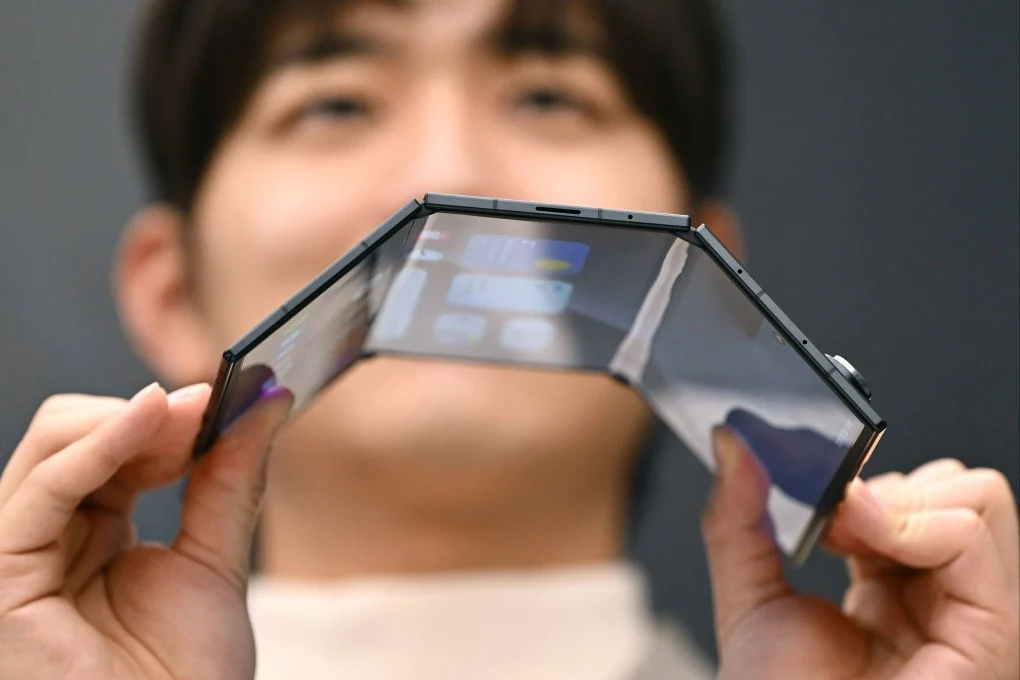
Photo: South China Morning Post
Samsung Electronics has officially launched the Galaxy Z TriFold, its first three-panel, multi-folding smartphone and one of the most ambitious devices the company has ever released. The debut comes amid surging competition from Chinese manufacturers and growing anticipation of Apple’s potential entry into the foldable market. Samsung’s move signals a renewed effort to maintain technological leadership in a category it helped pioneer in 2019.
Launch Timeline and Pricing
The Galaxy Z TriFold will hit Samsung’s home market on December 12, followed by phased rollouts across China, Taiwan, Singapore and the United Arab Emirates. A U.S. launch is scheduled for the first quarter of 2026, with the company promising additional specifications and carrier details closer to release.
Samsung will offer the device as a single premium configuration — black, 16GB RAM and 512GB storage — priced at 3,594,000 South Korean won, roughly $2,449. While positioned as an early-generation multi-fold showcase rather than a mass-market product, the device underscores Samsung’s determination to remain ahead in the evolving foldable race.
A Three-Panel Flagship Aimed at Redefining Foldables
The Galaxy Z TriFold features two inward-folding hinges that expand into a 10-inch display with a 2160 x 1584 resolution. Though slightly smaller than the 11-inch screen on Apple’s latest iPad models, Samsung is targeting a blend of tablet-sized workspace and smartphone portability.
When folded, the device measures 12.9 mm thick. This makes it slightly bulkier than the Galaxy Z Fold6 at 12.1 mm but slimmer than Huawei’s recently introduced second-generation trifold, which comes in at 12.8 mm folded and was launched earlier this year for the Chinese market.
The TriFold also offers advanced multitasking capabilities, allowing three apps to run simultaneously in vertical panes. Samsung has included a desktop-like mode that functions without needing an external monitor, signaling a push toward more laptop-replacement functionality.
Battery, Performance and Durability
Samsung equipped the TriFold with its largest foldable battery to date. The phone supports super-fast charging that takes it from empty to 50 percent in 30 minutes, a significant upgrade over earlier foldable generations.
Durability and hinge engineering remain critical, especially as consumers have raised concerns about folding fatigue across multiple generations of devices. According to Samsung, the TriFold incorporates reinforced hinge architecture designed to withstand repeated folding cycles, though the company has not yet released specific durability metrics.
Like Samsung’s latest Galaxy Z series models, the TriFold carries an IP48 rating. This offers resistance to water immersion up to 1.5 meters for 30 minutes but only limited dust protection, a trade-off that remains a challenge across the broader foldable category.
Strategic Positioning in a Shifting Market
Industry analysts say that the TriFold’s launch is less about unit sales and more about reaffirming Samsung’s leadership in an increasingly contested market. Liz Lee, associate director at Counterpoint Research, noted that the device is intended as a “multi-fold pilot” to test software optimization, hinge reliability and real-world use cases ahead of wider commercialization.
Competition in the foldable sector has intensified significantly. Huawei, Honor and several other Chinese brands have aggressively expanded their international presence through slimmer designs, competitive pricing and accelerated release cycles. Honor’s global push — following its separation from Huawei in 2020 — has made it one of the fastest-growing names in the foldable segment across Europe and parts of Asia.
Analysts expect 2026 to be a pivotal year, with Apple’s rumored foldable device likely to alter competitive dynamics. Samsung appears to be positioning the TriFold as a technological statement ahead of that shift.
Executive Perspective
TM Roh, Samsung’s newly appointed co-CEO and head of the Device eXperience division, highlighted that the TriFold represents years of research into multi-fold technology. He described the device as an effort to merge portability, multitasking power and productivity into a single product category that will continue to evolve over the coming years.
Roh emphasized that Samsung’s goal is not just to expand its foldable portfolio but to develop new form factors that can eventually redefine mobile computing.
The Galaxy Z TriFold is not designed to become Samsung’s next mainstream bestseller. Instead, it serves as a strategic, high-end showcase of what the company believes will shape the next generation of mobile devices. As Chinese brands accelerate innovation and Apple prepares its own entrance, Samsung’s tri-fold debut marks an important moment in the global race to reinvent the smartphone.

Popular articles


Subscribe to unlock premium content
Dinner Reinvented in Los Angeles

The Rise of Celebrity-Curated Designer Board Games

The Rise of Designer Car Interiors in Luxury SUVs

Dinner Reinvented in Los Angeles
The Rise of Celebrity-Curated Designer Board Games
Dinner Reinvented in Los Angeles