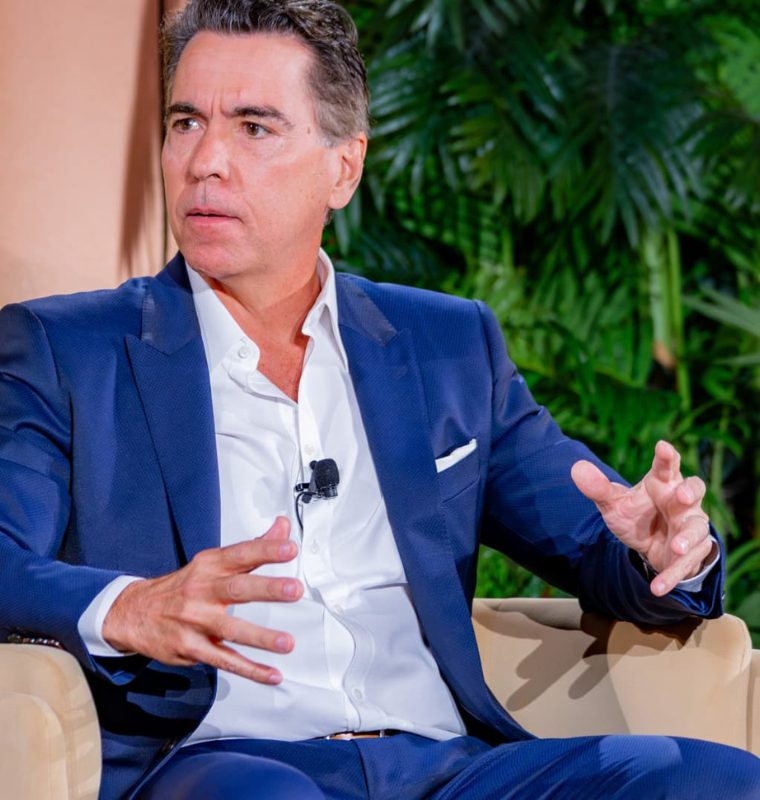
Korea Exchange Chief Rejects Foreign Exit Narrative as $13 Trillion Kospi Selloff Seen as Portfolio Rebalancing

Korea Exchange Chief Rejects Foreign Exit Narrative as $13 Trillion Kospi Selloff Seen as Portfolio Rebalancing
By
Alina Sinclair
Last updated:
June 12, 2026
First Published:
June 12, 2026


South Korea’s recent stock market correction is not a signal that global investors are abandoning the country, according to Korea Exchange CEO Jeong Eun-bo, who argues that the sharp selloff is primarily driven by technical portfolio rebalancing after an exceptional rally rather than a fundamental reassessment of the market.
Speaking to CNBC, Jeong emphasized that foreign institutional investors continue to view South Korea as a structurally attractive market, even as volatility spikes across equities and foreign exchange markets.
The benchmark KOSPI index had surged dramatically earlier in the year, rising 76% in 2025 and more than doubling year-to-date before the recent reversal began on June 3. That rapid appreciation significantly increased Korea’s weighting in global equity benchmarks, triggering automatic reallocation by large funds.
Sharp Rally Precedes Fast Correction
The recent downturn follows one of the strongest rallies in South Korean equities in decades.
After reaching record highs on June 2, the KOSPI index fell more than 13% within just six trading sessions, marking one of the sharpest short-term pullbacks in recent market history.
According to exchange data, foreign investors sold approximately 1.24 trillion won, or roughly $800 million, in a single session during peak outflows, highlighting the speed at which global capital repositioning can impact domestic markets.
Despite the volatility, Jeong maintained that investor conversations with major global institutions consistently point to portfolio rebalancing rather than structural exit behavior.
Foreign Ownership Shifts Driven by Index Weighting
A key driver behind the selloff has been South Korea’s rising weight in global equity portfolios following its strong performance.
As Korean equities outperformed most global benchmarks, foreign exposure levels increased significantly, in some cases doubling or tripling relative to benchmark allocation targets.
Institutional investors typically operate under strict allocation frameworks, meaning that when a market outperforms and exceeds target weights, funds are required to rebalance by selling assets to maintain portfolio balance.
Jeong explained that this mechanical process, rather than a loss of conviction, has been the dominant factor behind recent capital outflows.
He added that the rebalancing cycle is now showing signs of completion, suggesting that selling pressure from this channel may soon ease.
Semiconductor Concentration Amplifies Market Swings
One of the structural factors contributing to heightened volatility is the heavy concentration of the KOSPI index in a small number of technology and semiconductor companies.
Samsung Electronics and SK Hynix together account for roughly 45% of the index, making South Korea’s stock market highly sensitive to global chip cycles.
This concentration means that fluctuations in semiconductor pricing, demand forecasts, and global AI-related chip demand can disproportionately influence overall index performance.
The semiconductor industry itself is highly cyclical, characterized by extended periods of expansion followed by sharp corrections as supply and demand fall out of alignment.
Because production capacity often takes years to adjust while demand can shift rapidly due to technological changes, pricing cycles tend to amplify both upside rallies and downside corrections.
External Shocks Add to Market Volatility
Beyond sector-specific dynamics, broader geopolitical developments have also contributed to recent instability in Korean equities.
Ongoing tensions in the Middle East, particularly the Iran conflict, have increased global energy price volatility and reduced risk appetite across emerging and export-dependent markets.
Given South Korea’s deep integration into global supply chains, particularly in technology exports, the market is highly sensitive to external macroeconomic shocks.
Jeong noted that this combination of external geopolitical risk and sector concentration has made short-term fluctuations more pronounced than usual.
Foreign Outflows Reach Multi-Billion-Dollar Scale
Recent estimates from global investment banks suggest that foreign net outflows from South Korean equities have reached approximately $62 billion so far this year.
This scale of capital movement underscores how quickly global portfolio adjustments can impact mid-sized but highly liquid equity markets.
Despite this, Jeong stressed that the underlying investor sentiment remains stable, with no significant evidence of a broad withdrawal of long-term capital from the Korean market.
Currency Pressure Reflects Capital Flow Dynamics
The equity market volatility has also had a direct impact on the South Korean won, which recently weakened to its lowest level in 17 years, trading near 1,561 against the U.S. dollar.
As Korea does not issue a global reserve currency, its exchange rate is more sensitive to capital inflows and outflows, particularly from institutional investors.
However, monetary authorities have reportedly intervened through stabilization measures aimed at smoothing excessive volatility in foreign exchange markets.
Officials expect that once portfolio rebalancing pressures subside, currency conditions will gradually stabilize alongside equity markets.
Market Structure Under Scrutiny
The recent turbulence has also prompted discussions within regulatory circles about market mechanisms such as circuit breakers and trading halt thresholds.
During the sharpest phases of the selloff, circuit breakers were triggered as the index fell more than 8% in a single session, temporarily halting trading activity to prevent disorderly market conditions.
Jeong indicated that authorities are reviewing whether existing volatility controls remain appropriate given current market structure and increased participation from global algorithmic trading flows.
Wall Street Still Sees Upside Potential
Despite short-term volatility, major global financial institutions continue to maintain positive medium-term outlooks on South Korean equities.
Some investment banks have recently raised their 12-month KOSPI targets significantly, with revised forecasts suggesting further upside potential from current levels.
This divergence between short-term capital outflows and long-term bullish forecasts reflects the distinction between tactical portfolio rebalancing and structural investment conviction.
Jeong noted that continued upward revisions by global banks reinforce the view that South Korea’s equity market still has substantial long-term growth potential.
South Korea’s recent stock market correction appears to be driven less by weakening investor sentiment and more by mechanical portfolio adjustments following an extraordinary rally.
While concentrated exposure to semiconductor giants and external geopolitical risks have intensified volatility, market officials argue that foreign investors have not fundamentally changed their long-term view on the country.
As rebalancing cycles normalize and global benchmark weights stabilize, policymakers expect capital flows and currency pressures to ease, potentially setting the stage for renewed market momentum.
.webp)
Popular articles



Subscribe to unlock premium content
Iceland’s Adventure Lodges Are Redefining Remote Work

Inside Japan’s Luxury Ryokans That Blend Tradition with Modern Experiences

Greece’s Tourism-Driven Economy: Lessons From Financial Crises

Iceland’s Adventure Lodges Are Redefining Remote Work
Inside Japan’s Luxury Ryokans That Blend Tradition with Modern Experiences
Iceland’s Adventure Lodges Are Redefining Remote Work