Johnson Signals Shutdown End in Sight as House Prepares Crucial Vote

Johnson Signals Shutdown End in Sight as House Prepares Crucial Vote
By
Rachel Steinberg
Last updated:
February 2, 2026
First Published:
February 2, 2026

Getty Images
Shutdown Enters New Phase as House Moves Toward Vote
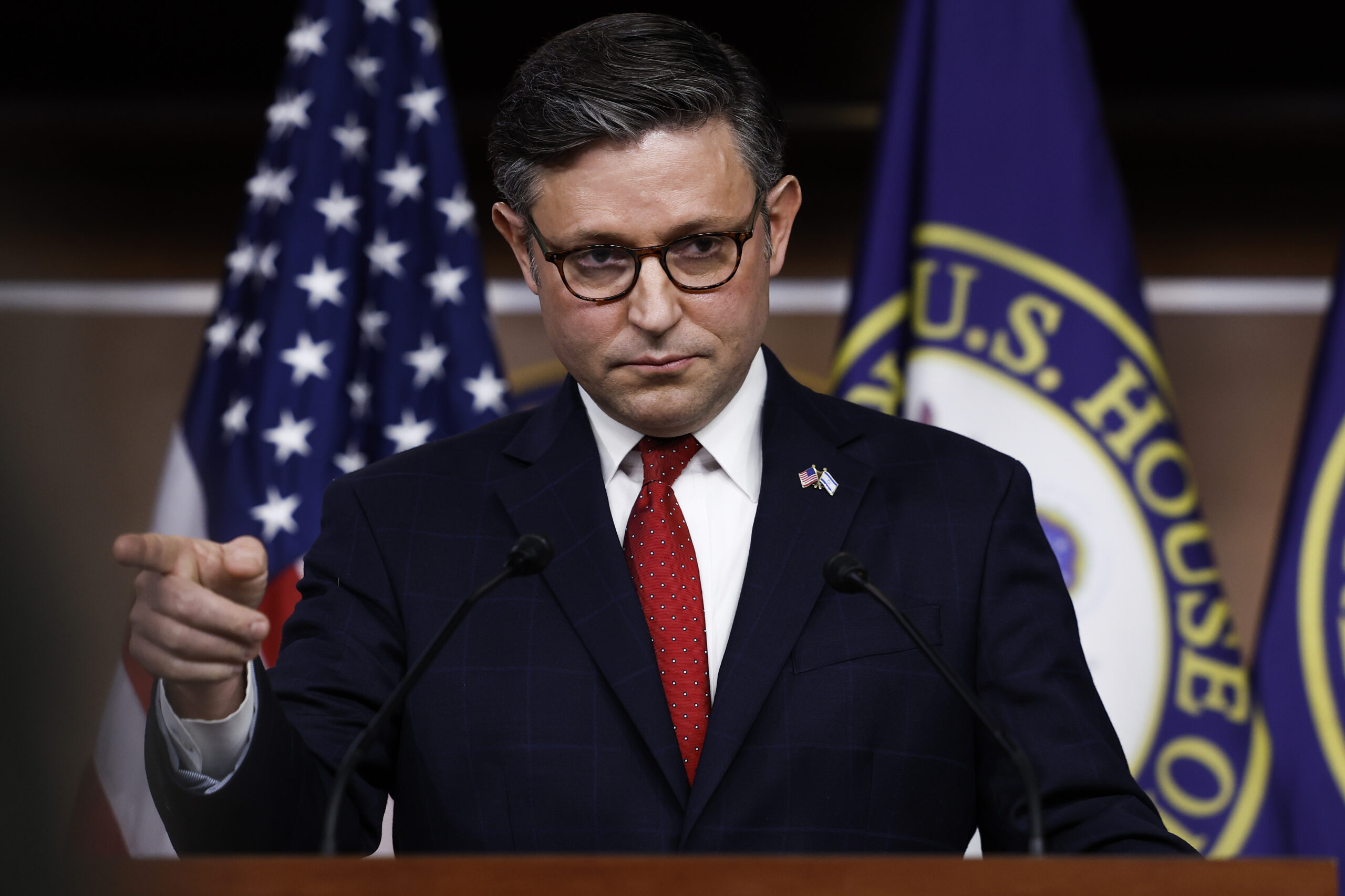
House Speaker Mike Johnson said Sunday he expects the partial federal government shutdown to be resolved by Tuesday, expressing confidence that House Republicans can pass a Senate-approved spending package and send it to President Donald Trump for signature.
Speaking on NBC’s Meet the Press, Johnson said he believes he has the votes needed to advance the legislation once lawmakers return to Washington.
“Let’s say I’m confident that we’ll do it at least by Tuesday,” the Louisiana Republican said, emphasizing that the House will begin formal consideration of the bill on Monday.
The shutdown began early Saturday after Congress failed to meet the Jan. 30 funding deadline. Several federal agencies were left without appropriations, forcing furloughs, delaying services, and adding uncertainty for hundreds of thousands of federal workers and contractors.
How the Spending Deal Changed
The measure now heading back to the House looks different from what lawmakers originally passed.
Senate Democrats demanded revisions after two U.S. citizens were fatally shot by federal immigration agents in Minnesota, raising fresh concerns about enforcement practices within the Department of Homeland Security. In response, DHS funding was stripped from the original bill and replaced with a two-week temporary extension, while the rest of the package was left intact.
Because of those changes, the revised legislation must be approved again by the House before it can reach the president’s desk.
The House Rules Committee is scheduled to meet Monday, marking the first procedural step toward a floor vote.
Johnson acknowledged that the process will likely move forward without Democratic cooperation.
“We have a logistical challenge of getting everyone in town,” he said. “And based on conversations I’ve had with Leader Jeffries, we’re going to have to pass a rule and probably do this mostly on our own.”
Fast-tracking the bill under a suspension of the rules would require a two-thirds majority, an option Johnson has already ruled out due to a lack of Democratic support.
Democrats Demand Immigration Commitments
House Democrats are withholding votes as they push for firm commitments on immigration policy and DHS reforms before backing any broader spending agreement.
Minority Leader Hakeem Jeffries said Sunday that Democrats want more than promises.
“The administration can’t just talk the talk. They need to walk the walk,” Jeffries said in an interview on ABC’s This Week. “That should begin today. Not in two weeks — today.”
Sources familiar with internal discussions say Jeffries informed Johnson over the weekend that Democrats will not help fast-track the package, raising the stakes for Republicans trying to pass the bill with their own narrow majority.
Rep. Ro Khanna of California confirmed he plans to vote against the measure.
“I’m not just a no — I’m a firm no,” Khanna said on Meet the Press. “I cannot in good conscience vote to give more money to ICE agents while constitutional rights are being violated.”
Razor-Thin Majority Complicates Johnson’s Path
Democratic resistance leaves Johnson with little margin for error.
Republicans currently hold a fragile 218–213 majority in the House, a gap that will shrink further following Democrat Christian Menefee’s victory in a recent special election in Texas. That effectively gives Johnson just one vote to spare if all members are present.
“I have a one-vote margin, yes, for the rest of 2026,” Johnson said. “But we’re going to demonstrate once again that this is the party that takes governing seriously.”
Any defections within GOP ranks could derail the effort, making attendance and party unity critical as lawmakers return to Capitol Hill.
What’s Inside the Spending Package
Beyond the short-term DHS funding extension, the broader legislation would fully fund most federal departments for the remainder of the fiscal year. That includes:
The Department of Defense
The Treasury Department
The State Department
Health and Human Services
Labor
Housing and Urban Development
Transportation
Education
Approval would restore operations across large portions of the federal government, providing budget certainty for agencies overseeing national security, healthcare programs, education funding, housing assistance, and transportation infrastructure.
Markets and Workers Watching Closely
The shutdown has already begun to ripple through the economy, with federal employees facing delayed paychecks, contractors seeing work paused, and investors monitoring Washington for signs of political stability. Economists warn that even short shutdowns can shave measurable points off quarterly GDP growth if disruptions persist.
With financial markets open and a new trading month underway, pressure is mounting on Congress to deliver a swift resolution.
For now, Johnson is betting that House Republicans can carry the vote on their own and bring the shutdown to an end by Tuesday — a timeline that would limit economic damage but hinges on near-perfect party discipline.
.webp)
Popular articles



Subscribe to unlock premium content
Zara’s Hyper-Fast Fashion Supply Chain Is Changing Global Retail

The Rise of Apple Stores as Experiential Brand Centers Worldwide

Boutique Eco-Lodges in Costa Rica Redefining Ultra-Luxury Travel

Zara’s Hyper-Fast Fashion Supply Chain Is Changing Global Retail
The Rise of Apple Stores as Experiential Brand Centers Worldwide
Zara’s Hyper-Fast Fashion Supply Chain Is Changing Global Retail