China’s AI Wearables Surge as Homegrown Innovators Race Ahead in Hardware

China’s AI Wearables Surge as Homegrown Innovators Race Ahead in Hardware
By
Leah Rosenfeld
Last updated:
December 10, 2025
First Published:
December 10, 2025

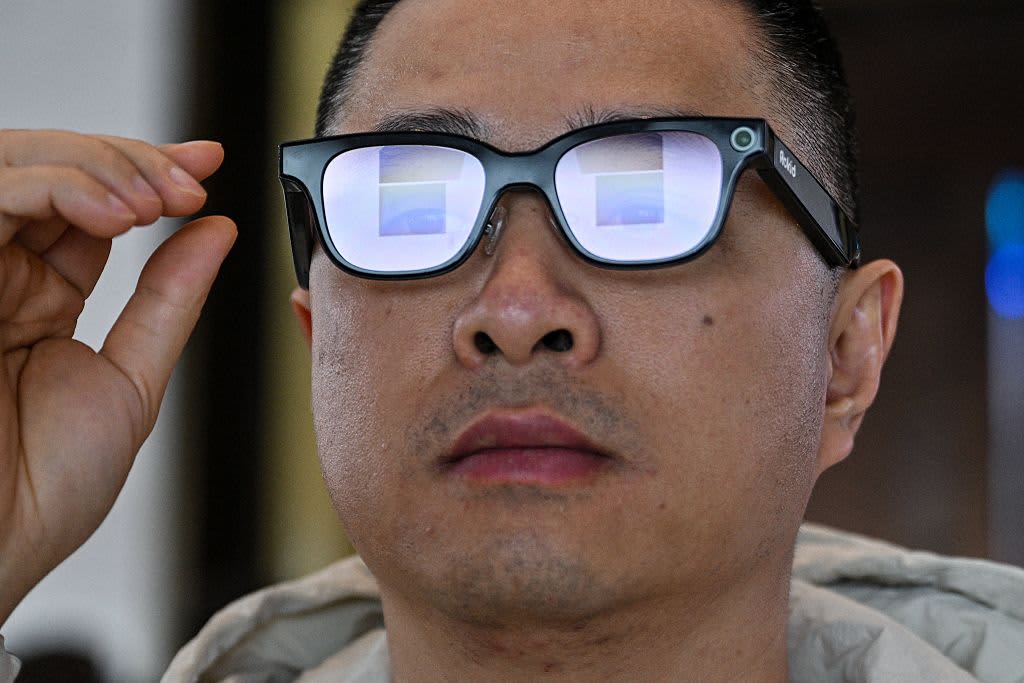
This picture taken on November 13, 2025 shows a man checking a pair of Rokid glasses with display and camera using artificial intelligence (AI) and augmented reality (AR) during a presentation event in Hangzhou, in China’s eastern Zhejiang province.
Hector Retamal | Afp | Getty Images
China’s artificial intelligence wearables market is scaling at remarkable speed, fueled by the country’s deep manufacturing capabilities and its rapid embrace of next generation consumer hardware. While global competition intensifies, China’s advantage in producing sophisticated devices at scale is increasingly evident across product categories ranging from smartglasses to workplace AI tools and consumer language learning gadgets.
China’s stronghold in manufacturing remains at the core of this momentum. According to leaders in the sector, the next phase of AI competition will extend beyond large language models and software ecosystems and into the physical devices that bring these technologies into everyday life. This shift is already visible in China’s product pipeline and in the speed at which new hardware reaches commercial markets.
A Rapidly Expanding Smartglasses Sector
Meta has sold millions of smartglasses globally since launching its updated models in 2023. Within months, Chinese companies accelerated their own efforts, resulting in more than seventy domestic firms now producing smartglasses and comparable AI eyewear. Brands such as Inmo and Rokid have secured international distribution, while Xiaomi and Alibaba have focused on the domestic market and integrated their products with their proprietary AI systems.
Alibaba’s DingTalk platform, a dominant workplace messaging tool, introduced a compact AI powered card sized device designed for professionals. The DingTalk A1 can capture speech from up to eight meters away and automatically transcribe, summarise and analyse conversations. Its capabilities mirror those of the Plaud Note, a productivity device already sold in the United States, highlighting how quickly Chinese firms are matching and expanding global product categories.
From Productivity Tools to Unconventional Consumer Devices
China’s AI hardware innovation spans both practical and unusual use cases. One of the more unconventional examples comes from Le Le Gaoshang Education Technology, which created the “Native Language Star” translator device aimed at Chinese parents who want to help their children learn English. The device wraps around the neck like a travel pillow, includes a voice muffling attachment, and uses embedded Tencent and iFlyTek AI models to simulate a native English speaker during pronunciation exercises. Priced at around four hundred twenty dollars, the product reflects how broadly AI hardware experimentation is unfolding across the Chinese market.
With hundreds of device types emerging simultaneously, China benefits from an unusually dense and active feedback loop between consumers, manufacturers and developers. Adoption accelerates because hardware is widely available, prices are competitive, and new devices are constantly being introduced. Analysts argue this dynamic enables Chinese companies to collect larger and more diverse datasets, improving AI performance and enhancing their competitive position globally.
The Strategic Value — and Limitations — of Hardware Strength
While China’s hardware capabilities provide a significant advantage, the global AI race remains far from settled. Success will hinge not only on innovation but also on international consumer trust, regulatory acceptance and the ability to create devices that achieve the cultural impact of an iPhone level breakthrough. Concerns about data privacy, cybersecurity and geopolitical tensions may constrain global expansion despite technological strengths.
Industry leaders note that China does have the engineering talent, manufacturing scale and entrepreneurial capacity needed to produce category defining devices. However, the challenge lies in aligning hardware excellence with software leadership and consumer appeal in advanced markets such as North America and Europe.
For now, China’s AI wearables landscape continues to expand at a speed unmatched in most other regions. Whether this early dominance in hardware translates into long term global leadership will depend on the country’s ability to deliver devices that resonate with international users while maintaining rapid innovation at home.

Popular articles


Subscribe to unlock premium content
Riding Waves and Wealth in Bali

The Billionaire’s Symphony

Stars, Silence, and Luxury in Chile

Riding Waves and Wealth in Bali
The Billionaire’s Symphony
Riding Waves and Wealth in Bali