Zhipu AI Ignites 30% Surge in Chinese AI Stocks as Model Wars Heat Up

Zhipu AI Ignites 30% Surge in Chinese AI Stocks as Model Wars Heat Up
By
Alina Sinclair
Last updated:
February 12, 2026
First Published:
February 12, 2026

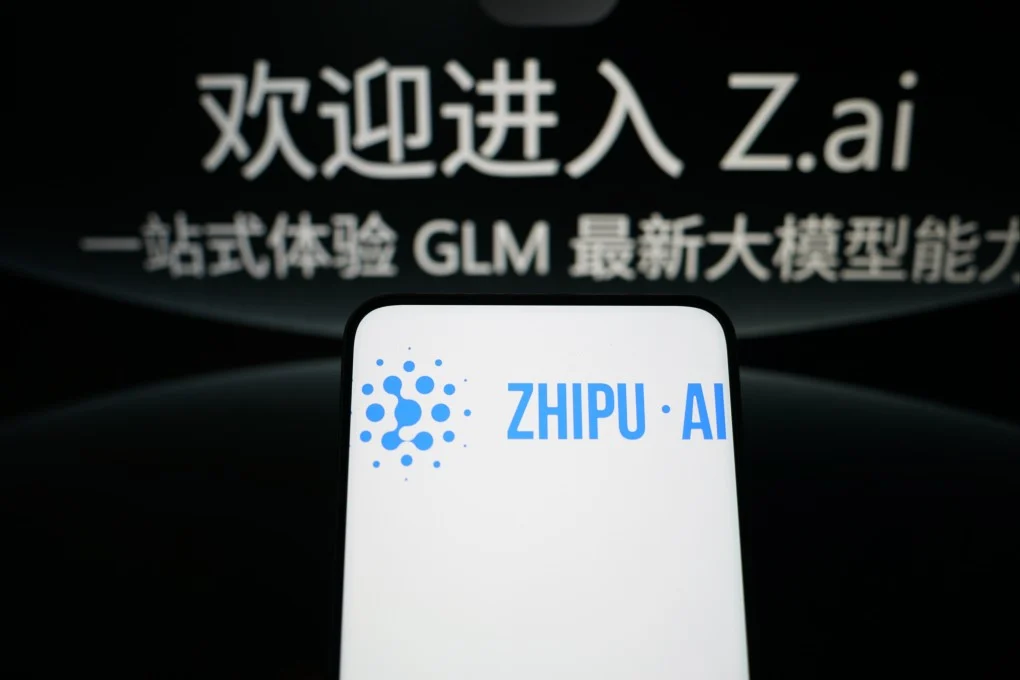
Photo: South China Morning Post
Chinese artificial intelligence stocks staged a powerful rally on Thursday, led by a dramatic 30% surge in Hong Kong-listed Zhipu AI, trading under the name Knowledge Atlas Technology. The spike came after the company unveiled GLM-5, its latest open-source large language model designed for advanced coding tasks and long-duration AI agent workflows.
The rally was not limited to a single name. MiniMax climbed 11% in Hong Kong following the release of its upgraded M2.5 open-source model, while the Shanghai STAR AI Industry Index gained as much as 1.7% before trimming gains. AI infrastructure and software providers across mainland China and Hong Kong saw renewed buying interest, underscoring how rapidly shifting product cycles are driving market sentiment.
Zhipu’s GLM-5 Release Sparks Breakout Move
Zhipu’s GLM-5 marks a significant milestone in China’s AI race. The company claims the model approaches Anthropic’s Claude Opus 4.5 in coding benchmarks and exceeds Google’s Gemini 3 Pro on select evaluations. While those comparisons remain unverified by third parties, the market reaction suggests investors are pricing in stronger technical competitiveness from Chinese AI firms.
The new model emphasizes agentic workflows—AI systems capable of executing multi-step tasks over extended timeframes. This area is increasingly viewed as the next frontier in generative AI, moving beyond simple chat responses into autonomous coding, research synthesis, and business automation.
Zhipu’s sharp rally added billions in market capitalization within a single session, reflecting how sensitive AI stocks remain to product announcements. The company has positioned itself as one of China’s leading open-source AI players, focusing on ecosystem development and enterprise adoption.
MiniMax, DeepSeek and Ant Group Add Momentum
MiniMax’s 11% jump followed the overseas launch of its M2.5 model, described by the company as “built for max coding and agentic workflows.” The upgrade enhances tool integration and developer productivity features, targeting global users and international developers.
Meanwhile, DeepSeek—one of last year’s breakout AI names—reportedly upgraded its flagship model to support a larger context window and more current data, addressing two key limitations often cited in generative AI performance. Larger context windows allow AI systems to process longer documents, complex codebases, and extended conversations more effectively.
Ant Group also entered the spotlight with the release of Ming-Flash-Omni 2.0, a unified multimodal open-source model capable of generating text, speech, music, sound effects and visuals. The multimodal capability places it in direct competition with global AI leaders that are racing to integrate text, image, audio and video generation into unified systems.
ByteDance contributed to the momentum earlier in the week by launching Seedance 2.0, the latest iteration of its AI video generation application. The upgrade triggered gains in Chinese AI app stocks and reinforced ByteDance’s broader ambitions in generative video. Reports that the company is working with Samsung on in-house chip development further signal Beijing’s long-term push for AI hardware independence.
Infrastructure Players Join the Rally
The enthusiasm spilled over into AI infrastructure providers. UCloud Technology, a Shanghai-listed cloud and computing company that supports Zhipu, surged 20%, hitting its daily trading limit. The move reflects growing investor recognition that AI model innovation drives parallel demand for compute, data storage and energy infrastructure.
SenseTime, which has pivoted from facial recognition surveillance technologies to enterprise AI platforms, gained 5% in Hong Kong trading. The company’s strategic repositioning toward AI software ecosystems appears to be resonating with investors seeking scalable business models rather than hardware-heavy deployments.
Policy Support Reinforces Long-Term Thesis
The rally coincided with renewed policy backing from Beijing. Chinese Premier Li Qiang emphasized the need for a comprehensive push toward scaled and commercialized AI applications. He called for stronger coordination of computing power, electricity supply and infrastructure resources—critical components for sustaining large-scale model training and deployment.
Li also highlighted efforts to improve the environment for AI talent and technology companies, signaling continued regulatory and institutional support. In a sector where state backing often shapes long-term growth trajectories, such statements carry weight in financial markets.
China’s approach to AI development has been notably capital-efficient compared to U.S. tech giants. While American companies have poured tens of billions of dollars into AI-related capital expenditures, many Chinese firms have focused on domestic market optimization and incremental infrastructure scaling. Analysts note that this comparatively frugal strategy reduces balance sheet risk while maintaining competitive progress.
Divergence Within Chinese Tech
Interestingly, the surge in pure-play AI stocks occurred against a broader downturn in major Chinese tech conglomerates. Tencent and Alibaba shares fell 2.6% and 2.1% respectively, while the Hang Seng Tech Index declined 1.7%.
This divergence suggests investors are selectively rotating capital into companies with concentrated AI exposure rather than diversified tech giants whose earnings are influenced by multiple segments such as e-commerce, gaming and advertising.
The pattern mirrors developments on Wall Street, where the AI trade has experienced heightened volatility in 2026. Markets have swung between enthusiasm over transformative AI potential and concerns about stretched valuations. Strategists argue that the current phase favors firms with clear monetization pathways, strong fundamentals and disciplined capital spending.
Global AI Competition Intensifies
The flurry of releases from Zhipu, MiniMax, DeepSeek, Ant Group and ByteDance highlights the accelerating competition between Chinese and U.S. AI developers. The race is no longer limited to model size; it now encompasses agent capabilities, multimodal integration, hardware independence and commercial scalability.
Investors appear increasingly discerning. Rather than betting indiscriminately on all AI-related names, capital is flowing toward companies demonstrating tangible product upgrades and ecosystem expansion. The fact that infrastructure providers and specialized AI startups are outperforming diversified tech giants underscores this shift.
With new model iterations emerging almost weekly and policymakers signaling structural support, China’s AI sector is entering a high-velocity phase. Whether these gains mark the start of a sustained uptrend or another volatile cycle will depend on execution, monetization and the global competitive landscape.
For now, the message from markets is clear: in the battle for AI supremacy, product momentum translates directly into stock performance.
.webp)
Popular articles



Subscribe to unlock premium content
Zara’s Hyper-Fast Fashion Supply Chain Is Changing Global Retail

The Rise of Apple Stores as Experiential Brand Centers Worldwide

Boutique Eco-Lodges in Costa Rica Redefining Ultra-Luxury Travel

Zara’s Hyper-Fast Fashion Supply Chain Is Changing Global Retail
The Rise of Apple Stores as Experiential Brand Centers Worldwide
Zara’s Hyper-Fast Fashion Supply Chain Is Changing Global Retail