Wall Street Prepares for First AI Chip Futures Market as Computing Costs Surge

Wall Street Prepares for First AI Chip Futures Market as Computing Costs Surge
By
Rachel Steinberg
Last updated:
May 13, 2026
First Published:
May 13, 2026

Getty Images
A major shift is coming to financial markets as traders prepare to buy and sell futures tied directly to the cost of artificial intelligence computing power, marking a new chapter in the rapidly expanding AI economy.
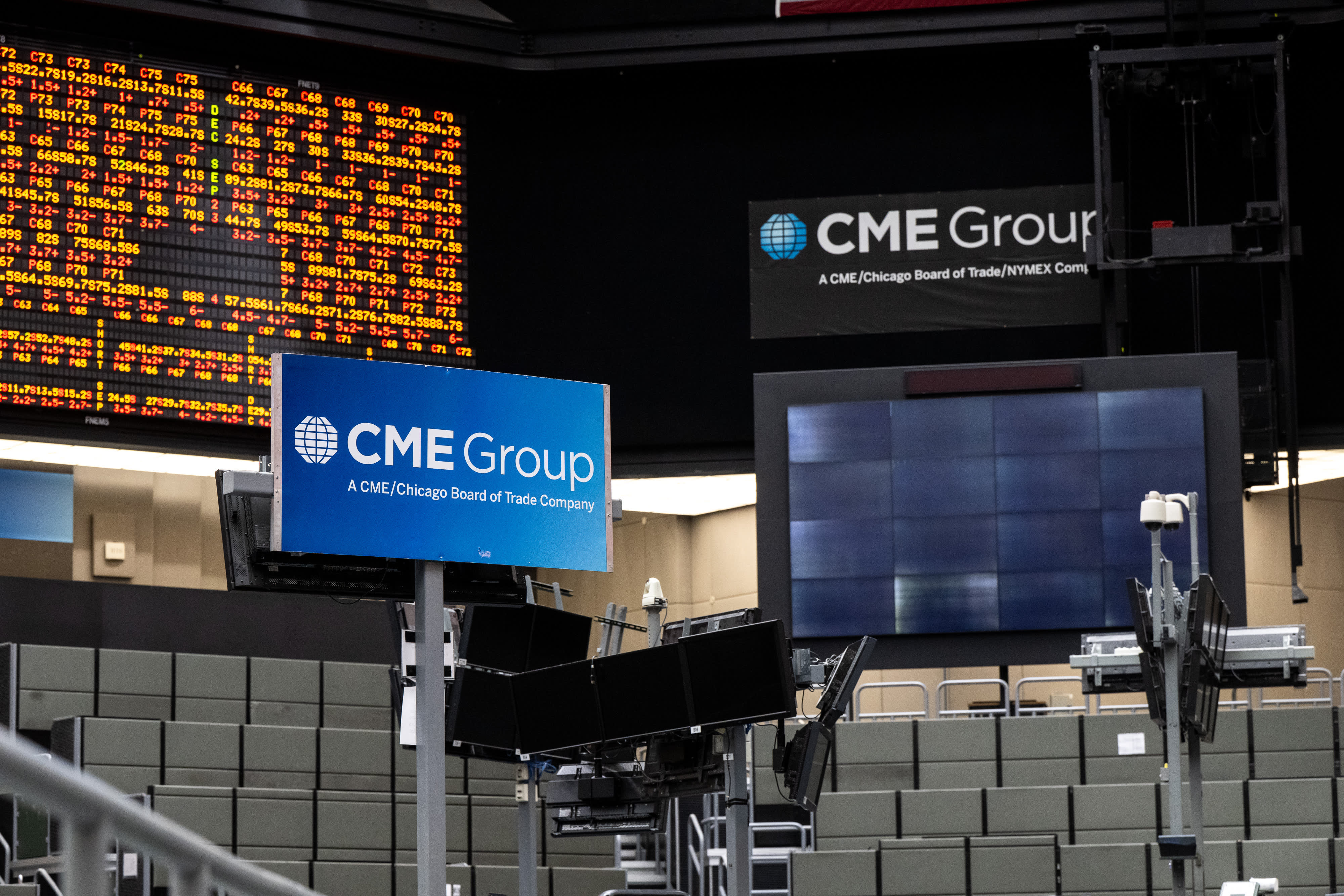
CME Group and Silicon Data announced plans to launch a new “compute futures” market that will allow investors, cloud providers, AI developers, and technology companies to hedge against rising semiconductor and GPU-related costs.
The proposed futures exchange, which is still awaiting regulatory approval, will create one of the world’s first large-scale financial markets focused specifically on AI computing infrastructure.
The move highlights how artificial intelligence is transforming semiconductors and computing power into strategic assets similar to oil, electricity, metals, and other core industrial commodities.
AI Boom Is Driving Chip Prices Higher
The explosive growth of generative AI, machine learning systems, and large language models has created unprecedented demand for graphics processing units, commonly known as GPUs.
These specialized chips power AI training and inference systems used by companies such as OpenAI, Microsoft, Google, Amazon Web Services, and Meta.
As AI adoption accelerates worldwide, demand for GPU capacity has skyrocketed, pushing prices for advanced semiconductors and cloud computing infrastructure to record highs.
Industry analysts estimate that global AI infrastructure spending could surpass $500 billion annually within the next several years, with GPU supply becoming one of the most critical bottlenecks in the sector.
Rental rates for high-performance AI chips have climbed sharply over the past two years as businesses race to secure access to computing capacity for AI model development and deployment.
The new futures market is designed to help participants manage those rising costs more effectively.
How the Compute Futures Market Will Work
Under the proposed structure, futures contracts will be linked to GPU pricing benchmarks created by Silicon Data.
These indexes track the daily market value of GPU rental capacity and semiconductor-related computing services, creating standardized reference prices for the industry.
The contracts would allow investors and companies to lock in future prices for computing capacity, similar to how airlines hedge fuel costs or manufacturers hedge commodity prices.
For AI startups and cloud providers, the system could help reduce uncertainty surrounding future operating expenses, especially as GPU shortages continue affecting the market.
For institutional investors and hedge funds, the contracts may create entirely new trading opportunities tied to semiconductor demand and AI infrastructure growth.
Carmen Li, chief executive of Silicon Data, said the market has long lacked reliable standardized pricing systems for GPUs and AI computing resources.
According to Li, the launch of compute futures could provide AI companies, cloud providers, and investors with stronger tools for valuation, risk management, and long-term financial planning.
AI Infrastructure Is Becoming a Financial Asset Class
Traditionally, futures markets have focused on raw commodities such as oil, wheat, gold, natural gas, and industrial metals.
However, as technology becomes increasingly central to the global economy, financial markets are expanding into digital infrastructure and advanced industrial components.
The rise of compute futures reflects the growing view that AI processing power is becoming a core economic resource.
Some analysts compare the current AI infrastructure boom to the early internet and telecom expansion of the late 1990s, when companies sought ways to monetize excess broadband and fiber-optic network capacity.
This time, instead of bandwidth, the key asset is high-performance computing power.
The shift also mirrors the growing financialization of semiconductor markets as chips become essential to industries ranging from cloud computing and autonomous vehicles to robotics, cybersecurity, healthcare, and defense systems.
GPU Demand Shows No Signs of Slowing
Wall Street analysts remain highly bullish on long-term demand for GPUs and advanced computing infrastructure.
Much of that optimism is being driven by the rapid development of “agentic AI” systems — software capable of autonomously performing complex tasks, managing workflows, and interacting with multiple tools simultaneously.
Morgan Stanley analyst Shawn Kim recently noted that future AI systems will require massive networks of both GPU servers and traditional CPU infrastructure working together.
According to Kim, next-generation AI architectures are expected to rely on dense GPU clusters for model computation alongside large CPU server networks responsible for orchestration, data processing, and execution tasks.
This evolving structure is increasing demand not only for advanced GPUs but also for memory chips, networking hardware, cooling systems, and data center infrastructure.
Memory Chip Prices Are Surging Alongside AI Growth
The AI boom is already reshaping the semiconductor industry financially.
Memory chip prices rose sharply during the first quarter of the year as hyperscale cloud providers dramatically increased capital expenditures tied to AI infrastructure expansion.
Technology giants including NVIDIA, AMD, Intel, and major memory manufacturers have benefited from surging demand for AI hardware.
Industry executives have repeatedly warned about growing bottlenecks in memory supply chains as AI systems require enormous amounts of high-bandwidth memory and advanced storage capacity.
Some semiconductor manufacturers are now projecting exceptionally high profit margins through 2026 due to sustained demand and tight supply conditions.
This has also helped semiconductor stocks outperform much of the broader market over the past year, with investors aggressively pouring capital into AI-related chipmakers and infrastructure providers.
Why Investors Are Watching the New Market Closely
The introduction of compute futures could become a major milestone for both financial markets and the AI industry.
If successful, the exchange may create a new benchmark for valuing AI infrastructure costs globally, much like oil futures became central to energy markets.
Analysts believe the contracts could also improve transparency around GPU pricing, which has historically been opaque and highly volatile due to limited supply and rapidly changing demand.
For institutional investors, the market could provide another way to gain exposure to the AI boom without directly owning technology stocks.
Meanwhile, companies building AI products may gain stronger financial protection against sudden increases in computing expenses.
As artificial intelligence becomes more deeply integrated into global business operations, financial markets are increasingly adapting to treat computing power as a tradable economic resource rather than simply a technical utility.
AI Is Reshaping Both Technology and Finance
The emergence of a futures market for computing capacity shows how rapidly AI is transforming global industries beyond software development.
Semiconductors and cloud infrastructure are no longer just back-end technology components. They are becoming strategic economic assets that influence corporate profitability, stock market performance, industrial competitiveness, and global investment flows.
With AI demand continuing to accelerate and GPU shortages expected to remain a challenge for years, investors and businesses alike are searching for new ways to manage costs and reduce uncertainty.
The creation of compute futures may ultimately become one of the clearest signs yet that artificial intelligence is evolving into an entirely new financial ecosystem — one where processing power itself becomes a tradable commodity.
.webp)
Popular articles



Subscribe to unlock premium content
Living History Like Never Before

Capturing the Night Like Never Before

Transforming Small Spaces Into Personal Sanctuaries

Living History Like Never Before
Capturing the Night Like Never Before
Living History Like Never Before