

Trump Pulls Canada’s Seat From Proposed Board of Peace
By
Alina Sinclair
Last updated:
January 23, 2026
First Published:
April 25, 2026

Getty Images
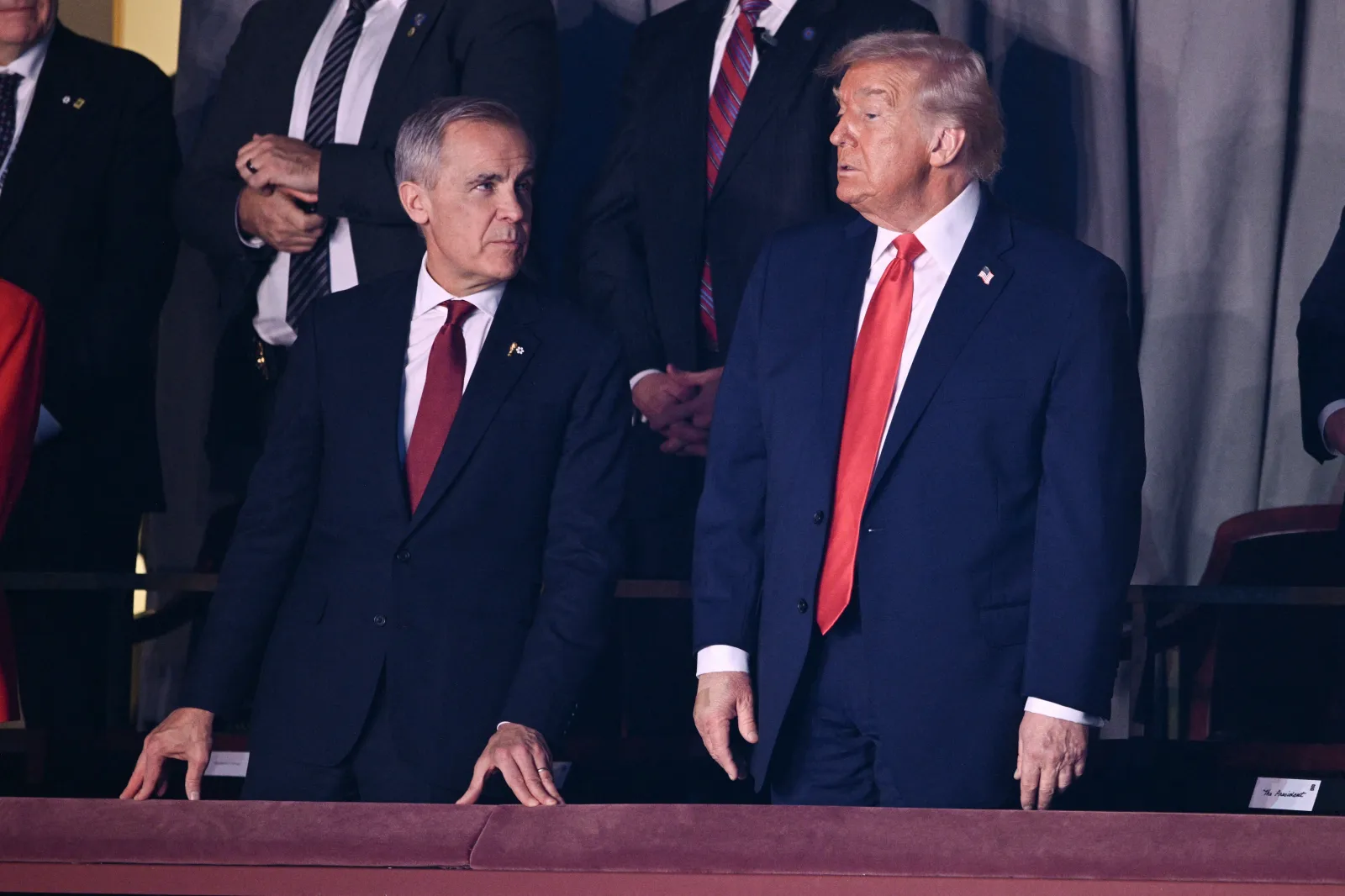
U.S. President Donald Trump has formally withdrawn Canada’s invitation to join his proposed “Board of Peace,” escalating an already fragile relationship with one of America’s closest allies and injecting new uncertainty into global diplomatic and trade alignments.
The decision came just days after Canadian Prime Minister Mark Carney used the World Economic Forum in Davos to warn that the world’s largest powers are increasingly weaponizing trade, finance, and supply chains to exert pressure on smaller and mid-sized economies. While Carney did not name any country directly, the message landed squarely in Washington.
In a late-night post on Truth Social, Trump announced that the invitation extended to Canada was no longer valid. He framed the move as a unilateral withdrawal by the board itself, signaling a clear break from earlier discussions between the two governments.
A proposal with a steep price tag
Carney had said the previous week that Canada was open to joining the Board of Peace, though he emphasized that key details were still unresolved. One of the most significant hurdles was financial. Countries seeking a permanent seat are expected to contribute a reported $1 billion, a figure that has raised eyebrows even among nations broadly supportive of multilateral initiatives.
The board, chaired by Trump, was initially presented as a mechanism to oversee the demilitarization and reconstruction of Gaza following nearly two years of conflict. However, Trump has since expanded its proposed mandate, suggesting it could evolve into a standing global body with influence comparable to, or even rivaling, the United Nations. That ambition has unsettled several U.S. allies who see the plan as bypassing existing international institutions rather than reforming them.
Davos speech triggers sharp response
In Davos, Carney argued that the rules-based international system is effectively breaking down. He said tariffs are being used as leverage, financial networks as tools of coercion, and supply chains as strategic vulnerabilities. His remarks echoed growing concerns among middle powers that economic interdependence is no longer a stabilizing force but a battleground.
Trump responded publicly on the sidelines of the forum, delivering a pointed rebuke. He suggested that Canada’s economic survival depends heavily on the United States and warned Carney to keep that reality in mind when making global statements. The exchange underscored how quickly economic policy disagreements have spilled into personal and political rhetoric.
Hours before Carney took the Davos stage, Trump had also shared a digitally altered image online depicting Greenland, Venezuela, and Canada draped in the American flag, a post widely interpreted as symbolic of his expansive and provocative view of U.S. influence.
U.S.–Canada ties under mounting strain
Relations between Washington and Ottawa have deteriorated markedly during Trump’s second term. The president has repeatedly referred to Canada as America’s “51st state” and has targeted Canadian exports with tariffs, reigniting long-running disputes over trade imbalances and market access.
Against this backdrop, the withdrawal from the Board of Peace invitation is being read in Ottawa as more than a symbolic snub. It reflects a broader recalibration of U.S. expectations toward allies, particularly those exploring closer economic ties with rival powers.
Global reactions to the Board of Peace
Trump has secured backing for the initiative from several Middle Eastern governments, including Turkey, Egypt, Saudi Arabia, and Qatar, along with emerging economies such as Indonesia. Supporters argue the board could act faster and more decisively than existing multilateral bodies.
Yet resistance remains strong among traditional Western allies. Countries such as Australia, France, Germany, and Italy have expressed reservations, and some have outright declined to participate. The United Kingdom has reportedly ruled out joining, citing concerns over the inclusion of Russian President Vladimir Putin among the invitees.
Russia and China are both on the invitation list. Moscow has said it is still reviewing the proposal internally, while Beijing has not confirmed whether it intends to participate. The prospect of these powers sitting on a Trump-led global body has added to skepticism in Europe and beyond.
Canada’s parallel pivot toward China
Carney’s Davos appearance followed a high-profile visit to China, where he met President Xi Jinping and finalized a broad agreement aimed at stabilizing and rebuilding bilateral trade ties. As part of the deal, Beijing reduced tariffs on several Canadian agricultural exports, offering relief to farmers who have faced declining access to key markets.
In return, Canada agreed to expand quotas for Chinese electric vehicle imports, applying a most-favored-nation tariff rate of 6.1 percent. The agreement signals a pragmatic shift by Ottawa as it seeks to diversify trade relationships amid growing unpredictability in U.S. policy.
Carney has described the renewed partnership with China as strategically necessary in what he called a “new world order,” a phrase widely interpreted as a response to the volatility created by Trump’s foreign policy and aggressive trade agenda.
A widening rift with global implications
The withdrawal of Canada’s invitation to the Board of Peace is not an isolated episode. It highlights a deeper realignment in global politics, where trade, diplomacy, and security are increasingly intertwined. For Canada, the episode reinforces the risks of navigating between competing superpowers. For the United States, it signals a willingness to use access and exclusion as leverage, even with longstanding allies.
As debates over tariffs, economic coercion, and global governance intensify, the Trump–Carney clash may prove to be an early marker of how sharply divided the next phase of international relations could become.
.webp)
Popular articles



Subscribe to unlock premium content
Crypto in the Arctic
Iceland’s Seaweed Revolution
Private Island Rentals for Corporate Retreats Hit $1 Billion
Crypto in the Arctic
Iceland’s Seaweed Revolution
Crypto in the Arctic


