
South Korea Introduces Fuel Price Cap as Global Oil Surge Hits Economy

South Korea Introduces Fuel Price Cap as Global Oil Surge Hits Economy
By
David Goldfarb
Last updated:
March 10, 2026
First Published:
April 25, 2026

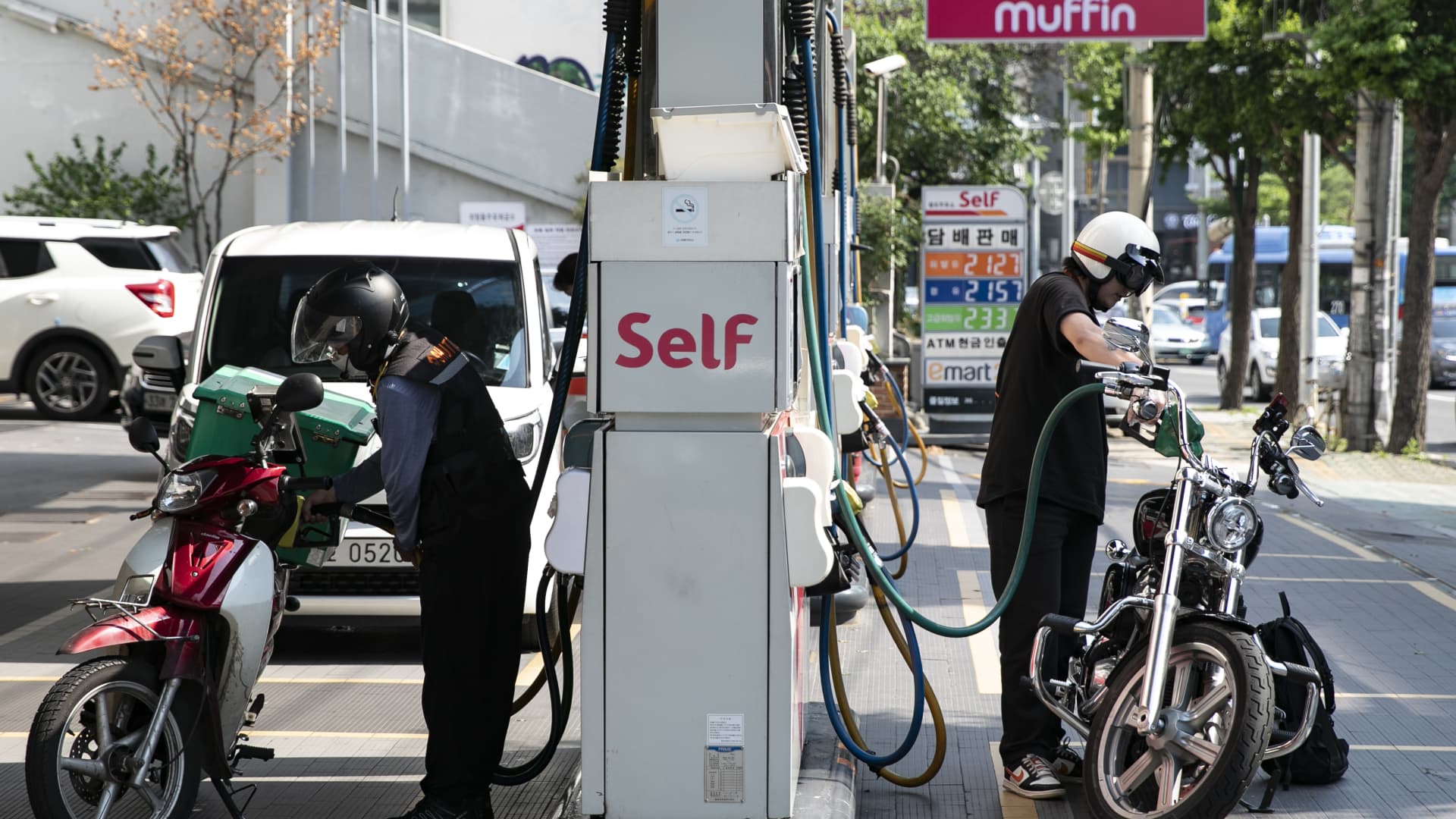
Riders refuel their motorbikes at a gas station in Hongdae district in Seoul, South Korea, on Saturday, July 2, 2022.
Bloomberg | Bloomberg | Getty Images
Government Moves to Contain Soaring Fuel Costs
South Korea is preparing to impose a nationwide price ceiling on petroleum products for the first time in nearly three decades, as a sharp surge in global oil prices threatens to strain the country’s economy and household budgets.
President Lee Jae Myung announced that the government will move quickly to implement the emergency measure after energy markets reacted dramatically to escalating tensions in the Middle East, particularly the war involving Iran.
The decision marks one of the most significant government interventions in the country’s fuel market since the late 1990s. Officials say the goal is to protect consumers and businesses from excessive price increases while stabilizing the broader economy.
South Korea relies heavily on imported energy, making it especially vulnerable to disruptions in global oil supply chains.
Oil Prices Spike After Middle East Escalation
The policy response comes after one of the most dramatic movements in oil markets in decades.
Crude prices surged sharply following reports that several major producers in the Middle East were cutting output and tensions around Iran were intensifying. The situation was further aggravated by concerns that energy shipments could be disrupted in key maritime routes.
Brent crude, the international benchmark, climbed roughly 13 percent to about $104.70 per barrel, while U.S. West Texas Intermediate (WTI) briefly jumped 30 percent to $118.46 per barrel, marking the largest single-day spike in crude prices since 1988 before settling around $102 per barrel later in the trading session.
Energy traders attribute the volatility to fears that escalating military conflict could disrupt oil flows from the Persian Gulf. Roughly one-fifth of the world’s oil supply moves through the Strait of Hormuz, a narrow shipping channel that has become increasingly unstable during the conflict.
Any prolonged disruption could tighten global supply and push prices even higher.
Fuel Prices Climb Rapidly Across South Korea
The surge in global oil prices has quickly translated into higher costs at the pump across South Korea.
According to data reported by local media, the average price of gasoline in Seoul recently climbed above 1,900 Korean won per liter for the first time in almost four years, reaching approximately 1,945 won per liter shortly afterward.
That translates to roughly $1.28 per liter, with prices continuing to rise as global energy markets remain volatile.
Such increases place significant pressure on consumers and businesses alike, especially in a country where transportation, logistics, and manufacturing sectors rely heavily on petroleum products.
President Lee warned that the recent surge in energy prices was excessive and required decisive action.
First Fuel Price Cap in Nearly 30 Years
The government’s decision to impose a maximum fuel price represents an extraordinary step.
South Korea has not implemented such a cap in nearly 30 years, reflecting the seriousness of the current energy crisis. The policy would set an upper limit on petroleum product prices, preventing retailers from passing the full impact of global price spikes on to consumers.
Officials say the cap is intended as a temporary emergency measure until global energy markets stabilize.
At the same time, authorities are exploring broader strategies to strengthen energy security, including diversifying import sources and building stronger partnerships with alternative suppliers.
One of the key priorities is reducing dependence on shipping routes that pass through the Strait of Hormuz, which remains vulnerable to military disruptions.
Economic Risks From Energy Dependence
South Korea’s heavy reliance on imported fuel makes the country particularly sensitive to oil price shocks.
The nation imports the vast majority of its crude oil, with a large portion historically sourced from the Middle East. This dependence means that geopolitical instability in the region can quickly ripple through the Korean economy.
Higher fuel costs affect nearly every sector, from transportation and manufacturing to electricity generation and consumer goods production.
For households, rising gasoline and heating prices can significantly increase monthly expenses, especially during periods of broader inflation.
President Lee described the energy shock as placing a “significant burden” on the national economy and warned that further volatility could intensify economic uncertainty.
Financial Markets Experience Extreme Volatility
The oil shock has not only affected energy markets but has also triggered turbulence in South Korea’s financial system.
Over the past week, the country’s benchmark Kospi stock index experienced dramatic swings. At one point the index recorded a 12 percent single-day decline, marking one of the worst trading days in its history.
The following session saw a sharp rebound of around 10 percent, before markets resumed their downward movement amid continued uncertainty.
Authorities were forced to activate multiple trading curbs and circuit breakers, emergency mechanisms designed to pause trading during periods of extreme volatility.
Currency markets have also been affected. The South Korean won weakened sharply against the U.S. dollar, reaching an intraday level of 1,506.37 per dollar, its weakest point since the global financial crisis in 2009. The currency later recovered slightly but remains under pressure.
Government Expands Market Stabilization Measures
To counter financial instability, President Lee has instructed economic authorities to be prepared to expand the government’s 100 trillion won market stabilization program, equivalent to roughly $75 billion.
The program was originally launched earlier this month to support financial markets and reassure investors amid rising geopolitical tensions.
If necessary, the government and the Bank of Korea may introduce additional measures to ensure liquidity in the financial system and prevent excessive market volatility.
However, officials emphasized that the stabilization program is not intended to artificially inflate stock prices. Authorities have warned against large-scale equity purchases that could distort market conditions.
Instead, the program focuses on maintaining financial stability and preventing panic-driven sell-offs.
Other Asian Economies Respond to Energy Risks
South Korea is not the only Asian economy reacting to the global energy shock.
In Japan, government officials have reportedly instructed operators of national oil reserve facilities to prepare for a potential release of strategic crude stocks if market conditions worsen. Japan currently maintains emergency reserves equivalent to roughly 254 days of domestic consumption, one of the largest stockpiles in the world.
Meanwhile, Vietnam has announced plans to eliminate import taxes on certain fuel products to help stabilize domestic energy prices and ensure sufficient supply.
Across Asia, governments are scrambling to protect their economies from the ripple effects of rising oil prices.
Regional Energy Vulnerability
Asian economies are among the most exposed to oil supply disruptions due to their heavy dependence on imported energy.
While China is the world’s largest crude oil importer, it also has substantial domestic production capacity. In contrast, countries like South Korea, Japan, and Taiwan rely far more heavily on foreign oil shipments.
South Korea in particular has an energy-intensive economy driven by major industrial sectors such as shipbuilding, petrochemicals, and electronics manufacturing.
This means a sustained oil crisis could have significant consequences for economic growth, trade competitiveness, and inflation across the region.
Energy Security Now a Top Priority
The current crisis is likely to accelerate South Korea’s efforts to strengthen long-term energy security.
In addition to short-term interventions like fuel price caps, policymakers are increasingly focused on diversifying supply sources, expanding strategic reserves, and investing in alternative energy technologies.
The government is also expected to intensify cooperation with international partners to secure stable supply chains and reduce dependence on politically volatile regions.
For now, however, the immediate priority remains protecting consumers and stabilizing the domestic economy as global oil markets remain highly uncertain.
.webp)
Popular articles



Subscribe to unlock premium content
How Finland Uses Ice Swimming Festivals to Boost Winter Tourism and Local Economies

The Boom of Luxury Personal Libraries Renting Rare Books to the Ultra-Wealthy

Why Bhutan’s Hand-Woven Textiles Are Gaining Global Collector Value

How Finland Uses Ice Swimming Festivals to Boost Winter Tourism and Local Economies
The Boom of Luxury Personal Libraries Renting Rare Books to the Ultra-Wealthy
How Finland Uses Ice Swimming Festivals to Boost Winter Tourism and Local Economies


