
South Korea Approves Law to Launch $350 Billion U.S. Investment Program

South Korea Approves Law to Launch $350 Billion U.S. Investment Program
By
David Goldfarb
Last updated:
March 13, 2026
First Published:
April 25, 2026

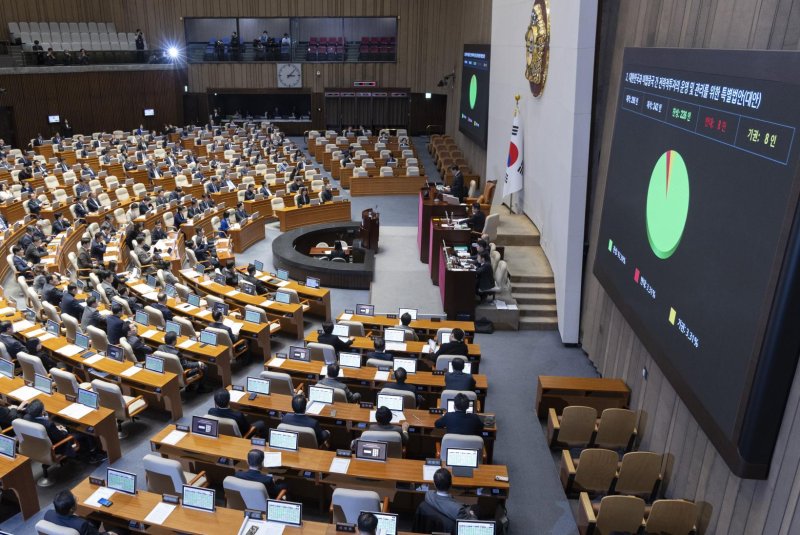
South Korea has taken a major step toward strengthening its economic relationship with the United States after lawmakers approved legislation to implement a massive $350 billion investment commitment tied to a broader trade agreement between the two countries.
The South Korean parliament passed a special bill that establishes a government-backed investment corporation, designed specifically to manage and execute Seoul’s large-scale financial pledge to the U.S. economy. The investment plan is widely seen as a strategic move by South Korea to protect its export-driven economy from rising trade pressures and potential tariffs from Washington.
The decision comes amid renewed trade tensions after the United States launched investigations into multiple trading partners and warned that higher tariffs could return if agreements are not fulfilled.
Government-Backed Investment Corporation Created
Under the newly approved legislation, South Korea will establish a state-run investment entity responsible for managing and deploying the full $350 billion investment package in the United States.
According to South Korean officials and local media reports, the corporation will be fully financed by the government and will focus on long-term investments in industries considered strategically important for both economies.
The new structure provides Seoul with the legal and financial framework necessary to execute its commitment under the bilateral trade deal signed with Washington in July 2025.
Officials say the organization will coordinate funding, partnerships, and large-scale industrial projects across several sectors in the United States, while also ensuring transparency and government oversight of the investments.
The initiative represents one of the largest overseas investment commitments ever made by South Korea, reflecting the country’s deep economic ties with the U.S., which remains one of its largest export markets.
Breakdown of the $350 Billion Investment Plan
The investment package will be divided across several strategic industries, with a particular focus on sectors where the United States is seeking to expand domestic production capacity.
Approximately $150 billion will be directed toward shipbuilding and maritime infrastructure, a sector where South Korean companies such as Hyundai Heavy Industries, Hanwha Ocean, and Samsung Heavy Industries are already global leaders.
The remaining $200 billion will support projects in strategic industries including advanced manufacturing, semiconductors, artificial intelligence infrastructure, clean energy, and critical supply chains.
Government officials indicated that the investment rollout will occur gradually, with annual spending capped at roughly $20 billion per year to ensure long-term sustainability and effective project management.
This phased approach allows South Korea to distribute investment over multiple years while supporting major infrastructure and technology projects across the United States.
Tariff Pressures Pushed Seoul to Act
The passage of the bill follows a period of rising trade pressure from Washington.
Earlier this year, U.S. President Donald Trump warned that tariffs on South Korean goods could rise sharply if Seoul failed to meet commitments made under the bilateral trade deal.
In January, Trump threatened to increase tariffs on imports from South Korea to 25 percent, significantly higher than the 15 percent tariff level previously negotiated in the 2025 agreement between the two countries.
The warning was delivered through a public statement in which Trump criticized South Korea’s legislature, claiming it was not moving quickly enough to fulfill the investment pledge.
The investment program is therefore viewed as a key component of Seoul’s strategy to maintain stable trade relations and prevent additional tariffs that could harm South Korean exporters.
South Korea is currently Asia’s fourth-largest economy, with exports accounting for nearly 40 percent of its GDP, making stable trade agreements with major markets like the United States essential.
New U.S. Trade Investigations Add Pressure
Complicating matters further, Washington recently announced that it had opened Section 301 trade investigations into 16 trading partners, including South Korea.
These investigations allow the U.S. government to determine whether foreign countries are engaging in practices considered unfair to American businesses. If violations are found, the U.S. has the authority to impose new tariffs or other trade restrictions.
Section 301 has historically been one of Washington’s most powerful trade enforcement tools and was widely used during earlier trade disputes.
The launch of these investigations has created additional urgency in Seoul to demonstrate its commitment to the bilateral trade agreement and the large investment package.
Tariff Uncertainty Continues After Court Ruling
Trade policy uncertainty increased further after the U.S. Supreme Court recently struck down a significant portion of tariffs previously imposed by the Trump administration.
Following the ruling, the administration introduced new tariffs of about 10 percent under Section 122, another provision of U.S. trade law that allows temporary duties during balance-of-payments crises.
While the court decision removed some existing tariffs, it also created uncertainty about future trade policy, leaving export-focused economies like South Korea closely watching developments in Washington.
South Korea’s Industry Minister Kim Jung-kwan acknowledged earlier this year that the ruling created new uncertainties for exporters, though he emphasized that the overall framework of the bilateral tariff agreement remains largely intact.
Strategic Investment to Strengthen Economic Ties
The $350 billion investment commitment highlights how economic partnerships are increasingly being used as tools to manage global trade tensions.
For the United States, the influx of investment could support domestic manufacturing, strengthen supply chains, and generate thousands of jobs in key industrial sectors.
For South Korea, the strategy provides a pathway to secure continued access to one of its most important export markets while reducing the risk of punitive tariffs.
Economic analysts say the plan also reflects a broader trend in global trade policy, where governments are linking investment commitments, industrial cooperation, and supply chain development to tariff negotiations.
With the legal framework now in place, South Korea’s new investment corporation will begin planning and coordinating projects, marking the next phase of one of the most ambitious economic partnership initiatives between Seoul and Washington in recent years.
.webp)
Popular articles



Subscribe to unlock premium content
How Finland Uses Ice Swimming Festivals to Boost Winter Tourism and Local Economies

The Boom of Luxury Personal Libraries Renting Rare Books to the Ultra-Wealthy

Why Bhutan’s Hand-Woven Textiles Are Gaining Global Collector Value

How Finland Uses Ice Swimming Festivals to Boost Winter Tourism and Local Economies
The Boom of Luxury Personal Libraries Renting Rare Books to the Ultra-Wealthy
How Finland Uses Ice Swimming Festivals to Boost Winter Tourism and Local Economies


