Salesforce Staff Urge Marc Benioff to Halt ICE Engagements Amid Growing Internal Backlash

Salesforce Staff Urge Marc Benioff to Halt ICE Engagements Amid Growing Internal Backlash
By
Calder Monroe
Last updated:
February 11, 2026
First Published:
February 11, 2026

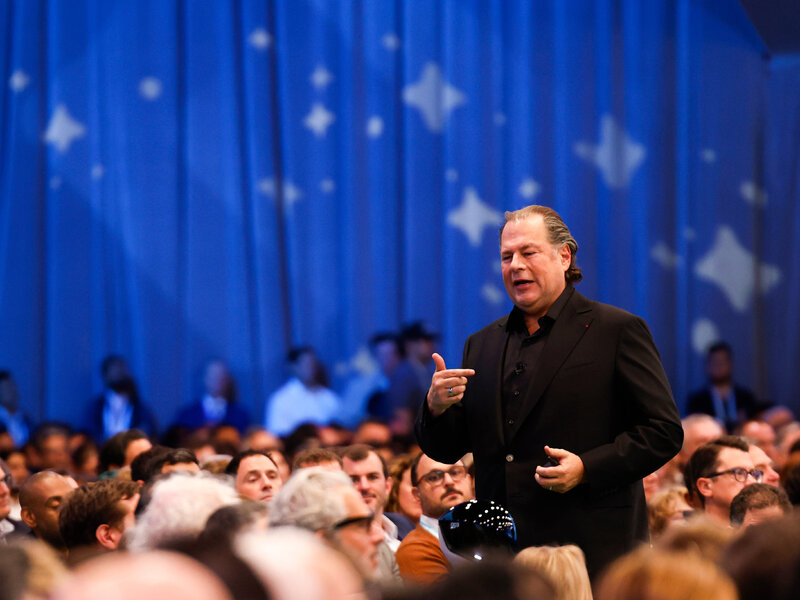
Photo: The New York Times
A growing internal movement at Salesforce is putting CEO Marc Benioff under renewed scrutiny after more than 1,400 employees signed a letter urging the company to abandon potential business engagements with U.S. Immigration and Customs Enforcement. The petition reflects mounting tension inside major technology firms over government contracts tied to immigration enforcement and AI-driven operational tools.
The letter, which organizers plan to deliver directly to Benioff this week, calls on Salesforce to withdraw from what employees describe as “active pitches or opportunities” aimed at supporting ICE recruitment and enforcement activities. According to individuals familiar with the effort, the number of signatories has continued to rise since the document began circulating internally.
The dispute intensified following reports that Salesforce had presented artificial intelligence capabilities to ICE that could assist the agency in recruiting and onboarding as many as 10,000 additional agents. Employees expressed concern that Salesforce’s cloud infrastructure, automation tools, and AI-driven workflow systems could accelerate ICE’s operational capacity at a time when immigration enforcement remains politically and socially contentious.
Concerns Over AI and Operational Scale
In the letter, employees state they are “deeply troubled” by reports suggesting Salesforce technology may be positioned as an “ideal platform” for ICE recruitment, applicant screening, and tip-line data management. A supplementary internal memo argues that modern enterprise software platforms—especially those powered by generative AI, predictive analytics, and CRM automation—can significantly increase the scale and speed of government operations.
Workers are asking leadership to disclose precisely what services, if any, Salesforce currently provides to ICE, and whether proposals involve AI infrastructure, Slack communications software, or other enterprise solutions. They are also urging the company to pause or prohibit deployments that could contribute to enforcement expansion.
The backlash is part of a broader pattern in Silicon Valley. Over the past several years, thousands of tech employees across companies including Google, Amazon, Microsoft, and Palantir have protested contracts involving defense, border security, and law enforcement agencies. Just last week, approximately 900 Google employees signed a similar petition asking leadership to sever ties with ICE and U.S. Customs and Border Protection.
Industry analysts note that enterprise software platforms like Salesforce are deeply embedded across federal agencies. In May, the U.S. General Services Administration announced discounted government-wide software agreements involving Salesforce Slack, alongside offerings from Adobe, Microsoft, and ServiceNow. These multi-agency procurement programs can run into hundreds of millions of dollars over multi-year terms.
Internal Culture Clash and Public Perception Risks
Tensions escalated further after reports that Benioff made a lighthearted remark about ICE agents being present at an employee event in Las Vegas. According to people familiar with internal discussions, the comment sparked immediate criticism on Slack channels and reopened deeper concerns about leadership’s alignment with workforce values.
Employees argue that involvement with ICE poses reputational and personal risks. In their supplementary document, organizers warn that staff may face “social targeting, reputational harm, or misidentification as complicit” in policies they oppose. They also highlight what they describe as a lack of transparency surrounding the scope and governance of Salesforce’s government relationships.
The internal campaign comes at a delicate time for Salesforce. The company’s stock has fallen roughly 27% year to date in 2026, reflecting broader investor anxiety about the long-term impact of generative AI on traditional enterprise software revenue models. Analysts have questioned whether AI-native competitors could compress growth rates across the sector.
In its most recent fiscal guidance, Salesforce projected annual revenue growth between 9% and 10%, slightly higher than prior expectations. Management has also emphasized federal contracts as a stable growth channel amid macroeconomic uncertainty. Government cloud services and AI-enabled workflow automation remain priority investment areas.
This tension between ethical positioning and revenue diversification is not unique to Salesforce. As federal agencies expand AI adoption, enterprise software vendors face increasing scrutiny from both investors and employees. The federal government spends more than $100 billion annually on IT services, and modernization initiatives—including AI integration—represent a significant addressable market.
Political Optics and Executive Relationships
Benioff’s public positioning has further complicated the narrative. In October, he publicly questioned the necessity of deploying the National Guard to San Francisco, where Salesforce maintains its headquarters and hosts its flagship Dreamforce conference. Yet reports have also indicated that he has maintained dialogue with senior federal officials, including participation in high-level White House events and discussions with policymakers overseeing AI and cryptocurrency initiatives.
These optics have fueled internal debate about the company’s role in politically sensitive government programs. Employees have invoked Benioff’s long-standing statement that “business is the greatest platform for change,” urging him to apply that philosophy to immigration enforcement partnerships.
A Defining Moment for Tech Governance
The outcome of this internal push could signal how major enterprise technology firms navigate the intersection of artificial intelligence, public sector contracts, and employee activism. With over 1,400 employees already backing the letter—and the possibility of additional signatures before submission—pressure is mounting for Salesforce leadership to clarify its position.
Whether the company chooses to proceed with federal AI engagements, limit certain applications, or establish new governance frameworks, the decision will likely shape its corporate identity at a time when workforce expectations, political scrutiny, and investor demands are converging.
For Salesforce, the issue extends beyond a single contract. It represents a broader test of how a $200+ billion enterprise balances shareholder growth objectives with employee values and the societal implications of its technology.

Popular articles


Subscribe to unlock premium content
Drake’s OVO Sound Evolves Into a Lifestyle Empire

Beyoncé’s Wellness Retreats Redefine Luxury Lifestyle
Selena Gomez’s Plant-Based Café Takes the World by Storm

Drake’s OVO Sound Evolves Into a Lifestyle Empire
Beyoncé’s Wellness Retreats Redefine Luxury Lifestyle
Drake’s OVO Sound Evolves Into a Lifestyle Empire