Ray-Ban Parent EssilorLuxottica Reports AI Smart Glasses Sales Surge Past 7 Million in 2025

Ray-Ban Parent EssilorLuxottica Reports AI Smart Glasses Sales Surge Past 7 Million in 2025
By
Leah Rosenfeld
Last updated:
February 12, 2026
First Published:
April 25, 2026

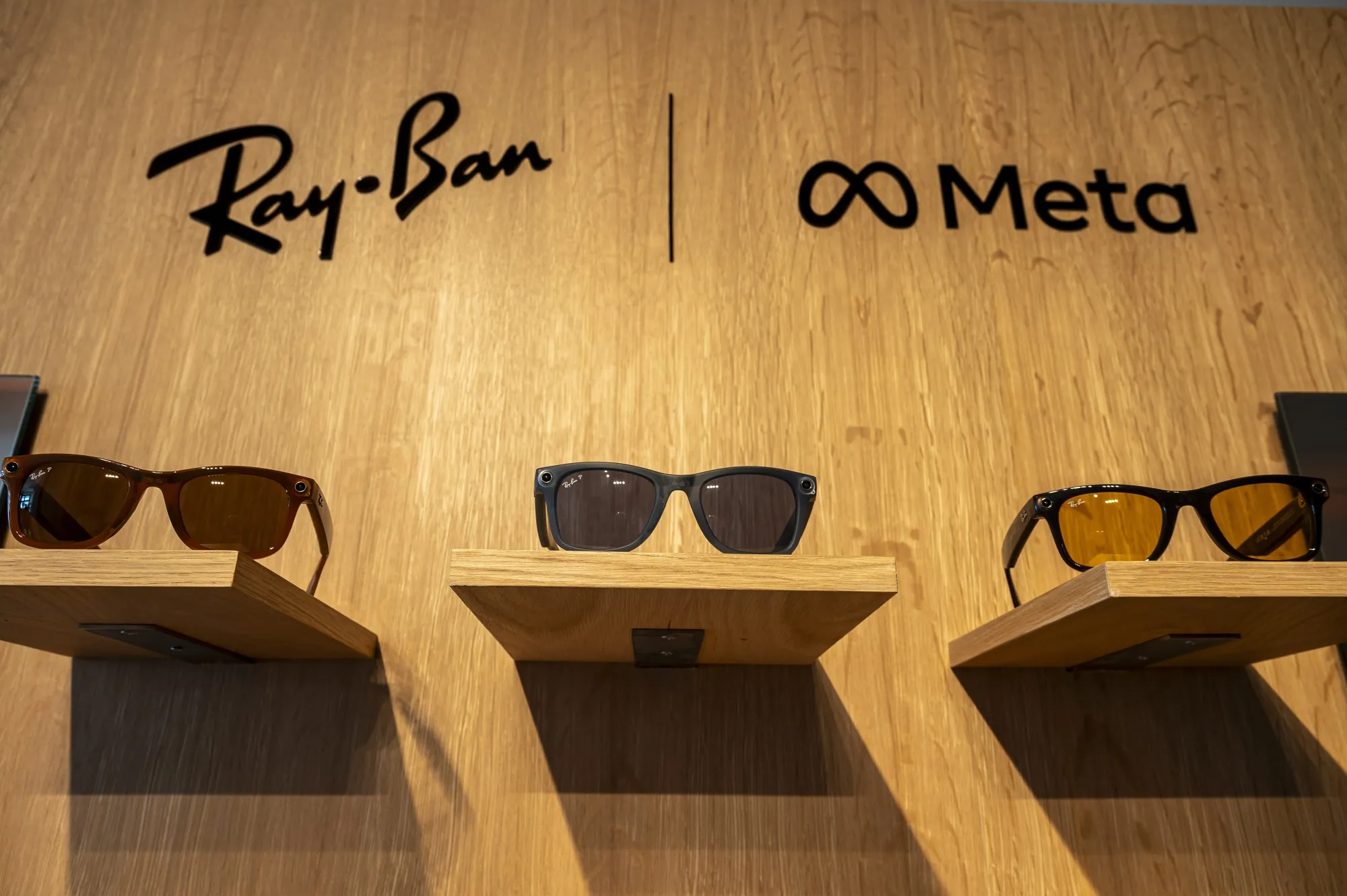
Photo: Bloomberg.com
EssilorLuxottica, the global eyewear powerhouse behind Ray-Ban and Oakley, says demand for its Meta-powered smart glasses accelerated dramatically in 2025, with annual sales more than tripling year over year.
In its fourth-quarter earnings report, the French-Italian optical giant disclosed that it sold more than 7 million AI-enabled glasses during the year. That figure marks a sharp jump from the roughly 2 million units sold across 2023 and 2024 combined.
The surge underscores a broader shift in consumer technology: wearable AI devices are moving from novelty to scalable product category.
AI eyewear moves into the mainstream
The reported 7 million-plus units include Meta smart glasses sold under both the Ray-Ban and Oakley brands. Oakley’s AI-integrated models were introduced in June, expanding the product line beyond the lifestyle-focused Ray-Ban collection and into performance-oriented eyewear.
EssilorLuxottica described its momentum in wearables as a key driver of growth, citing the strength of its globally recognized brands as a catalyst for adoption.
The partnership between EssilorLuxottica and Meta dates back to 2019, when the two companies began collaborating on connected eyewear. Their first-generation smart glasses debuted in September 2021 but saw limited consumer traction. It wasn’t until the second-generation release in 2023 — featuring improved cameras, audio, battery life and integrated Meta AI capabilities — that sales began to accelerate meaningfully.
The latest Ray-Ban iteration, introduced in September, incorporates gesture controls and neural interface elements, allowing users to interact with the device more seamlessly. The premium model, retailing at $799, includes a discreet display embedded in one lens, enabling notifications, navigation prompts and AI-driven features directly within the user’s field of vision.
Production ramps up amid strong demand
The strong 2025 sales figures reflect surging interest in hands-free AI experiences, particularly as consumers look for alternatives to smartphones for certain everyday tasks such as messaging, photography, translation and voice-assisted search.
Meta has acknowledged that demand for its Ray-Ban Display glasses in the United States has exceeded expectations. In January, the company said it would delay its planned early 2026 international rollout due to what it described as “unprecedented” domestic demand.
According to industry reports, Meta and EssilorLuxottica are now discussing expanding annual production capacity to at least 20 million units by the end of the year — nearly triple the current sales run rate — in order to meet projected global demand.
If realized, that production target would position AI glasses as one of the fastest-scaling new consumer hardware categories in recent years.
Strategic partnership extended into the next decade
Meta has signaled a long-term commitment to the collaboration. In 2024, the two companies extended their strategic partnership agreement, pledging to work together “into the next decade” on wearable technology innovation.
For Meta, smart glasses represent a key pillar of its broader strategy to integrate artificial intelligence into everyday life through hardware. The company has invested heavily in augmented reality, mixed reality and AI-driven devices as part of its vision for next-generation computing platforms.
For EssilorLuxottica, the partnership adds a high-growth technology layer to its core eyewear business, which already includes brands such as Ray-Ban, Oakley, Persol and Oliver Peoples, as well as a vast retail distribution network. The company generates tens of billions of euros annually in revenue from prescription lenses, sunglasses and optical retail operations worldwide.
Wearable AI market gathers momentum
The rapid increase from 2 million cumulative units over two years to more than 7 million units in a single year suggests a meaningful inflection point for AI-enabled wearables.
Analysts note that consumer adoption of smart glasses historically lagged due to privacy concerns, limited functionality and high price points. However, advances in on-device AI processing, lightweight components and improved battery performance have made the latest generation significantly more practical.
In addition, the integration of generative AI assistants capable of real-time language translation, contextual information retrieval and voice-driven queries has expanded the use cases beyond simple photo capture.
The broader wearable technology market — which includes smartwatches, fitness trackers and AR headsets — is projected to grow steadily over the next several years, with AI integration expected to be a primary growth driver.
What the growth means for the tech sector
EssilorLuxottica’s sales acceleration signals that AI hardware is evolving from experimental to commercially viable at scale. The combination of established consumer brands and advanced AI software appears to be resonating with buyers.
With more than 7 million units sold in 2025 alone and production potentially rising toward 20 million annually, Meta’s smart glasses are emerging as one of the most successful AI hardware launches to date.
If demand continues at this pace, wearable AI devices could become a central interface for digital interaction — complementing or, in some use cases, partially replacing smartphones.
For now, EssilorLuxottica’s results indicate that the AI glasses category has crossed an important threshold: from early adopter enthusiasm to mainstream consumer momentum.
.webp)
Popular articles



Subscribe to unlock premium content
Urban Sanctuaries in the Sky

Frozen Luxury Comes to Life

The Glow of Luxury Bioluminescence

Urban Sanctuaries in the Sky
Frozen Luxury Comes to Life
Urban Sanctuaries in the Sky