Powerful East Coast Blizzard Grounds Flights and Strains U.S. Airline Networks

Powerful East Coast Blizzard Grounds Flights and Strains U.S. Airline Networks
By
David Goldfarb
Last updated:
February 23, 2026
First Published:
February 23, 2026

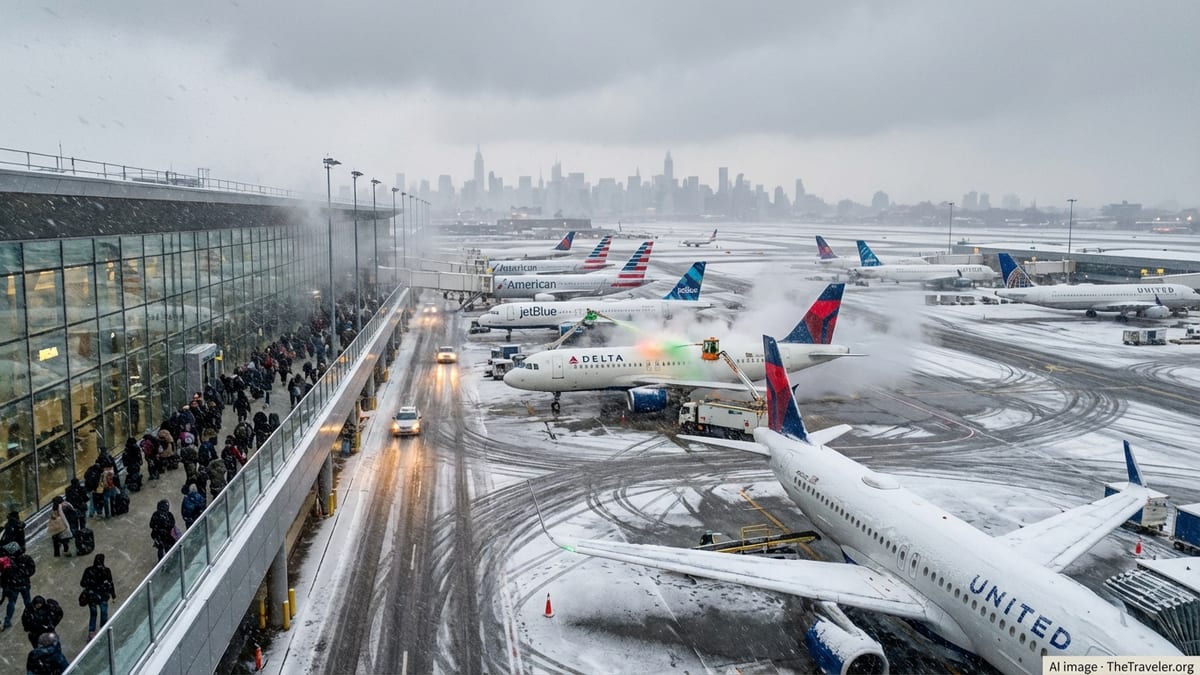
Photo: The Traveler
Severe Winter Storm Disrupts Major Travel Corridors
A powerful winter system sweeping across the U.S. East Coast has triggered one of the most significant air-travel disruptions of the season, forcing airlines to cancel thousands of flights and reshuffle schedules across key hubs.
Forecasters issued blizzard warnings across densely populated areas, including the New York metropolitan region, as the storm pushed northward with heavy snowfall, near-whiteout visibility, and wind gusts approaching 50 miles per hour. Accumulations in some locations are projected to exceed 12 to 24 inches, creating hazardous travel conditions across highways, rail lines, and airports.
Flight Cancellations Surge Far Above Normal Levels
Airlines began preemptive cancellations over the weekend, with disruptions intensifying into Monday as snowfall persisted. Roughly 3,800 flights—about 15% of all scheduled U.S. departures—were scrapped in a single day, compared with a typical cancellation rate closer to 1%.
At several major airports, operations were nearly halted. More than 90% of departures at LaGuardia and Boston Logan were canceled, while cancellations reached roughly 80% at Philadelphia International and John F. Kennedy. On Sunday, about two-thirds of incoming flights to New York’s major airports were already off the schedule, signaling the scale of the disruption before the storm’s peak.
Airlines often take this proactive approach to avoid cascading delays, ensuring aircraft and crews are positioned to resume service quickly once conditions improve.
Airlines Activate Flexible Travel Policies
Major U.S. carriers, including Delta Air Lines, American Airlines, United Airlines, JetBlue Airways, Spirit Airlines, and Southwest Airlines, issued travel waivers allowing passengers to rebook without change fees or fare differences.
Most waivers cover travel through late February, while some carriers are permitting rebooking windows of up to two weeks. These policies are designed to reduce airport congestion and give travelers more flexibility as conditions evolve.
Operational and Financial Pressures on Carriers
Severe winter weather events routinely test airline logistics, from crew scheduling to aircraft repositioning. Recent storms have shown how costly disruptions can become. A major cold-weather event earlier in the season resulted in revenue losses estimated between $150 million and $200 million for one large U.S. carrier, highlighting the financial stakes tied to extreme weather.
Beyond immediate revenue hits, storms can ripple through airline networks for days, leading to aircraft imbalances, overtime labor costs, and customer compensation expenses. With peak winter travel periods still underway, carriers are prioritizing rapid recovery once airports reopen fully.
Why Storm Impacts Are Intensifying
The East Coast’s dense air-traffic corridors—anchored by New York, Boston, and Washington—make the region particularly vulnerable to weather disruptions. Even localized snowfall can cascade through the national system because so many flights connect through these hubs.
This storm’s combination of heavy snow, strong winds, and low visibility significantly reduced runway capacity, forcing air-traffic managers to implement ground stops and spacing measures that further constrained operations.
Outlook for Travelers
Forecasters expect lingering delays as airlines work through backlogs of passengers and reposition aircraft. Travelers are being advised to monitor flight statuses closely, allow extra time for rebooking, and prepare for residual disruptions even after snowfall ends.
While conditions are expected to gradually improve, the scale of cancellations means normal schedules could take several days to fully stabilize.

Popular articles


Subscribe to unlock premium content
Africa’s Leap into Cashless Economies

The Rise of Livestream Shopping in Southeast Asia

The Niche Market for Upcycled Automotive Parts in Classic Car Restoration

Africa’s Leap into Cashless Economies
The Rise of Livestream Shopping in Southeast Asia
Africa’s Leap into Cashless Economies