Nvidia’s China Business Faces Senate Scrutiny as Jensen Huang Is Called to Testify on AI Chip Exports

Nvidia’s China Business Faces Senate Scrutiny as Jensen Huang Is Called to Testify on AI Chip Exports
By
David Goldfarb
Last updated:
June 5, 2026
First Published:
June 5, 2026

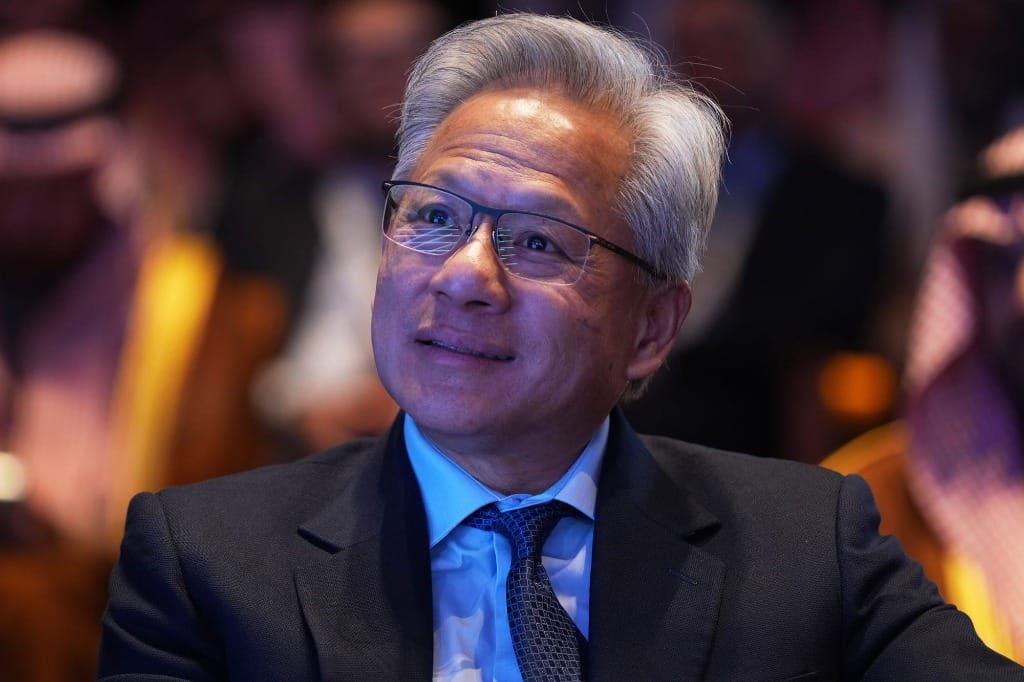
Photo: Broadband Breakfast
Nvidia CEO Jensen Huang has been invited to appear before the U.S. Senate Banking Committee as lawmakers intensify their examination of America's most influential artificial intelligence company and its business activities in China.
The proposed hearing comes at a critical moment for both Nvidia and the broader semiconductor industry. As AI becomes increasingly central to economic growth, national security, and technological competition, policymakers are grappling with a difficult question: how can the United States maintain its leadership in artificial intelligence while preventing advanced technologies from strengthening strategic rivals?
The hearing would give lawmakers a rare opportunity to question Huang directly about Nvidia's China operations, U.S. export restrictions, and the company's position at the center of the global AI boom.
Nvidia Becomes the Focal Point of the AI Debate
Few companies have benefited more from the rise of artificial intelligence than Nvidia.
Over the past several years, the company's graphics processing units (GPUs) have become the foundation of modern AI infrastructure. Its chips power many of the world's largest AI models, cloud computing platforms, research laboratories, and data centers.
As demand for generative AI applications has exploded, Nvidia's revenue, profits, and market value have surged to unprecedented levels. The company has become one of the most valuable corporations in the world, with its hardware widely regarded as essential for training and deploying advanced AI systems.
However, that dominance has also placed Nvidia squarely in the middle of an increasingly complex geopolitical battle between Washington and Beijing.
Government officials, national security experts, and lawmakers have become increasingly concerned that advanced AI chips could be used to support military modernization, intelligence operations, surveillance systems, and strategic technological development in China.
As a result, Nvidia has found itself navigating a delicate balance between commercial growth opportunities and government-imposed export restrictions.
Why Washington Is Paying Close Attention
The Senate hearing invitation reflects growing concern among lawmakers regarding the transfer of advanced technology to China.
Over the past several years, both Republican and Democratic administrations have introduced multiple rounds of export controls designed to limit China's access to cutting-edge semiconductor technology.
These restrictions target advanced AI processors, high-performance computing hardware, semiconductor manufacturing equipment, and other technologies considered critical to national security.
Policymakers argue that maintaining a technological advantage is essential for protecting U.S. economic and military interests.
The concern extends beyond traditional commercial competition. Officials increasingly view artificial intelligence as a strategic technology that could influence future military capabilities, cybersecurity operations, autonomous systems, and intelligence gathering.
As the leading supplier of AI accelerators and advanced computing chips, Nvidia occupies a unique position within this debate.
The Challenge of Balancing Security and Competitiveness
The central issue facing policymakers is how to protect national security without undermining American innovation.
Supporters of stricter export controls argue that limiting access to advanced chips helps prevent strategic rivals from accelerating AI development using U.S.-designed technologies.
Others warn that overly restrictive policies could have unintended consequences.
Technology companies have repeatedly argued that aggressive export limitations may encourage foreign customers to develop domestic alternatives, reducing the long-term competitiveness of U.S. firms.
Nvidia has consistently maintained that broad restrictions risk harming American industry while creating opportunities for competing technology ecosystems to emerge outside U.S. influence.
The debate has become one of the most significant policy questions facing the global semiconductor industry.
A High-Profile Appearance Following Diplomatic Engagements
The timing of the hearing invitation is particularly notable.
It comes only weeks after Huang participated in a major international summit involving President Donald Trump and Chinese President Xi Jinping.
That appearance further elevated Huang's profile beyond the technology sector and underscored Nvidia's growing strategic importance within global economic and geopolitical discussions.
Unlike many corporate executives, Huang increasingly finds himself operating at the intersection of technology, diplomacy, trade policy, and national security.
His testimony could provide lawmakers with valuable insight into how one of the world's most influential technology companies views the future of AI competition between the United States and China.
Broader Concerns About China's Technology Ambitions
The Senate inquiry is occurring alongside broader congressional efforts focused on China's technological development.
Several lawmakers have expressed concerns that Beijing is actively working to strengthen its artificial intelligence capabilities through substantial investments in semiconductor manufacturing, research initiatives, cloud infrastructure, and advanced computing systems.
China has identified artificial intelligence as a strategic national priority and has committed significant resources toward achieving greater technological self-sufficiency.
At the same time, Chinese technology firms continue seeking access to advanced computing power needed to train increasingly sophisticated AI models.
These developments have intensified pressure on policymakers to reassess existing export-control frameworks and determine whether current restrictions remain effective.
The Growing Debate Over AI and National Security
The hearing is expected to focus heavily on the relationship between artificial intelligence and national security.
Advanced AI systems increasingly rely on powerful computing hardware capable of processing enormous volumes of data and performing highly complex calculations.
Many experts believe that future military systems, intelligence platforms, autonomous technologies, and cybersecurity tools will depend heavily on artificial intelligence capabilities.
This reality has transformed AI chips from commercial products into assets with strategic importance.
As a result, companies like Nvidia now operate in an environment where business decisions can have significant geopolitical implications.
Lawmakers are expected to explore how export controls should evolve as AI technology continues advancing at a rapid pace.
AI's Economic Impact Extends Beyond National Security
While national security concerns dominate much of the discussion, policymakers are also increasingly focused on artificial intelligence's economic and social consequences.
Some lawmakers have warned that widespread AI adoption could reshape labor markets, automate certain job categories, and create significant workforce disruptions over the coming decade.
As businesses accelerate investments in AI-powered systems, questions surrounding worker retraining, education, social safety nets, and economic adaptation are becoming more prominent.
The rapid expansion of AI infrastructure—including data centers, cloud computing networks, and advanced semiconductor facilities—has also generated debate about energy consumption, taxation, and public investment priorities.
These broader concerns suggest that future AI regulation may extend well beyond export controls alone.
Nvidia's Position Has Never Been More Important
Nvidia's influence within the global technology ecosystem has expanded dramatically over the past few years.
The company's hardware now sits at the center of nearly every major AI initiative, from startup projects and enterprise software platforms to government research programs and cloud computing networks.
This position has transformed Nvidia from a semiconductor manufacturer into one of the most strategically important technology companies in the world.
Its decisions regarding product development, international partnerships, supply chain management, and market access increasingly attract attention from governments, investors, and regulators alike.
The upcoming Senate hearing reflects that reality.
Questions that once would have been directed solely at policymakers are now being asked of corporate leaders whose technologies shape the future of artificial intelligence.
A Defining Moment for the AI Industry
The invitation to Jensen Huang represents more than a routine congressional hearing.
It highlights the growing recognition that artificial intelligence has become a central issue in economic policy, international relations, national security, and technological leadership.
For Nvidia, the hearing offers an opportunity to explain its approach to export controls, global competition, and the future of AI innovation.
For lawmakers, it provides a chance to better understand how one of the world's most important technology companies views the challenges and opportunities ahead.
As governments race to establish rules for the AI era, the discussion surrounding Nvidia's China business may ultimately serve as a preview of the broader regulatory and geopolitical battles that will define the next decade of technological development.
.webp)
Popular articles



Subscribe to unlock premium content
Bali’s Digital Detox Revolution

Elevating Perspectives with Drone Photography

Dinner Reinvented in Los Angeles

Bali’s Digital Detox Revolution
Elevating Perspectives with Drone Photography
Bali’s Digital Detox Revolution