
McDonald’s Expands Aggressively in China as Global Rivals Pull Back from the Market

McDonald’s Expands Aggressively in China as Global Rivals Pull Back from the Market
By
Rachel Steinberg
Last updated:
May 8, 2026
First Published:
May 8, 2026

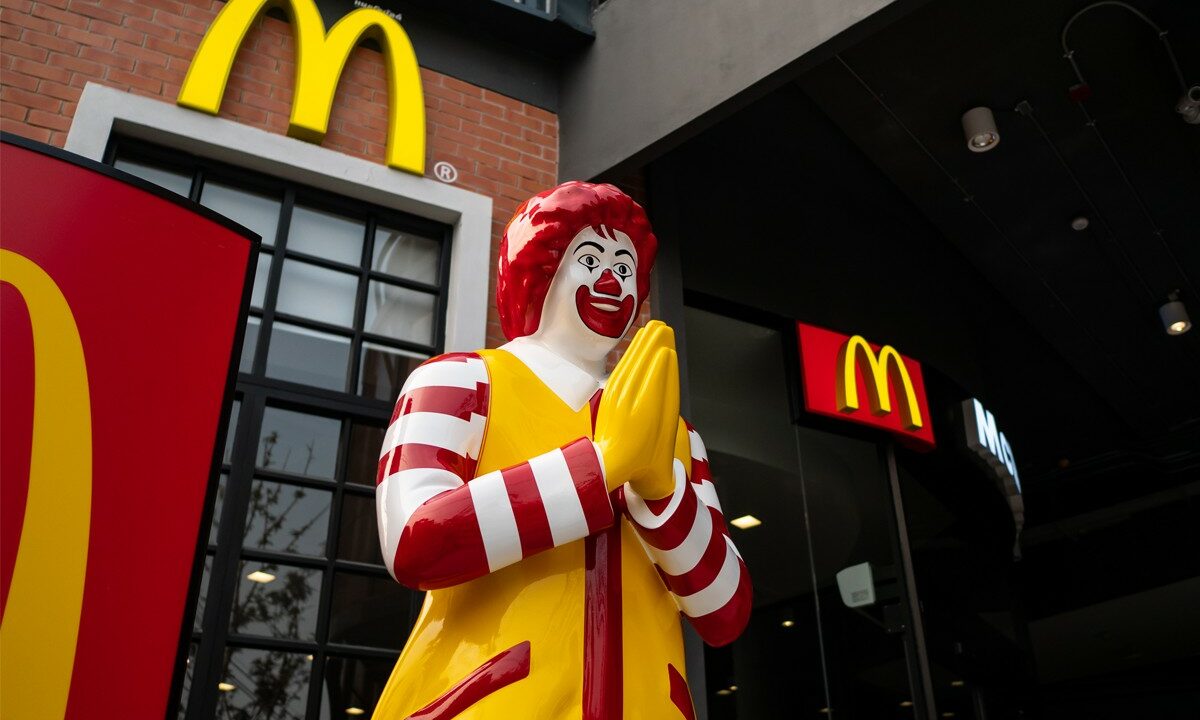
Photo: Branding Strategy Insider
While several global consumer brands are scaling back their exposure to China amid slowing demand and rising competition from domestic players, McDonald’s is taking the opposite approach — accelerating expansion and deepening its presence in one of the world’s most competitive consumer markets.
The fast-food giant is positioning China as a central pillar of its global growth strategy, with plans to expand to 10,000 restaurants across mainland China by the end of 2028, up from more than 7,700 locations projected by the end of 2025.
That means China will remain McDonald’s second-largest market globally after the United States, and one of its fastest-growing in terms of new store openings and system-wide sales.
At a time when brands like Starbucks, Nike, and luxury groups such as LVMH are facing uneven demand and adjusting their China strategies, McDonald’s is leaning into affordability, nostalgia, and localization to maintain momentum.
China Becomes a Core Growth Engine for McDonald’s
China now represents a major driver of McDonald’s international expansion.
The company has been aggressively opening new outlets across major cities and lower-tier urban areas, with nearly half of its new global store openings last year coming from mainland China alone.
McDonald’s operates in China through its international developmental licensed markets segment, where same-store sales rose 3.4% in the most recent quarter, reflecting steady consumer demand even in a slowing economic environment.
A majority stake of McDonald’s China operations is held by local investor Trustar Capital, a private equity arm linked to Citic Capital, allowing the company to navigate regulatory conditions while maintaining rapid expansion.
Industry analysts say this joint-venture structure has been critical in helping McDonald’s scale efficiently while adapting to local consumer behavior and supply chain dynamics.
Nostalgia Drives Consumer Loyalty in China
One of McDonald’s strongest advantages in China is emotional branding built over decades.
The first McDonald’s outlet in China opened in 1990, during a period when Western brands symbolized modernization, economic reform, and rising consumer aspirations.
For many Chinese consumers, McDonald’s represents more than fast food — it reflects a cultural memory tied to the country’s opening to global markets.
That nostalgia effect continues to influence consumer behavior today.
During recent promotional campaigns, McDonald’s reintroduced its classic strawberry and vanilla milkshakes in select stores, sparking viral interest across social media platforms.
Originally discontinued in 2014, the milkshakes were brought back in limited quantities at just 44 stores across 15 cities, including Beijing, creating scarcity-driven demand among younger consumers and nostalgic older customers.
Many customers traveled significant distances just to experience the product again, highlighting the emotional pull of legacy menu items.
Affordability Becomes a Key Competitive Advantage
Beyond nostalgia, McDonald’s is also benefiting from a shift in consumer spending behavior in China.
As economic growth slows and household budgets become more cautious, affordability has become a central decision-making factor for millions of consumers.
McDonald’s has positioned itself in the “value-for-money” segment, offering low-cost meal bundles that resonate strongly with price-sensitive customers.
One of its most popular offerings is the “1+1 combo,” which allows customers to pair a burger with either a drink or dessert for as little as 14 yuan, or roughly 2 US dollars.
This pricing strategy places McDonald’s in direct competition with both international fast-food chains and rapidly improving domestic brands such as Tastien, which have gained market share through aggressive pricing and localized menus.
Despite rising competition, McDonald’s maintains a perception of higher quality and consistency compared to many local rivals, which continues to support its premium-value positioning.
Localized Menu Innovation Supports Growth
McDonald’s China strategy goes beyond standard global menu offerings and heavily incorporates localized food innovation.
Alongside global staples like the Big Mac and French fries, the company frequently introduces China-specific items such as honey barbecue chicken dishes, rice-based meals, and seasonal desserts like dragon fruit McFlurry variants.
This hybrid approach allows McDonald’s to appeal to both international fast-food expectations and local culinary preferences.
Industry experts note that Chinese consumers are highly receptive to novelty and limited-time offerings, making frequent menu updates an important driver of repeat visits.
The combination of global branding and localized experimentation has helped McDonald’s remain competitive in a market where consumer tastes evolve quickly.
Foreign Brands Face Growing Pressure in China
McDonald’s expansion comes at a time when several global brands are reassessing their presence in China.
Companies such as Starbucks, Nike, and major luxury retailers have faced slower growth, increased competition from domestic brands, and shifting consumer sentiment favoring local products.
Chinese consumers are increasingly supporting homegrown brands due to improved quality, stronger cultural identity, and more competitive pricing.
However, McDonald’s has managed to maintain a unique position by balancing international branding with localized adaptation, avoiding the perception of being either fully foreign or fully domestic.
Value Perception Defines Consumer Behavior
Experts say Chinese consumers are no longer driven purely by brand prestige but by perceived value, which includes price, quality, convenience, and experience.
Tracy Dai, director of operations at Shanghai-based branding consultancy China Skinny, said McDonald’s succeeds because it delivers a consistent experience that consumers trust.
She noted that while McDonald’s may not always be the cheapest option, customers perceive higher overall value due to product reliability and dining experience.
This value-driven mindset has become increasingly important in China’s competitive food and beverage sector, where consumers are constantly comparing options across both international and domestic brands.
Strategic Expansion Reflects Long-Term Confidence
McDonald’s continued expansion in China signals strong long-term confidence in the market despite broader economic uncertainty.
The company’s plan to reach 10,000 restaurants by 2028 reflects expectations of sustained urbanization, rising disposable income in lower-tier cities, and continued demand for affordable dining options.
China’s fast-food market remains one of the largest and most dynamic in the world, with intense competition but also significant room for growth.
For McDonald’s, success in China is no longer just about brand recognition — it is about balancing cost efficiency, cultural adaptation, digital engagement, and consumer psychology.
As global rivals retreat or slow expansion, McDonald’s is doubling down, betting that its mix of nostalgia, affordability, and localization will keep it firmly embedded in China’s evolving consumer landscape.
.webp)
Popular articles



Subscribe to unlock premium content
Wild Luxury Redefined

Cinema in the Sky
Sustainable Style Without Compromise

Wild Luxury Redefined
Cinema in the Sky
Wild Luxury Redefined

.png)