China’s Humanoid Robots Make a Leap From Clumsy Demos to Precision Performers

China’s Humanoid Robots Make a Leap From Clumsy Demos to Precision Performers
By
Junia Wells
Last updated:
February 23, 2026
First Published:
February 23, 2026

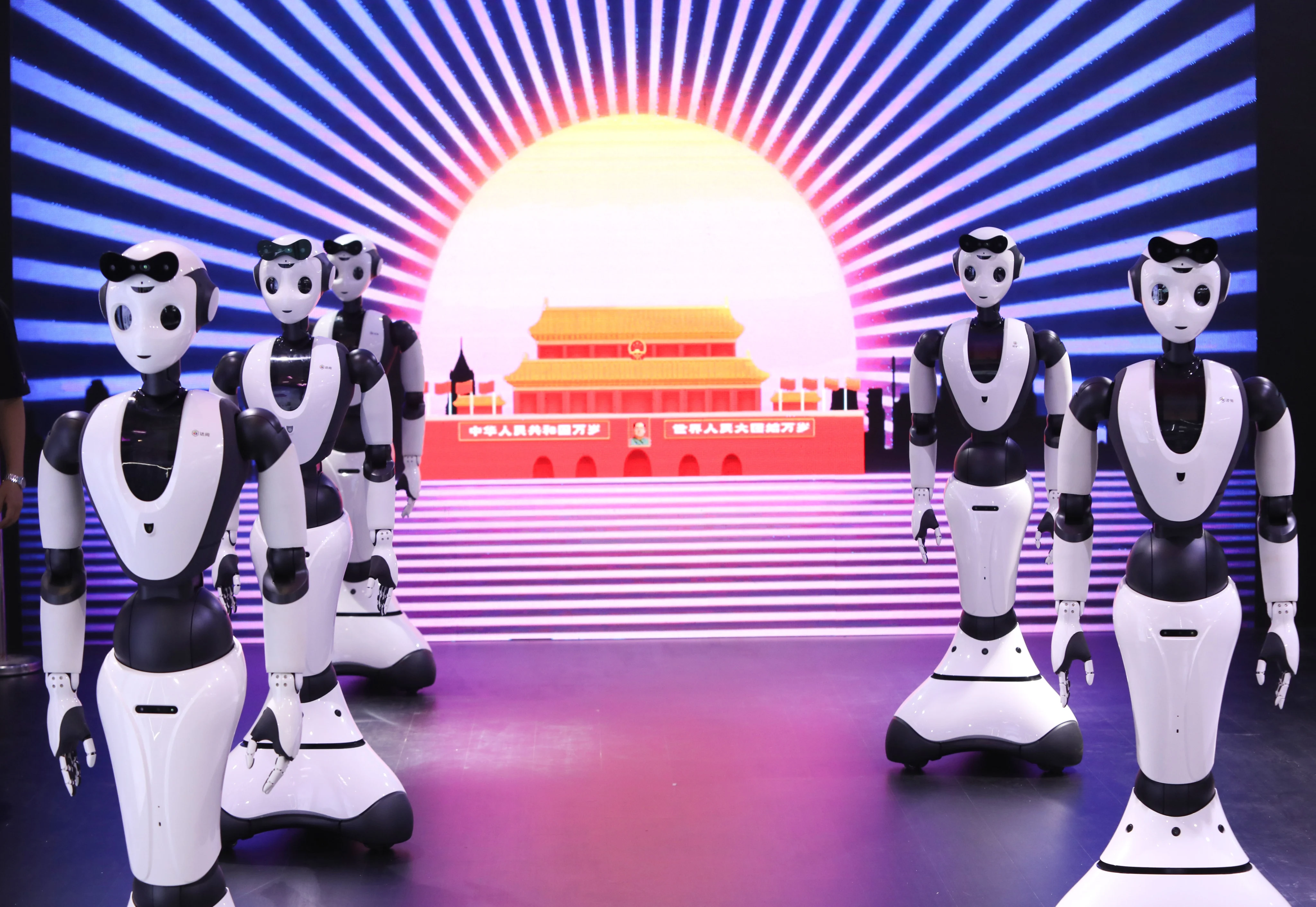
Photo: SCMP
From Viral Mishaps to Center Stage
Public perception of Chinese humanoid robots has shifted dramatically after their high-profile appearance at this year’s Spring Festival Gala, widely regarded as the most-watched television broadcast globally with an audience often exceeding 700 million viewers.
At the event, robots built by several domestic startups performed complex kung fu routines, synchronized dance sequences, and gymnastic maneuvers with notable stability and fluidity. The display marked a stark improvement from the 2025 show, when earlier models drew polite applause but struggled with balance during simple choreographed movements.
Throughout last year, public demonstrations including a widely reported robot marathon highlighted technical limitations such as overheating, navigation errors, and mechanical failures. The contrast between those incidents and this year’s polished performance underscores how quickly the technology is maturing.
Rapid Progress in Capability
Industry analysts say the pace of improvement has been unusually fast even by robotics standards. According to SemiAnalysis analyst Reyk Knuhtsen, the newest generation of humanoids shows markedly better balance, joint control, and motion planning.
Advances in actuators, battery density, and real-time perception software have enabled robots to execute human-like movements with greater precision. Demonstrations of aerial flips, coordinated object handling, and dynamic obstacle avoidance suggest the machines are moving closer to practical deployment scenarios beyond staged performances.
China’s Structural Advantage
China has built a commanding early lead in humanoid manufacturing. Research from Barclays estimates that out of roughly 15,000 humanoid robot installations worldwide in 2025, more than 85% were deployed in China, compared with about 13% in the United States.
This dominance is largely attributed to a vertically integrated supply chain. Domestic producers benefit from proximity to rare-earth processing, motor and sensor manufacturing, battery production, and large-scale electronics assembly. Government incentives, regional robotics clusters, and strong contract manufacturing capacity have also pushed production costs lower.
Key Players and Pricing Dynamics
One of the most visible companies at the gala was Unitree Robotics, whose humanoids are priced at around $13,500 for entry-level configurations. The firm has signaled plans to ship between 10,000 and 20,000 units in 2026, a scale that would significantly expand real-world deployments in logistics, inspection, and light industrial tasks.
In the United States, Tesla continues to develop its Optimus platform. CEO Elon Musk has suggested production costs could drop below $20,000 if manufacturing reaches one million units annually, though commercial pricing and timelines remain uncertain.
Analysts expect U.S. and European robotics firms to increase output over the next two years, but most forecasts indicate China will maintain a scale advantage through at least the late 2020s.
Economic Potential Beyond the Showmanship
While the gala highlighted acrobatic feats, researchers emphasize that the real economic value will come from task automation rather than spectacle. According to Omdia chief analyst Lian Jye Su, improvements in dexterity and force control could unlock applications in precision manufacturing, warehouse operations, and hazardous-environment work.
Potential use cases include assembly tasks requiring millimeter-level accuracy, equipment maintenance in confined spaces, and repetitive handling jobs where labor shortages persist. With global spending on service and industrial robotics projected to surpass $250 billion annually within the decade, even modest productivity gains could translate into substantial economic impact.
Remaining Technical Hurdles
Despite the momentum, significant challenges remain. Reliability in unpredictable environments, long-duration autonomy, and advanced reasoning capabilities are still under development.
Experts note that progress in AI models, particularly those enabling multi-step planning and contextual decision-making, will ultimately determine how useful humanoids become in sectors like healthcare, elder care, and domestic assistance. In other words, the competitive frontier is shifting from hardware engineering to software intelligence.
The Bigger Picture
China’s latest demonstrations have amplified global attention on the humanoid race, highlighting both the country’s manufacturing strength and the rapid evolution of robotics technology.
While eye-catching performances have helped shift public sentiment from skepticism to curiosity, the next phase will be defined by real-world deployments, cost reductions, and breakthroughs in machine intelligence. If current trends continue, humanoid robots could move from novelty to mainstream industrial tools sooner than many analysts predicted just a year ago.

Popular articles


Subscribe to unlock premium content
Africa’s Leap into Cashless Economies

The Rise of Livestream Shopping in Southeast Asia

The Niche Market for Upcycled Automotive Parts in Classic Car Restoration

Africa’s Leap into Cashless Economies
The Rise of Livestream Shopping in Southeast Asia
Africa’s Leap into Cashless Economies