China’s Chip Champions Surge as AI Demand and U.S. Curbs Reshape the Industry

China’s Chip Champions Surge as AI Demand and U.S. Curbs Reshape the Industry
By
Alina Sinclair
Last updated:
April 3, 2026
First Published:
April 3, 2026

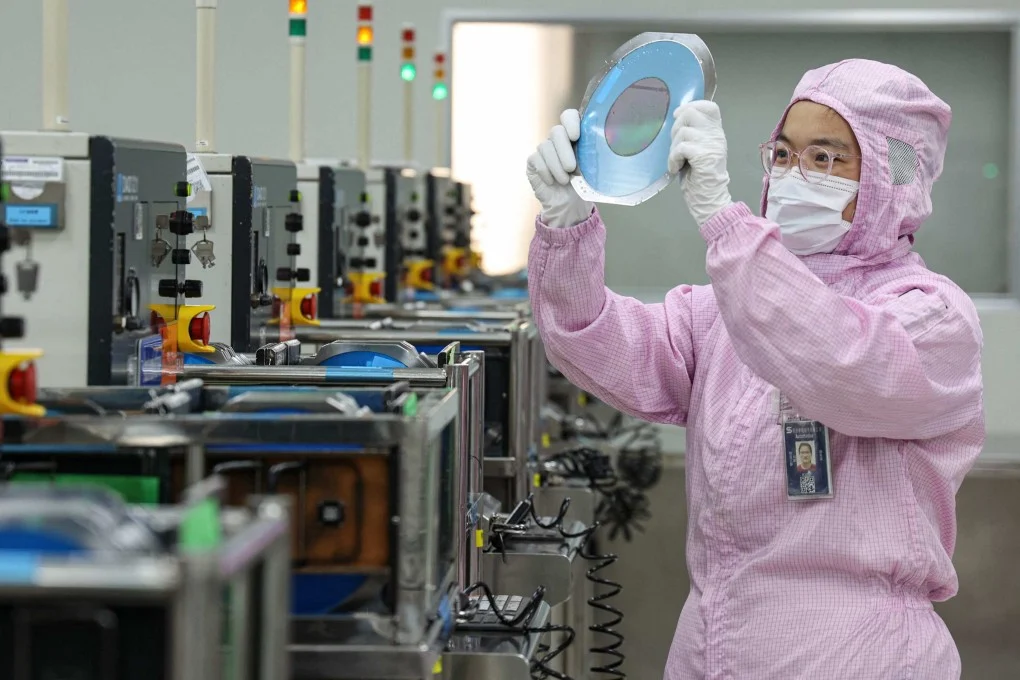
Photo: South China Morning Post
China’s semiconductor industry is entering a new phase of accelerated growth, with leading chipmakers posting record-breaking revenues as artificial intelligence demand surges and geopolitical pressures reshape global supply chains. From foundries to memory producers, domestic firms are capitalizing on a unique convergence of factors that is rapidly strengthening China’s position in the global chip race.
At the center of this growth is an unprecedented spike in demand for AI-related semiconductors. As Chinese tech giants aggressively expand their AI infrastructure—from data centers to large language models—the need for both advanced and mature-node chips has skyrocketed. This demand is not only fueling revenue growth but also reshaping procurement strategies, with companies increasingly prioritizing domestic suppliers.
Semiconductor Manufacturing International Corporation (SMIC), China’s largest chipmaker, reported a 16% year-on-year revenue increase for 2025, reaching a record $9.3 billion. Analysts expect this figure to climb beyond $11 billion in 2026, reflecting sustained demand momentum. Meanwhile, Hua Hong Semiconductor posted record quarterly revenue of $659.9 million and projected continued stability in the $650 million to $660 million range for upcoming quarters.
Emerging players are also experiencing explosive growth. GPU startup Moore Threads, positioning itself as a domestic alternative to global leaders, has forecast 2025 revenue between 1.45 billion and 1.52 billion yuan—representing a staggering 231% to 247% annual increase. This rapid expansion underscores how newer entrants are benefiting from both policy support and a growing domestic market hungry for compute power.
Several structural drivers are behind this record-setting performance. The rise of electric vehicles and industrial automation has sustained demand for mature-node chips, while AI applications—from cloud computing to edge devices—are pushing demand for advanced semiconductors to unprecedented levels. At the same time, global shortages in memory chips have driven prices higher, creating additional revenue tailwinds for producers.
China’s memory segment has emerged as a particularly strong growth engine. ChangXin Memory Technologies (CXMT), one of the country’s leading DRAM manufacturers, reportedly saw revenue surge over 130% year-on-year to exceed 55 billion yuan, or roughly $8 billion. This growth is being fueled by tight global supply and increasing demand for high-performance memory used in AI workloads and consumer electronics.
High-bandwidth memory (HBM), a critical component for AI computing, remains dominated by global leaders such as Samsung Electronics, SK Hynix, and Micron Technology. However, U.S. export restrictions on advanced memory technologies have created an opportunity for Chinese firms like CXMT to step in. Even earlier-generation products such as HBM2 and HBM2e are seeing strong domestic uptake, as companies prioritize availability over cutting-edge performance.
Geopolitical dynamics have played a decisive role in accelerating this transformation. U.S. export controls, particularly those introduced since 2022, have restricted China’s access to advanced chipmaking equipment and high-performance semiconductors. In response, Beijing has intensified its push for technological self-sufficiency, channeling investment and policy support into the domestic semiconductor ecosystem.
These restrictions have had an unintended consequence: they have effectively boosted local demand for Chinese-made chips. With limited access to products from companies like Nvidia, Chinese firms are increasingly turning to domestic alternatives, including solutions developed by Huawei and other local players. While these chips may not yet match the performance of global leaders, they are proving sufficient for many applications and are rapidly improving.
Beyond immediate revenue gains, this shift is also fostering long-term capability building. China’s expanding network of semiconductor fabrication plants is becoming a testing ground for process innovation, particularly in memory and mature-node technologies. Industry experts suggest that this growing expertise could eventually spill over into more advanced areas such as GPUs and next-generation logic chips.
Despite the impressive growth, significant challenges remain. Chinese chipmakers continue to lag behind global leaders in cutting-edge manufacturing. Companies like SMIC and Hua Hong are still unable to produce the most advanced chips at scale, largely due to restricted access to extreme ultraviolet (EUV) lithography machines from Dutch firm ASML. These tools are essential for manufacturing chips at the smallest nodes, where performance gains are most critical.
Efforts to develop domestic alternatives are underway, but replicating the sophistication of global semiconductor equipment ecosystems is an immense technical and financial challenge. Industry analysts note that while China has made meaningful progress in certain segments, gaps remain across the broader supply chain.
Another emerging concern is the risk of overcapacity, particularly in mature-node chips. As China ramps up production to reduce reliance on imports, supply could outpace demand in lower-end segments, potentially putting pressure on prices and margins in the coming years.
Looking ahead, the sustainability of China’s semiconductor boom will depend on its ability to move up the value chain. Advancements in high-bandwidth memory, AI accelerators, and next-generation process nodes will be critical if domestic players aim to compete globally rather than just meet local demand.
For now, however, the trajectory is clear. A combination of strong domestic demand, constrained global supply, and strategic policy support has created a powerful growth cycle for China’s chip industry—one that is reshaping not only its own tech landscape but also the broader dynamics of the global semiconductor market.
.webp)
Popular articles



Subscribe to unlock premium content
LEGO Boutique Flagship Stores Are Redefining Global Play

How Boutique Safari Camps in Kenya Are Creating Premium Eco Experiences

Discovering Southeast Asia’s Private Culinary Travel Boom

LEGO Boutique Flagship Stores Are Redefining Global Play
How Boutique Safari Camps in Kenya Are Creating Premium Eco Experiences
LEGO Boutique Flagship Stores Are Redefining Global Play