China’s AI Powerhouses Unveil Wave of New Models as Competition With the West Intensifies

China’s AI Powerhouses Unveil Wave of New Models as Competition With the West Intensifies
By
Rachel Steinberg
Last updated:
February 16, 2026
First Published:
February 16, 2026

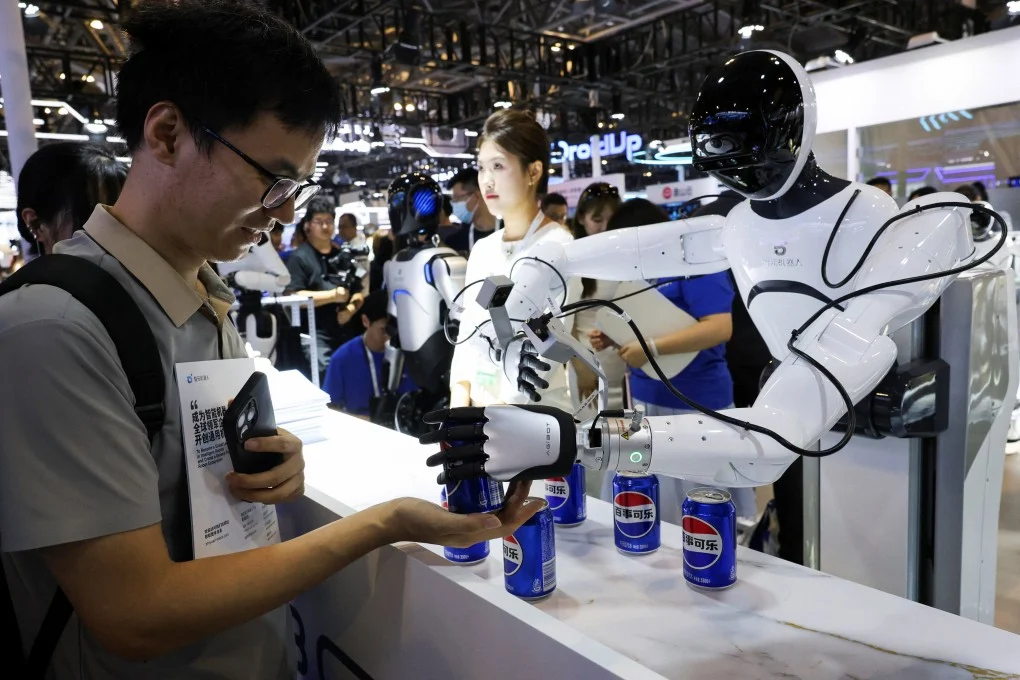
Photo: South China Morning Post
A Fast-Moving Week Highlights China’s AI Momentum
A series of high-profile artificial intelligence releases from China’s leading technology firms has underscored how quickly the country’s AI ecosystem is evolving — and how closely it is tracking developments in the United States.
Companies including Alibaba, ByteDance, and Kuaishou introduced new models spanning robotics intelligence, advanced video generation, and AI agents. Together, the launches signal a coordinated push to compete directly with Western offerings across multiple AI categories.
The rapid pace aligns with comments from Demis Hassabis, who recently noted that Chinese AI capabilities are only months behind their Western counterparts — a gap that appears to be narrowing.
Robotics Enters the Spotlight With Alibaba’s RynnBrain
One of the most notable announcements came from Alibaba’s research arm, which introduced RynnBrain, a model built specifically for “physical AI” — systems that allow robots to perceive and interact with real-world environments.
In demonstrations, robots powered by the model performed tasks such as identifying objects, counting items, and placing groceries into containers — actions that require complex visual recognition, spatial reasoning, and multi-step planning.
The model’s architecture reportedly incorporates temporal and spatial memory, enabling machines to track events over time and execute longer task sequences more reliably. This positions Alibaba in more direct competition with robotics initiatives from Nvidia and Google, both of which are investing heavily in embodied AI systems.
Industry observers say progress in this area is significant because robotics remains one of the hardest frontiers for AI, with real-world unpredictability making even simple actions technically demanding.
Video Generation Heats Up With Seedance and Kling
While robotics grabbed headlines, the most visible competition unfolded in AI video creation — a field that has advanced dramatically over the past two years.
ByteDance rolled out Seedance 2.0, a model capable of producing high-fidelity video from text prompts, images, or existing footage. Early demonstrations show improvements in motion realism, scene continuity, and cinematic composition, areas that historically limited AI video tools.
The model enters a competitive arena that includes systems like OpenAI’s Sora, with companies racing to deliver longer clips, better physics simulation, and integrated audio generation.
However, the launch has not been without controversy. Reports in Chinese media indicate that a feature allowing voice cloning from images was temporarily paused following concerns about consent and misuse — highlighting the governance challenges that accompany rapid innovation.
Kuaishou’s response came in the form of Kling 3.0, which offers longer video durations, improved visual consistency, and native multilingual audio. The company says the model will initially be available to subscribers before a broader rollout, reflecting a monetization strategy increasingly common across AI platforms.
Open-Source Models Drive Market Reactions
Beyond the major consumer-facing releases, several Chinese AI startups also introduced new large language models, reinforcing the country’s push into open-source ecosystems.
Zhipu AI launched its GLM-5 model, designed for coding and long-running agent workflows, while MiniMax unveiled an updated model with enhanced automation capabilities. Both announcements triggered notable stock gains, reflecting investor enthusiasm for AI infrastructure and platform plays.
Claims that some of these models approach the performance of systems from Anthropic and other Western developers illustrate the intensifying benchmark competition that now defines the global AI race.
Why This Week Matters for the Global AI Race
Taken together, the flurry of launches highlights three major trends shaping the industry.
First, competition is expanding beyond chatbots into specialized domains such as robotics, creative tools, and autonomous agents. Second, Chinese firms are increasingly pairing rapid iteration cycles with aggressive commercialization strategies, from subscription models to enterprise integrations. Third, regulatory and ethical scrutiny is rising in parallel, particularly around synthetic media and identity replication.
The result is a more multipolar AI landscape, where innovation is distributed across regions rather than concentrated in a single market.
The Road Ahead
With global spending on AI infrastructure projected to reach hundreds of billions of dollars over the next decade, the stakes for technological leadership remain high. Continued breakthroughs in video realism, robotic autonomy, and agent-based systems suggest that competition between Chinese and Western developers will only intensify.
For businesses and investors alike, the message from this week is clear: China’s AI sector is not just keeping pace — it is actively shaping the next phase of the industry’s evolution.

Popular articles


Subscribe to unlock premium content
Electrifying the Streets of Vietnam

Sky-High Living in Singapore

Sweden’s Startup Visa Sparks a $200 Million Entrepreneurial Boom

Electrifying the Streets of Vietnam
Sky-High Living in Singapore
Electrifying the Streets of Vietnam