
Belarus Releases Nobel Laureate and Top Opposition Figures in Sanctions-for-Prisoners Deal With Washington

Belarus Releases Nobel Laureate and Top Opposition Figures in Sanctions-for-Prisoners Deal With Washington
By
Rachel Steinberg
Last updated:
December 15, 2025
First Published:
April 25, 2026

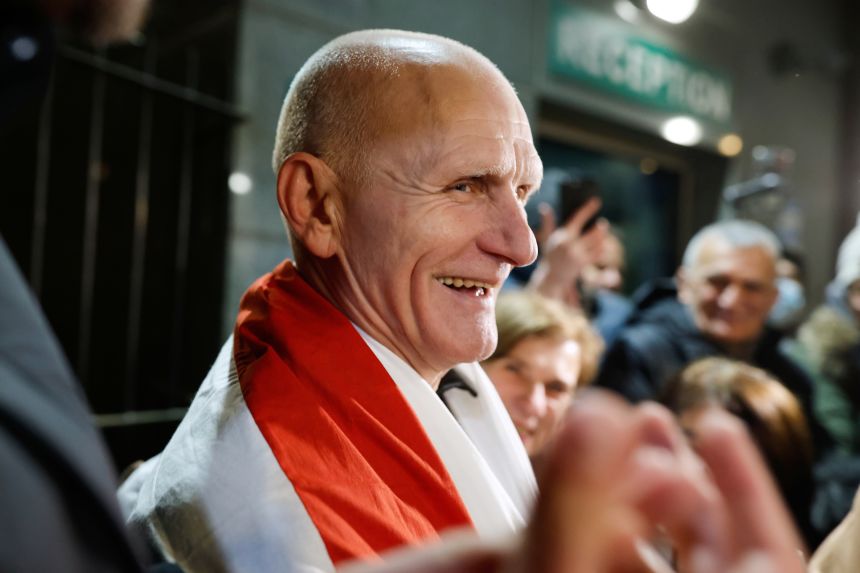
Photo: CNN
A landmark prisoner release after U.S. negotiations
Belarusian President Alexander Lukashenko has released 123 prisoners, including Nobel Peace Prize laureate Ales Bialiatski and prominent opposition leader Maria Kalesnikava, following two days of direct negotiations with an envoy representing U.S. President Donald Trump. The move marks the largest mass release of political detainees in Belarus in years and signals a notable shift in relations between Minsk and Washington after a prolonged diplomatic freeze.
The releases came in exchange for a U.S. decision to lift sanctions on Belarusian potash exports. Potash, a key ingredient in global fertilizer production, is one of Belarus’s most valuable exports, with the country historically ranking among the world’s top producers alongside Canada and Russia.
Who was freed and where they went
Officials said nine of the released prisoners were transferred to Lithuania, while 114 were taken by bus to Ukraine. Among them was Ales Bialiatski, co-recipient of the 2022 Nobel Peace Prize, who had been imprisoned since July 2021 for his work documenting political repression and defending detainees through the Viasna human rights group.
Visibly older but smiling, Bialiatski embraced exiled opposition leader Sviatlana Tsikhanouskaya upon arriving at the U.S. embassy in Lithuania. He described spending his final night in prison sharing a crowded cell with nearly 40 people and said freedom still felt unreal.
Despite his release, Bialiatski stressed that the broader human rights struggle in Belarus is far from over. He noted that more than a thousand people remain behind bars for political reasons, underscoring that the conditions which led to his imprisonment have not fundamentally changed.
Opposition figures reunite after years of separation
Maria Kalesnikava, a central figure in the mass protests that followed Belarus’s disputed 2020 election, was also among those freed. She was seen embracing fellow opposition politician Viktar Babaryka after crossing into Ukraine. Babaryka confirmed that his son remains imprisoned in Belarus, highlighting that the release, while significant, did not resolve all outstanding cases.
Kalesnikava’s sister, Tatsiana Khomich, said the family had feared Maria might refuse to leave the country despite her freedom. After speaking with her by phone, Khomich described a sense of emotional relief, saying the past five years of separation suddenly felt compressed into a single moment.
Sanctions, potash, and economic leverage
The U.S. decision to lift sanctions on potash is central to the deal. Sanctions imposed by the United States and the European Union after the 2020 crackdown sharply curtailed Belarus’s access to global fertilizer markets, costing the state billions of dollars in lost export revenue. Restrictions were tightened further after Belarus allowed its territory to be used as a staging ground for Russia’s invasion of Ukraine in 2022.
U.S. officials have framed the engagement with Lukashenko as both a humanitarian effort and a strategic attempt to reduce Belarus’s dependence on Moscow. By offering targeted economic relief tied to concrete actions, Washington appears to be testing whether selective sanctions easing can produce measurable outcomes.
A strategic gamble to loosen Moscow’s grip
American officials have acknowledged that outreach to Lukashenko is partly aimed at creating distance, however limited, between Minsk and Russian President Vladimir Putin. Belarus has long been one of Russia’s closest allies, politically, militarily, and economically, and any recalibration of that relationship would carry regional implications.
Trump’s envoy said the prisoner releases followed substantive discussions covering a broader agenda that included economic issues and future engagement. The talks suggest Washington sees at least a narrow opening for progress, even as skepticism remains high among Belarusian opposition groups.
Opposition reaction and cautious support
Exiled opposition leaders welcomed the releases while emphasizing that sanctions pressure remains essential. Tsikhanouskaya said the exchange demonstrated that sanctions can be effective when used to secure humanitarian outcomes, but argued that European Union restrictions should stay in place to drive systemic political change, accountability, and an end to Belarus’s role in the war in Ukraine.
Belarusian authorities have historically denied the existence of political prisoners, with Lukashenko frequently labeling detainees as criminals or extremists. As recently as this year, he publicly questioned why he should release people he views as threats to the state.
What comes next
Human rights monitors estimate that more than 1,200 political prisoners remained in Belarus even after Saturday’s releases. The U.S. embassy in Lithuania said Washington remains open to further engagement if it leads to additional releases and advances U.S. interests.
While the deal represents a rare breakthrough, analysts caution that it does not signal a broader political liberalization in Belarus. Instead, it highlights how trade-linked sanctions, particularly those targeting strategic commodities like potash, continue to play a decisive role in shaping negotiations between authoritarian governments and Western powers.
.webp)
Popular articles



Subscribe to unlock premium content
Crypto in the Arctic
Iceland’s Seaweed Revolution
Private Island Rentals for Corporate Retreats Hit $1 Billion

Crypto in the Arctic
Iceland’s Seaweed Revolution
Crypto in the Arctic


