Asian Stocks Climb as BOJ Holds Rates and Global Tensions Ease

Asian Stocks Climb as BOJ Holds Rates and Global Tensions Ease
By
Rachel Steinberg
Last updated:
January 23, 2026
First Published:
January 23, 2026

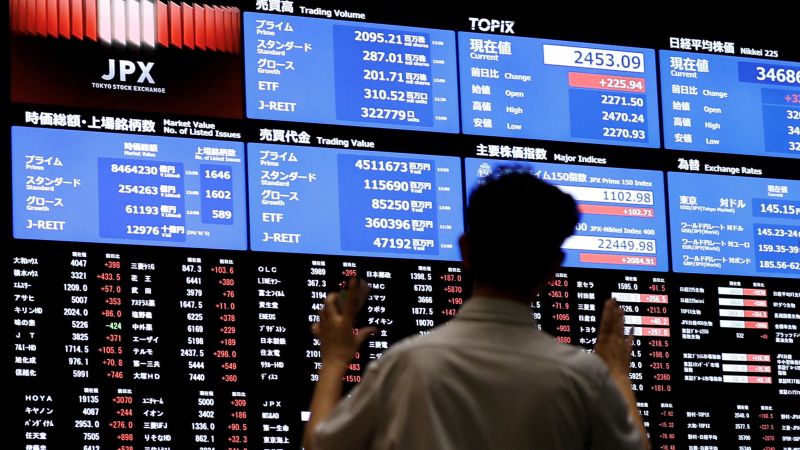
Photo: CNN
Asian equity markets ended mostly higher on Friday, buoyed by a calmer geopolitical backdrop and renewed confidence from Wall Street, as investors assessed the Bank of Japan’s decision to keep interest rates unchanged ahead of a closely watched national election.
The cautiously positive tone reflected a balance between relief over policy stability in Japan and ongoing scrutiny of inflation, bond market volatility, and global tech sector headwinds.
BOJ decision anchors market sentiment
Japan’s central bank left its benchmark interest rate steady at 0.75 percent, opting for continuity as the country heads toward a snap election on Feb. 8. Prime Minister Sanae Takaichi dissolved the Lower House earlier in the day, setting the stage for her first electoral test since taking office.
Takaichi has been vocal in her support for accommodative monetary policy and aggressive fiscal measures to support growth, a stance that has kept investors alert to potential political pressure on the BOJ’s normalization path.
Markets broadly welcomed the rate hold, viewing it as a signal that the central bank remains focused on gradualism despite rising bond yields and a volatile currency.
Bond market sends mixed signals
Japanese government bond yields moved sharply across the curve following the BOJ decision. The 40-year yield fell more than 4 basis points to around 3.95 percent after touching a record high earlier in the week, offering some relief to investors concerned about long-term fiscal sustainability.
In contrast, shorter-dated yields edged higher. The 10-year JGB yield rose roughly 2 basis points to about 2.26 percent, while the 20-year yield ticked up slightly to just over 3.20 percent. The divergent moves underscore continued uncertainty over the timing and pace of future rate hikes.
HSBC said it expects the BOJ’s next 25-basis-point increase to come in July 2026, though it cautioned that renewed yen weakness could accelerate that timeline. The bank flagged April as a possible alternative window, coinciding with the BOJ’s quarterly Outlook report and greater clarity from annual Shunto wage negotiations. Another hike later in 2026 remains a possibility if inflation pressures persist.
Inflation data reinforces cautious outlook
Japan’s latest inflation figures provided additional context for the BOJ’s decision. Headline consumer inflation slowed sharply to 2.1 percent in December, its lowest level since March 2022, while core inflation came in at 2.4 percent year on year, broadly in line with expectations.
The data suggests that while price pressures remain above the BOJ’s 2 percent target, momentum is easing, giving policymakers room to wait for clearer signs of sustained wage-driven inflation before tightening further.
Equity markets across the region
Japanese stocks posted moderate gains. The Nikkei 225 rose 0.3 percent, while the broader Topix advanced 0.6 percent, supported by financials and domestic cyclicals.
South Korean markets outperformed, with the Kospi climbing 0.8 percent and the tech-heavy Kosdaq surging 1.86 percent, reflecting selective buying after recent volatility.
In Greater China, performance was mixed. Hong Kong’s Hang Seng Index added 0.27 percent, while mainland China’s CSI 300 slipped 0.29 percent as investors weighed lingering concerns about growth and property-sector stress.
Australia’s S&P/ASX 200 edged up 0.16 percent, supported by gains in mining and financial stocks.
Tech sector weighs on sentiment
Some Asian technology names came under pressure following a sharp selloff in U.S. semiconductor stocks. Shares of Intel plunged 13 percent in after-hours trading after issuing softer-than-expected guidance for the current quarter, despite beating earnings estimates.
The weakness rippled through Asia. SoftBank Group dropped more than 4 percent, Lasertec slid nearly 6 percent, and Tokyo Electron fell over 1 percent. In South Korea, memory-chip maker SK Hynix declined about 1 percent, reflecting broader caution around the global chip cycle.
Wall Street sets a supportive backdrop
Overnight gains in U.S. equities helped underpin sentiment across Asia. Major Wall Street benchmarks extended their rally as geopolitical tensions eased and investors looked past recent tariff-related headlines.
The Dow Jones Industrial Average rose 306.78 points, or 0.63 percent, to close at 49,384.01, recovering from losses earlier in the week triggered by President Donald Trump’s announcement of new tariffs on Europe.
The S&P 500 advanced 0.55 percent to 6,913.35, while the Nasdaq Composite gained 0.91 percent to finish at 23,436.02, supported by strength in heavyweight technology stocks including Nvidia, Microsoft, and Meta Platforms.
Looking ahead
With Japan’s election approaching and global markets increasingly sensitive to central bank signals, investors are likely to remain focused on currency moves, bond yields, and wage data in the weeks ahead. For now, the BOJ’s decision to stay on hold has provided short-term stability, helping Asian markets push higher even as underlying risks remain firmly in view.
.webp)
Popular articles



Subscribe to unlock premium content
Zara’s Hyper-Fast Fashion Supply Chain Is Changing Global Retail

The Rise of Apple Stores as Experiential Brand Centers Worldwide

Boutique Eco-Lodges in Costa Rica Redefining Ultra-Luxury Travel

Zara’s Hyper-Fast Fashion Supply Chain Is Changing Global Retail
The Rise of Apple Stores as Experiential Brand Centers Worldwide
Zara’s Hyper-Fast Fashion Supply Chain Is Changing Global Retail