Asian Defense Stocks Surge as Hanwha Aerospace Jumps on Rising Geopolitical Risk

Asian Defense Stocks Surge as Hanwha Aerospace Jumps on Rising Geopolitical Risk
By
David Goldfarb
Last updated:
January 9, 2026
First Published:
April 25, 2026

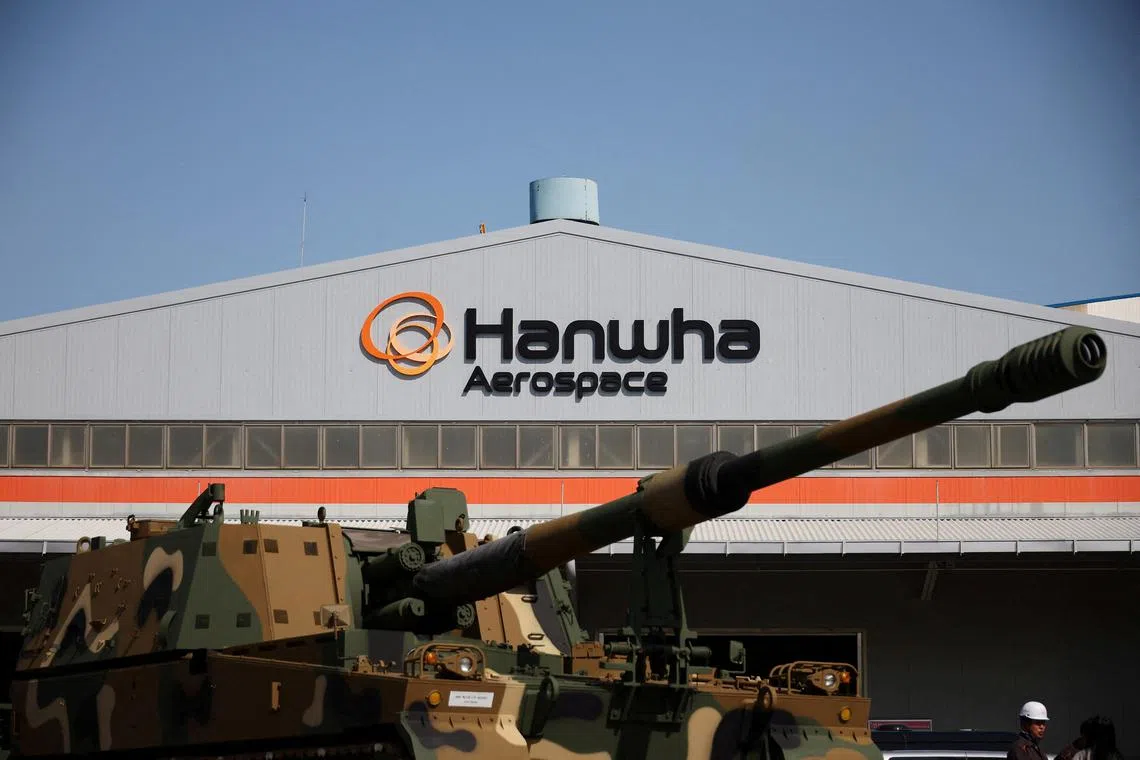
Photo: The Straits Times
Defense Shares Rally Across Asia
Defense stocks across Asia moved sharply higher on Friday, driven by renewed geopolitical uncertainty and increased investor demand for security and aerospace names. The rally followed heightened global tensions after a U.S. operation targeting Venezuelan leadership and renewed political rhetoric from U.S. President Donald Trump regarding Greenland, both of which reinforced expectations of sustained defense spending.
South Korea’s Hanwha Aerospace was the standout performer, surging as much as 11 percent during the session. The stock’s sharp move reflected its growing role as a key supplier of defense systems and aerospace components, as well as rising international orders tied to global military modernization efforts.
Other South Korean defense names followed suit. Poongsan climbed more than 6 percent, while Korea Aerospace Industries gained around 5 percent, extending a strong run for the sector this year.
In Japan, defense-linked industrials also advanced. Kawasaki Heavy Industries rose 2.29 percent, while IHI added 2.14 percent, supported by expectations of higher defense budgets and long-term government contracts.
Asian Markets Trade Mixed
Broader equity markets across Asia were mixed as investors weighed sector-specific gains against macroeconomic signals and global market developments.
In mainland China, the CSI 300 edged up 0.1 percent after official data showed consumer inflation rose 0.8 percent year on year in December, the fastest pace in nearly three years. The figure matched market expectations and followed a 0.7 percent increase in November. Producer prices declined 1.9 percent from a year earlier, a smaller drop than the anticipated 2 percent fall, suggesting some easing in factory-gate deflation.
Hong Kong’s Hang Seng Index was largely unchanged, reflecting a cautious tone among investors as concerns over growth and property-sector stress continued to cap gains.
Japan’s equity markets outperformed. The Nikkei 225 advanced 1.24 percent, while the broader Topix index rose 0.62 percent, supported by strong corporate earnings and renewed interest in cyclical and industrial stocks.
Corporate Earnings Lift Japanese Stocks
Japanese retail heavyweight Fast Retailing, the operator of Uniqlo, jumped more than 7 percent after reporting that quarterly operating profit rose by roughly one-third. The company also raised its full-year outlook, citing strong global demand that helped offset the impact of U.S. tariffs.
Management said the company remains on track for a fifth consecutive year of profit growth, supported by resilient sales in China and rapid expansion across North America and Europe, reinforcing investor confidence in Japan’s consumer and export-driven sectors.
South Korea and Australia See Diverging Moves
In South Korea, the benchmark Kospi index rose 0.67 percent, supported by gains in defense and industrial shares, while the tech-heavy Kosdaq ended flat as investors remained selective.
Australia’s S&P/ASX 200 slipped slightly below the flatline. Mining stocks weighed on the index after Rio Tinto shares fell more than 5 percent. The decline came after the company confirmed it had entered early-stage takeover discussions with rival Glencore. If completed, the deal would create a mining powerhouse valued at nearly $207 billion, but investors appeared cautious about execution risks and regulatory scrutiny.
U.S. Market Signals Influence Regional Sentiment
U.S. equity futures were little changed during early Asian trading hours as investors awaited key December jobs data and a potential U.S. Supreme Court ruling on the legality of President Trump’s tariffs. A ruling could have significant implications for trade policy, inflation expectations, and the broader fiscal outlook.
Overnight in the United States, markets showed clear sector rotation. The Dow Jones Industrial Average rose 270.03 points, or 0.55 percent, closing at 49,266.11, while the Nasdaq Composite fell 0.44 percent to 23,480.02 as investors reduced exposure to technology stocks. The S&P 500 edged up 0.01 percent to finish at 6,921.46.
Among the S&P 500’s 11 sectors, information technology was the weakest performer, dropping more than 1 percent, underscoring the shift toward industrials, defense, and value-oriented names.
Outlook
The sharp rally in Asian defense stocks highlights how quickly investor sentiment can pivot in response to geopolitical developments. With global security concerns remaining elevated and governments signaling sustained defense spending, the sector is likely to stay in focus. At the same time, mixed economic data, evolving trade policy risks, and sector rotation in U.S. markets suggest volatility across Asian equities may persist in the near term.
.webp)
Popular articles



Subscribe to unlock premium content
The Hidden World of Ultra-Rare Seaweed Farming

Riding Waves and Wealth in Bali

The Market for Renting Private Libraries Where Only Rare, Unpublished Manuscripts Exist

The Hidden World of Ultra-Rare Seaweed Farming
Riding Waves and Wealth in Bali
The Hidden World of Ultra-Rare Seaweed Farming