Amazon Acquires Robotics Startup Rivr to Advance AI-Powered Last-Mile Delivery

Amazon Acquires Robotics Startup Rivr to Advance AI-Powered Last-Mile Delivery
By
Junia Wells
Last updated:
March 20, 2026
First Published:
March 20, 2026

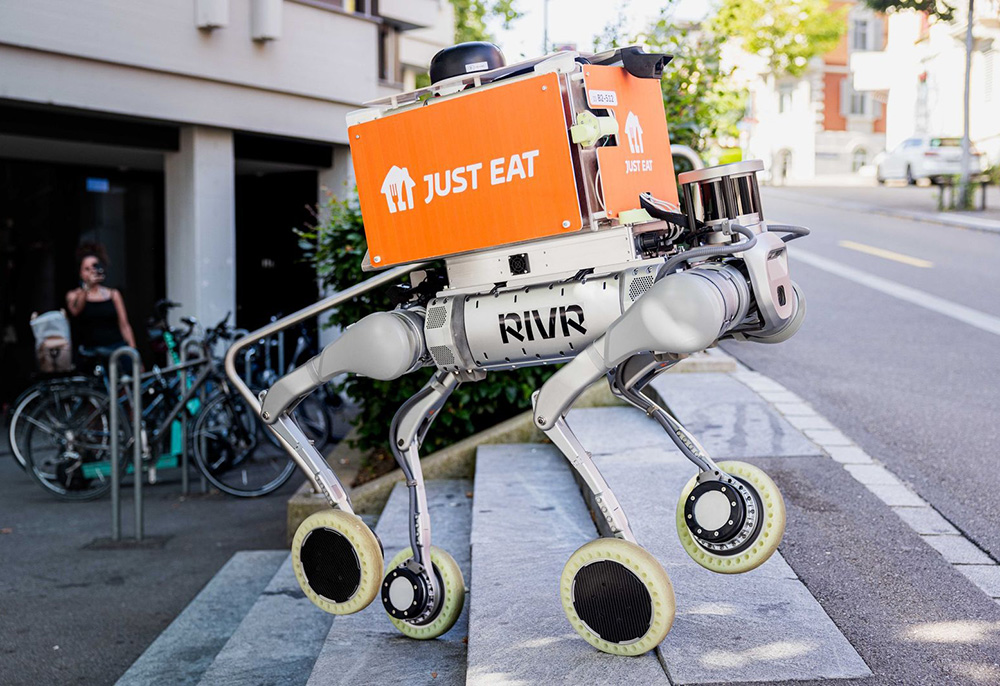
Photo: The Robot Report
Amazon has taken another major step toward automating its logistics ecosystem with the acquisition of Swiss robotics startup Rivr, a company known for developing four-legged delivery robots designed to operate in real-world urban environments. While financial terms of the deal were not disclosed, the move signals Amazon’s growing focus on enhancing efficiency and safety in the final stage of delivery.
The acquisition, which was quietly completed earlier in the week, was communicated to Amazon’s vast network of third-party delivery contractors through an internal notice. These contractors handle the critical “last mile” of delivery, transporting millions of packages daily from warehouses directly to customers’ homes.
At the center of this strategy is Rivr’s unique robotic platform. The company has built compact, four-legged robots equipped with wheels, combining stability and mobility to navigate sidewalks, stairs, and uneven terrain. Amazon plans to test how these robots can assist delivery associates by carrying packages from vans to customers’ doorsteps, reducing physical strain and improving delivery speed.
The company emphasized that the technology is not intended to replace workers but to work alongside them. By offloading repetitive and physically demanding tasks, Amazon aims to improve safety outcomes for drivers while enhancing the overall customer experience. Internal projections suggest that even a modest efficiency gain of 10% to 15% in last-mile operations could translate into billions of dollars in annual savings, given the scale of Amazon’s logistics network.
This move builds on more than a decade of aggressive investment in automation. Amazon’s robotics journey accelerated after its $775 million acquisition of Kiva Systems in 2012, which laid the foundation for its dedicated robotics division. Today, the company operates over 1 million robots across its global fulfillment network, handling tasks ranging from sorting and packing to inventory management.
Despite these advancements, the last mile remains one of the most complex and expensive parts of the delivery chain, often accounting for over 50% of total shipping costs. Factors such as traffic congestion, labor intensity, and unpredictable delivery environments make it difficult to fully automate. This is where Rivr’s technology could play a transformative role, bridging the gap between warehouse automation and doorstep delivery.
Amazon’s relationship with Rivr did not begin with this acquisition. The company had previously backed the startup through its $1 billion Industrial Innovation Fund, launched in 2022 to support emerging technologies in logistics, robotics, and supply chain optimization. Additionally, Bezos Expeditions, the investment arm of Amazon founder Jeff Bezos, participated in Rivr’s $22 million seed funding round. Rivr, formerly known as Swiss-Mile, has since evolved its technology to focus specifically on last-mile delivery solutions.
Amazon has made it clear that the integration of Rivr’s robots is still in its early stages. The company plans to conduct real-world testing in collaboration with delivery partners, gathering operational data and feedback before scaling the technology. Early pilot programs are expected to focus on dense urban areas and suburban neighborhoods, where delivery efficiency gains could be most impactful.
The broader context of this acquisition highlights a larger industry shift. Logistics and e-commerce companies are increasingly turning to artificial intelligence and robotics to address rising labor costs, faster delivery expectations, and growing order volumes. Competitors are also exploring autonomous delivery solutions, including drones and self-driving vehicles, but Amazon’s hybrid approach—augmenting human workers with robotics—could offer a more practical near-term path.
At the same time, developments around Jeff Bezos’ broader investment strategy underscore the scale of ambition in this space. Reports suggest early-stage discussions around a potential $100 billion investment fund focused on acquiring and modernizing manufacturing companies using AI and automation technologies. While separate from Amazon’s core operations, such initiatives reflect a wider push toward integrating advanced technologies across industrial sectors.
For Amazon, the Rivr acquisition is not just about robots. It is part of a long-term vision to create a fully optimized, AI-driven logistics network where every stage—from warehouse to doorstep—is enhanced by automation. If successful, this approach could redefine delivery economics and set a new standard for efficiency in global e-commerce.
.webp)
Popular articles



Subscribe to unlock premium content
Rolling the Dice in Style
Mind Games and City Streets
Indie Cinema Comes Home

Rolling the Dice in Style
Mind Games and City Streets
Rolling the Dice in Style