
Trump’s Iran Tariff Threat Puts U.S.–China Trade Truce on Shaky Ground

Trump’s Iran Tariff Threat Puts U.S.–China Trade Truce on Shaky Ground
By
Rachel Steinberg
Last updated:
January 14, 2026
First Published:
April 25, 2026

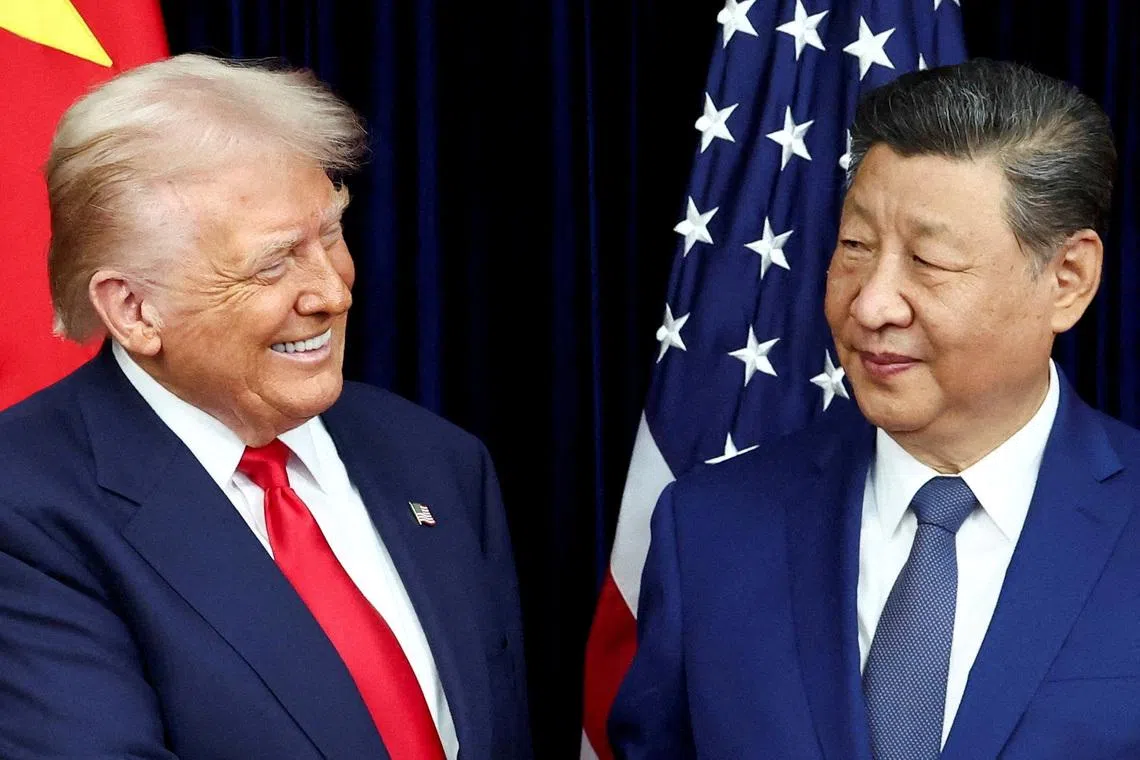
Photo: The Straits Times
President Donald Trump’s renewed tariff threat aimed at countries doing business with Iran has injected fresh uncertainty into already fragile U.S.–China trade relations, raising the risk of renewed escalation between the world’s two largest economies. Analysts warn the move could quickly unravel the interim trade truce reached just months ago and reopen old wounds from the previous trade war.
Speaking late Monday in the U.S., Trump said Washington would impose a 25% tariff on imports from any country that conducts business with Iran, describing the measure as “effective immediately” in a post on Truth Social. The announcement came at a sensitive moment for U.S.–China relations, with both sides attempting to stabilize ties ahead of high-level meetings expected later this year.
A fragile deal under pressure
The tariff threat arrives less than three months after the U.S. and China reached an interim trade agreement in late October. That deal included a partial rollback of punitive U.S. tariffs on Chinese goods and a pause by Beijing on its sweeping rare earth export controls, which are critical to global technology and defense supply chains.
At the time, the agreement was seen as a modest but important step toward de-escalation. Tariffs on Chinese exports to the U.S. were set to stabilize at roughly 47.5%, down from peaks exceeding 100% during the height of trade tensions earlier in the year.
Trump’s latest move now risks reversing that progress. Deborah Elms, head of trade policy at the Hinrich Foundation, described the proposed 25% tariff as a “major escalation” compared with existing trade barriers. She warned that similar tactics in the past rapidly spiraled out of control, driving cumulative tariff levels as high as 145%.
China pushes back as tensions rise
China responded swiftly, condemning what it called “illicit unilateral sanctions and long-arm jurisdiction.” A spokesperson for the Chinese Embassy in Washington said Beijing “firmly opposes” the move and would take “all necessary measures” to protect its interests.
Beijing’s concerns are closely tied to its economic relationship with Iran, particularly in energy markets. As the world’s largest oil importer, China has long purchased crude from Iran and other U.S.-sanctioned producers, providing a critical revenue stream for Tehran.
According to estimates from Kpler, Iranian crude shipments to China more than doubled between 2017 and 2024 to over 1.2 million barrels per day. As recently as 2022, fuel made up more than half of China’s imports from Iran, based on World Bank data.
However, that trade has already begun to slow. Chinese imports from Iran were on track to fall for a fourth consecutive year in 2025, dropping 28% to $2.9 billion in the January-to-November period, according to official customs figures. Full-year data is expected shortly.
Despite the slowdown, Chinese officials and academics have made clear that Beijing is unlikely to significantly alter its Iran policy due to U.S. pressure. Cui Shoujun, a professor of international studies at Renmin University of China, said Beijing would not reduce economic cooperation with Iran in response to tariff threats, warning that the situation has entered a “very dangerous period.”
Agriculture and energy caught in the crossfire
Beyond geopolitics, the tariff threat carries tangible economic risks. Analysts caution that renewed trade hostilities could derail U.S. agricultural exports, particularly soybeans, which were among the hardest-hit sectors during the last trade war.
China remains the world’s largest soybean importer, and U.S. farmers only recently began regaining lost market share after years of reduced access. A fresh round of tariffs could once again push Beijing toward alternative suppliers such as Brazil, cutting off a critical export channel for American producers.
Energy markets are also closely watching developments. Cui suggested Trump’s heightened focus on Iran is partly driven by global energy dynamics, noting Iran’s oil production capacity exceeds that of Venezuela at a time when U.S. electricity demand is surging due to the rapid expansion of AI data centers.
Diplomacy at risk ahead of key meetings
The tariff threat also complicates upcoming diplomatic engagements. Trump is expected to visit Beijing in April, with a reciprocal visit by Chinese President Xi Jinping later in the year. These meetings were widely viewed as opportunities to reinforce the one-year trade truce agreed after Trump and Xi met in South Korea last fall.
Dan Wang, China director at Eurasia Group, said Trump’s move risks eroding the limited trust built since that meeting. She noted that both the Chinese public and government already view Trump as unpredictable, a perception that complicates negotiations.
Historically, both Washington and Beijing have used pressure tactics ahead of major summits. Prior to the October Trump-Xi meeting, China expanded rare earth export controls and launched antitrust investigations into U.S. chipmaker Qualcomm, while the U.S. reportedly considered new restrictions on chip-design software exports to China.
Wang expects similar tit-for-tat measures in the coming months, potentially including sanctions on U.S. firms linked to Taiwan arms sales or new antitrust probes targeting American technology companies operating in China.
Legal uncertainty clouds the outlook
Adding another layer of uncertainty, the U.S. Supreme Court is expected to rule this week on the legality of Trump’s use of tariffs under existing trade laws. The decision could determine whether the administration has broad authority to impose such duties or faces new legal constraints.
Some analysts believe the Iran-linked tariff threat may reflect shifting political priorities rather than a calculated strategy toward China. Scott Kennedy, a senior adviser at the Center for Strategic and International Studies, said the move appears driven more by Trump’s changing focus than by a deliberate effort to gain leverage ahead of the April summit.
Still, Kennedy warned that Beijing is prepared for escalation. China, he said, “will not hesitate to retaliate in ways that impose serious costs on the U.S.” and has planned for multiple scenarios, including renewed trade conflict.
As markets, exporters, and diplomats assess the fallout, one thing is clear: the fragile calm in U.S.–China trade relations is once again under threat, with global economic consequences hanging in the balance.
.webp)
Popular articles



Subscribe to unlock premium content
How Finland Uses Ice Swimming Festivals to Boost Winter Tourism and Local Economies

The Boom of Luxury Personal Libraries Renting Rare Books to the Ultra-Wealthy

Why Bhutan’s Hand-Woven Textiles Are Gaining Global Collector Value

How Finland Uses Ice Swimming Festivals to Boost Winter Tourism and Local Economies
The Boom of Luxury Personal Libraries Renting Rare Books to the Ultra-Wealthy
How Finland Uses Ice Swimming Festivals to Boost Winter Tourism and Local Economies


