Trump’s “Battleship Revival” Collides With Modern Naval Warfare

Trump’s “Battleship Revival” Collides With Modern Naval Warfare
By
Leah Rosenfeld
Last updated:
December 29, 2025
First Published:
December 29, 2025

A Bold Vision Meets Immediate Skepticism
President Donald Trump has unveiled plans for a new “Trump class” battleship, describing it as the fastest, largest, and most powerful surface combatant ever conceived. According to Trump, the ship would anchor a new “golden fleet” and restore unquestioned American naval dominance while projecting fear across rival militaries.
Defense analysts, however, were quick to push back. Many described the proposal as unrealistic, strategically outdated, and financially unsustainable. Several experts labeled it a prestige driven concept rather than a viable military platform, arguing that battleships have been obsolete for decades.
Why Battleships Fell Out of Favor
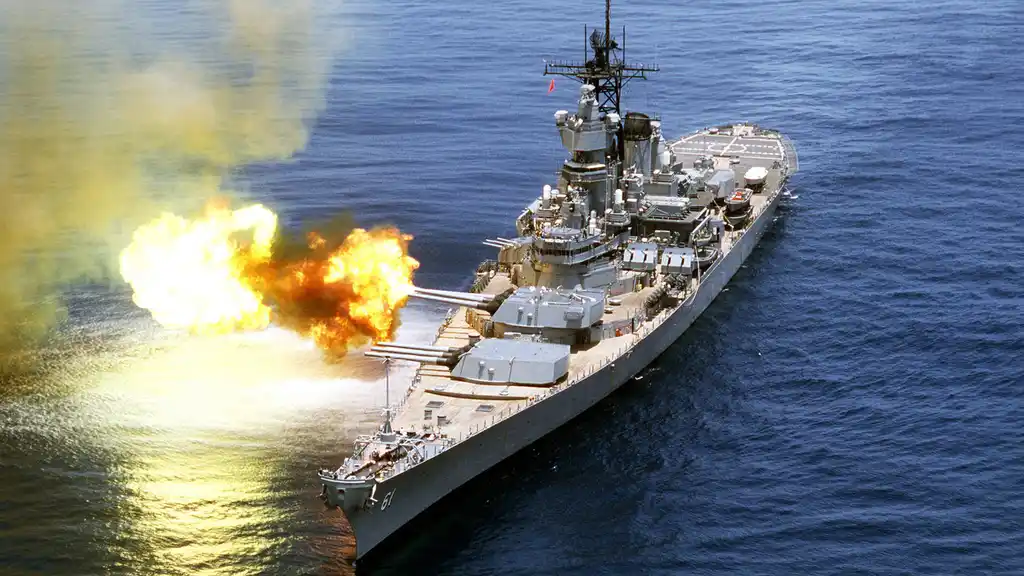
Battleships once symbolized naval supremacy, dominating oceans through sheer firepower and armor. That era ended with the rise of aircraft carriers, submarines, and long range precision missiles. The United States built its last battleship more than 80 years ago, and the Navy retired its final Iowa class vessels nearly 30 years ago.
The last time battleships saw combat was during the 1991 Gulf War, when modernized Iowa class ships provided shore bombardment. Even then, they played a limited role compared to air power and missile platforms. Since that point, naval doctrine has moved decisively away from concentrated surface firepower.
Strategic Conflicts With Modern Naval Doctrine
According to Mark Cancian of the Center for Strategic and International Studies, the Trump class concept runs directly against the Navy’s core strategy of distributed lethality. That approach spreads firepower across numerous smaller platforms to reduce vulnerability and improve survivability in missile heavy conflicts.
A single massive surface combatant, no matter how advanced, would concentrate risk rather than mitigate it. Analysts argue such a ship would become a high value target, drawing enemy attention in any conflict involving China, Russia, or other advanced missile powers.
Cancian stated bluntly that the ship would never reach operational status, predicting that timelines, costs, and shifting political leadership would kill the program long before launch.
Size, Prestige, and Vulnerability
Bernard Loo of Singapore’s S. Rajaratnam School of International Studies compared the proposal to World War II era super battleships like Japan’s Yamato and Musashi. Both were engineering marvels and symbols of national pride, yet were sunk by carrier based aircraft before shaping the outcome of the war.
The Trump class is reportedly envisioned at more than 35,000 tons and over 840 feet long, making it larger than many Cold War era cruisers and approaching the scale of smaller aircraft carriers. Experts warn that its size alone would make it a prime missile target, particularly in contested regions such as the South China Sea or Western Pacific.
Loo described the ship as a “bomb magnet,” noting that prestige assets often attract disproportionate enemy focus.
Symbolism Versus Combat Reality
Some analysts believe Trump is drawn to the historical symbolism of battleships rather than their battlefield relevance. The USS Missouri, the last U.S. battleship built, hosted Japan’s surrender in 1945 and remains a powerful image of American victory and dominance.
Bryan Clark of the Hudson Institute noted that battleships were briefly recommissioned in the 1980s as part of the Navy’s 600 ship Cold War expansion. That era, however, preceded today’s hypersonic missiles, satellite targeting, and autonomous weapons, which have dramatically reshaped naval warfare.
Clark emphasized that what matters is not the name of a ship, but the weapons it carries and how it fits into the broader force structure.
Advanced Weapons Do Not Solve Structural Flaws
According to Navy descriptions, the Trump class would carry conventional guns, advanced missiles, hypersonic weapons, railguns, and laser based systems. It would also reportedly be capable of deploying nuclear weapons.
Even with such capabilities, analysts argue the ship would effectively function as an oversized destroyer. Concentrating advanced weapons on a single hull increases the consequences of a successful enemy strike, undermining the logic of distributed operations.
Critics say the same firepower could be deployed more effectively across multiple destroyers, submarines, and unmanned platforms at lower risk and greater flexibility.
Cost as the Decisive Barrier
Even supporters acknowledge that cost would be the project’s greatest obstacle. U.S. naval programs frequently exceed budgets and timelines, often by billions of dollars.
The Navy’s Zumwalt class destroyers were originally planned as a fleet of 32 ships but were cut to just three due to escalating costs. Each Zumwalt now exceeds $4 billion per ship. The Constellation class frigate has also faced major delays and workforce challenges.
Clark estimates a Trump class battleship could cost two to three times more than an Arleigh Burke destroyer, which already costs around $2.7 billion. That places the projected price of a single battleship at $7 billion to $9 billion, excluding lifetime maintenance and crew expenses.
Such costs would add severe strain to a Navy budget already stretched by submarine programs, carrier maintenance, and emerging technologies.
Strategic Hubris or Political Theater
For many defense experts, the proposal reflects a misunderstanding of how modern wars are fought at sea. Rather than restoring dominance, critics argue a battleship revival could weaken flexibility and divert funding from more relevant capabilities.
Loo was particularly blunt in his assessment, calling the concept an example of strategic hubris rather than forward looking defense planning.
While the Trump class battleship may resonate as a symbol of past American power, analysts overwhelmingly agree that modern naval superiority depends on networks, missiles, submarines, and air power, not on resurrecting icons from a bygone era.
.webp)
Popular articles



Subscribe to unlock premium content
Iceland’s Geothermal Revolution

Bali’s Digital Detox Revolution

Step Into the Future of Art

Iceland’s Geothermal Revolution
Bali’s Digital Detox Revolution
Iceland’s Geothermal Revolution