
Trump Warns UK Against Deepening China Ties as Starmer Pushes Economic Reset With Beijing

Trump Warns UK Against Deepening China Ties as Starmer Pushes Economic Reset With Beijing
By
David Goldfarb
Last updated:
January 30, 2026
First Published:
April 25, 2026

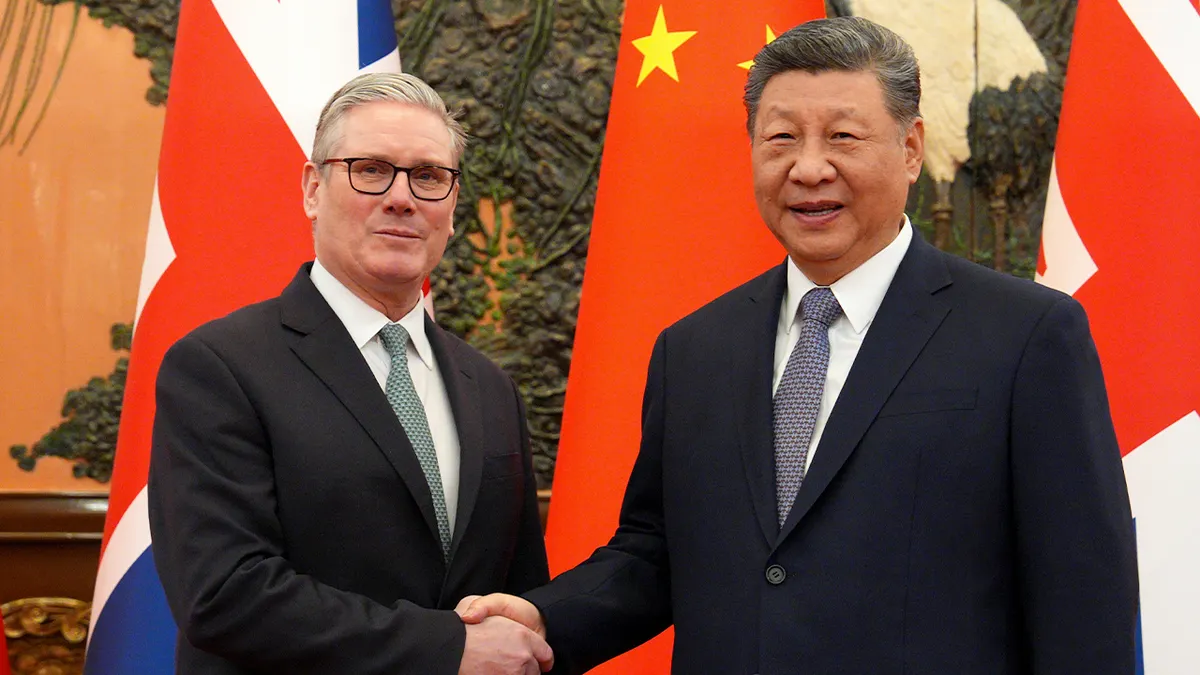
Photo: Fox News
Trump Sounds Alarm Over UK–China Business as Starmer Seeks Fresh Start
U.S. President Donald Trump has issued a stark warning to the United Kingdom, saying it would be “very dangerous” for Britain to expand business ties with China, just as Prime Minister Keir Starmer moves to reset relations with Beijing after years of diplomatic strain.
The comments came as the UK and China announced a series of measures aimed at rebuilding economic cooperation, including visa-free travel for British citizens, reduced tariffs on Scotch whisky, and a major new investment pledge from pharmaceutical giant AstraZeneca.
Starmer is currently on a four-day official visit to China, the first by a British prime minister in eight years. The trip follows a high-level meeting between Starmer and Chinese President Xi Jinping and signals London’s intention to revive what both sides are calling a long-term strategic partnership.
Speaking to reporters on the sidelines of a public appearance in Washington, Trump criticized Starmer’s outreach to Beijing, saying it would be “very dangerous” for the UK to deepen commercial ties with China. His remarks underscore growing unease in Washington as close allies explore closer economic engagement with the world’s second-largest economy.
Visa-Free Travel, Whisky Tariffs, and a $15 Billion Investment
Despite U.S. concerns, London and Beijing are moving ahead with tangible steps to improve bilateral relations.
China has confirmed that UK passport holders will soon be able to enter the country visa-free for stays of up to 30 days, a move expected to boost tourism, business travel, and academic exchange. At the same time, Beijing agreed to cut import tariffs on British whisky in half, reducing duties from 10% to 5%. The UK whisky industry, which exports hundreds of millions of dollars’ worth of products to China each year, has welcomed the decision as a meaningful boost for distillers and exporters.
In a major corporate development, AstraZeneca announced plans to invest approximately $15 billion in China by 2030. The funds will go toward expanding manufacturing capacity and accelerating research and development, reinforcing China’s role as a key hub for the company’s global operations. AstraZeneca already employs thousands of staff in China, and the new investment is expected to create additional high-skilled jobs while supporting innovation in medicines and biotechnology.
Starmer arrived in Beijing accompanied by a delegation of nearly 60 senior UK business leaders and heads of major organizations, spanning sectors such as pharmaceuticals, finance, energy, education, and advanced manufacturing. He described the agreements on travel and tariffs as “really important access,” adding that they symbolize a broader effort to rebuild trust and practical cooperation between the two countries.
Britain Says It Won’t Choose Between the US and China
Ahead of his visit, Starmer made clear that the UK does not intend to take sides between Washington and Beijing. In an interview prior to departing for China, he said Britain can maintain its close relationship with the United States while also strengthening economic links with China.
“We’ve got very close relations with the U.S., and of course we want to maintain that across business, security, and defense,” Starmer said. “But that doesn’t mean we can’t also engage constructively with China.”
The UK’s approach reflects a broader trend among Western economies seeking to diversify trade and investment partnerships amid geopolitical uncertainty and shifting U.S. foreign policy priorities.
Canada Drawn Into the Debate as Trump Issues Similar Warning
Trump also pointed to Canada as another example, criticizing Ottawa for exploring deeper ties with Beijing. Earlier this month, Canada signed a new trade agreement with China following a visit by Prime Minister Mark Carney, part of a strategy to broaden export markets and reduce reliance on any single partner.
Trump warned that it would be “even more dangerous for Canada to get into business with China,” suggesting that Beijing could exert pressure on Canadian industries and national interests. He went further by threatening tariffs of up to 100% on Canadian goods if Ottawa were to significantly expand trade with China, marking a sharp shift from earlier remarks in which he had suggested such agreements could be positive.
His comments highlight the growing tension between the U.S. and its allies over how to engage with China at a time when global supply chains, technology competition, and trade policies are increasingly politicized.
Beijing Welcomes Western Leaders as China Reopens to Engagement
Starmer’s visit comes amid a broader diplomatic push by Beijing to re-engage with Western governments. In recent weeks, China has hosted several high-profile leaders, including Ireland’s Prime Minister Michael Martin on the first Irish leadership visit in 14 years, Finnish Prime Minister Petteri Orpo, and South Korean President Lee Jae Myung.
These visits reflect renewed interest among advanced economies in stabilizing relations with China, especially as businesses look for growth opportunities in a market of more than 1.4 billion people and governments seek to hedge against uncertainty driven by protectionism and shifting U.S. policies.
For the UK, China remains a significant trading partner, with bilateral trade valued in the tens of billions of dollars annually. British exports to China span financial services, education, automotive, luxury goods, and pharmaceuticals, while Chinese imports play a key role in UK manufacturing and consumer markets.
A Delicate Balancing Act for Britain
Starmer’s China outreach underscores the delicate balancing act facing the UK. On one hand, the United States remains Britain’s closest ally in defense, intelligence, and security, as well as a major trading partner. On the other, China represents a vast market and a critical player in global growth, investment, and innovation.
As visa rules ease, tariffs fall, and multibillion-dollar investments move forward, London appears determined to pursue pragmatic economic engagement with Beijing, even as Washington urges caution.
Whether the UK can successfully strengthen ties with China while preserving its strategic alignment with the U.S. will be closely watched by markets, policymakers, and businesses alike in the months ahead.
.webp)
Popular articles



Subscribe to unlock premium content
Crypto in the Arctic

Iceland’s Seaweed Revolution
Private Island Rentals for Corporate Retreats Hit $1 Billion

Crypto in the Arctic
Iceland’s Seaweed Revolution
Crypto in the Arctic


