
Trump-Era Tariffs Couldn’t Slow China: How Supply Chain Rerouting and Forced Labor Helped Drive a Record $1.1 Trillion Trade Surplus

Trump-Era Tariffs Couldn’t Slow China: How Supply Chain Rerouting and Forced Labor Helped Drive a Record $1.1 Trillion Trade Surplus
By
Augusta Parker
Last updated:
January 30, 2026
First Published:
April 25, 2026

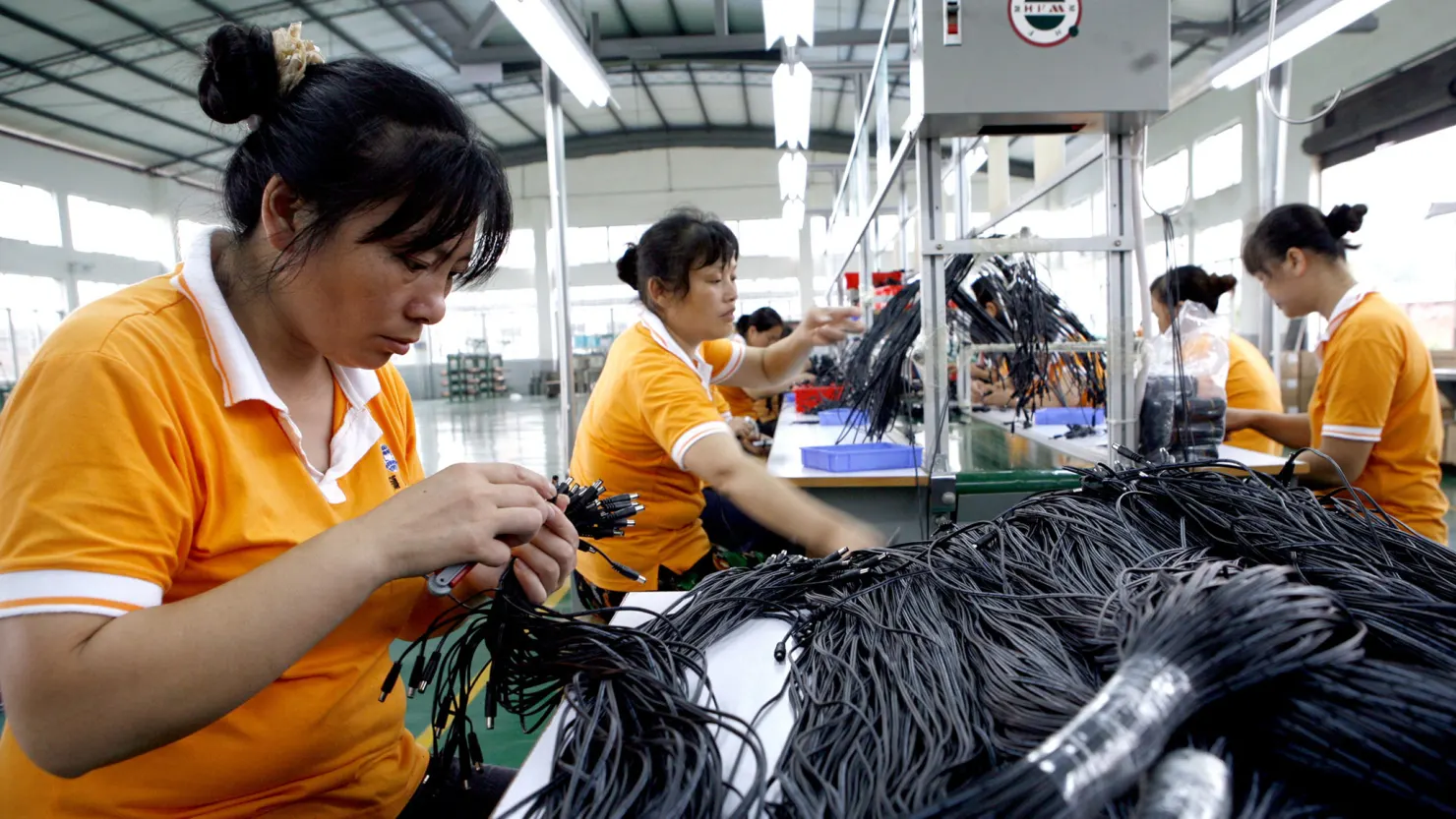
Labors work at a factory’s workshop in Huaying, Sichuan province of China.
Getty Images
China Hits Historic Trade Surplus Despite U.S. Tariffs
China has posted a record-breaking $1.1 trillion trade surplus, underscoring how President Donald Trump’s tariff strategy failed to curb the country’s export dominance. Instead of slowing China’s manufacturing engine, the trade war that began in 2018 appears to have accelerated a structural shift in global supply chains that ultimately strengthened Beijing’s position.
Supply chain data shows that Chinese manufacturers adapted quickly by rerouting production through lower-tariff countries, particularly across Southeast Asia, while also relying on forced labor at various stages of production. Together, these strategies allowed China to preserve its cost advantage, expand exports, and maintain momentum even as tariffs on Chinese-made goods rose as high as 25%.
Consultants tracking global trade flows say the result has been devastating for job creation in the U.S. and other advanced economies, while simultaneously embedding China deeper into international supply networks.
Manufacturing Moves to Southeast Asia but China Still Controls Production
One of the biggest shifts since the first round of Trump tariffs has been the relocation of final assembly to neighboring Asian countries such as Vietnam, Thailand, Indonesia, and Malaysia.
On paper, exports increasingly appear to originate from these nations. In reality, much of the core manufacturing still happens in China.
Freight and trade data show that shipments from Southeast Asia surged as companies sought to avoid higher U.S. tariffs on Chinese goods. Imports from key countries like Vietnam, Thailand, and Indonesia are each up roughly 20% year over year, according to logistics providers. These increases accelerated during late 2025, when manufacturers rushed to move inventory ahead of additional tariffs tied to Trump’s second-term trade actions.
Trade between China and Southeast Asia has also expanded sharply, as Chinese firms send near-finished components to these countries for final assembly before shipping products onward to the U.S. and Europe.
Supply chain analysts describe this as global rerouting through transshipment hubs. China establishes special economic zones or wholly owned subsidiaries in lower-tariff countries, completes minor assembly there, and then exports goods under a different country of origin.
The outcome is a higher Chinese surplus and a more complex enforcement challenge for customs authorities worldwide.
Vietnam Emerges as the Primary Gateway
Shipment data from 2024 shows Vietnam accounted for roughly 80% of U.S.-bound shipments from companies that are fully owned by Chinese entities. Italy ranked second, followed by Thailand and Malaysia.
Industry experts expect 2025 figures to mirror this pattern, noting that while policy headlines change quickly, physical supply chain infrastructure does not. The deeper impacts of reshoring efforts or tighter enforcement may not be visible until 2026 or 2027.
Weekly export flows show that China’s trade volumes across Vietnam, Indonesia, Malaysia, and Thailand have settled into a higher baseline since late 2025, indicating long-term sourcing relationships rather than temporary tariff avoidance.
A clear example is HHC Changzhou Corp., operating under the MotoMotion brand. After facing 10% tariffs in 2018 and 25% tariffs in 2019 on exports to the U.S., the company established a wholly owned subsidiary in Vietnam in mid-2019. Its own filings explicitly cite U.S. Section 301 tariffs as the reason for building the new facility.
Cases like this are now common across industries ranging from furniture to electronics.
U.S. Trade Deficit Continues to Widen
While China’s surplus climbed to unprecedented levels, the U.S. trade deficit has also grown.
Recent data shows the U.S. deficit with global trading partners nearly doubled to $56.8 billion in a single month, with about one-third tied to trade with the European Union. The U.S. goods deficit with China declined slightly to around $13.9 billion, but the overall annual U.S. trade deficit is still up roughly 4% year over year.
In other words, tariffs shifted trade routes more than they reduced imbalances.
Tariff Evasion and Shadow Factories Put Jobs at Risk
Supply chain experts warn that transshipment practices undermine domestic manufacturing across multiple countries. Jobs that could have been created in the U.S., Europe, or emerging markets are instead absorbed by Chinese-controlled facilities operating abroad.
These strategies extend far beyond Southeast Asia. Analysts have documented rerouting through Taiwan, Mexico, parts of South America, and other regions, depending on tariff structures and enforcement gaps.
Estimates suggest that tariff circumvention related to Section 301 alone could exceed $30 billion this year, translating into the loss of more than one million potential manufacturing and trade jobs globally.
Although the U.S. reached a trade agreement with Vietnam last summer that introduced an additional 40% transshipment tariff, tracing goods back to their true origin remains difficult once they pass through multiple countries.
Forced Labor Adds Another Layer to China’s Cost Advantage
Beyond logistics, labor practices play a critical role in China’s competitiveness.
New supply chain risk databases reveal patterns of forced labor embedded several layers deep in production networks. In many cases, companies offset tariff costs by accelerating production through illicit labor practices before sending goods to Southeast Asia for finishing and export.
The International Labour Organization estimates nearly 28 million people worldwide are subjected to forced labor, generating approximately $236 billion in illegal profits annually. Around 63% of these cases occur in the private economy.
China has long faced allegations from human rights organizations regarding forced labor, and those concerns have intensified. In 2025, U.S. authorities added 78 new entities to their forced labor enforcement list, bringing the total number of Chinese entities flagged to 144.
Analysts say forced labor allows Chinese manufacturers to produce ultra-low-cost components that feed into overseas assembly plants, further strengthening China’s pricing power in global markets.
Industries seeing heavy investment tied to this model include furniture, kitchen cabinets, automotive parts such as gears and drivetrains, and electronics. Billions of dollars have flowed into new facilities across Vietnam and neighboring countries to support these supply chains.
Tariffs Generated Revenue but Did Not Break China’s Manufacturing Power
Trump’s tariffs did bring in significant revenue for the U.S. government. During the first year of his second term, U.S. Customs and Border Protection collected more than $305 billion in tariffs, taxes, and fees, including roughly $250.9 billion in tariff revenue. Enforcement actions added another $1.2 billion, while closing the de minimis loophole recovered over $1 billion.
Yet despite these gains, experts say China’s manufacturing dominance remains intact.
Rather than retreat, China invested heavily in overseas shadow facilities and complex routing strategies that made enforcement harder and preserved export growth. These moves have complicated efforts to combat forced labor while giving Chinese firms a sustained economic edge.
The Bigger Picture: A Reshaped Global Supply Chain
China’s record $1.1 trillion surplus is not just a trade statistic. It reflects a fundamental transformation in how goods move around the world.
Tariffs pushed production outward, but ownership, control, and value creation largely stayed in Chinese hands. The result is a more fragmented supply chain, higher compliance risks, and fewer opportunities for job growth in countries hoping to reshore manufacturing.
For policymakers, the lesson is clear: tariffs alone reshuffle trade routes. Without coordinated enforcement, labor protections, and industrial investment at home, they do little to weaken a deeply entrenched global manufacturing powerhouse.
.webp)
Popular articles



Subscribe to unlock premium content
Crypto in the Arctic

Iceland’s Seaweed Revolution

Private Island Rentals for Corporate Retreats Hit $1 Billion

Crypto in the Arctic
Iceland’s Seaweed Revolution
Crypto in the Arctic


