SpaceX’s Historic Market Debut Ignites Wall Street Debate Over Valuation and Future Growth

SpaceX’s Historic Market Debut Ignites Wall Street Debate Over Valuation and Future Growth
By
Rachel Steinberg
Last updated:
June 15, 2026
First Published:
June 15, 2026

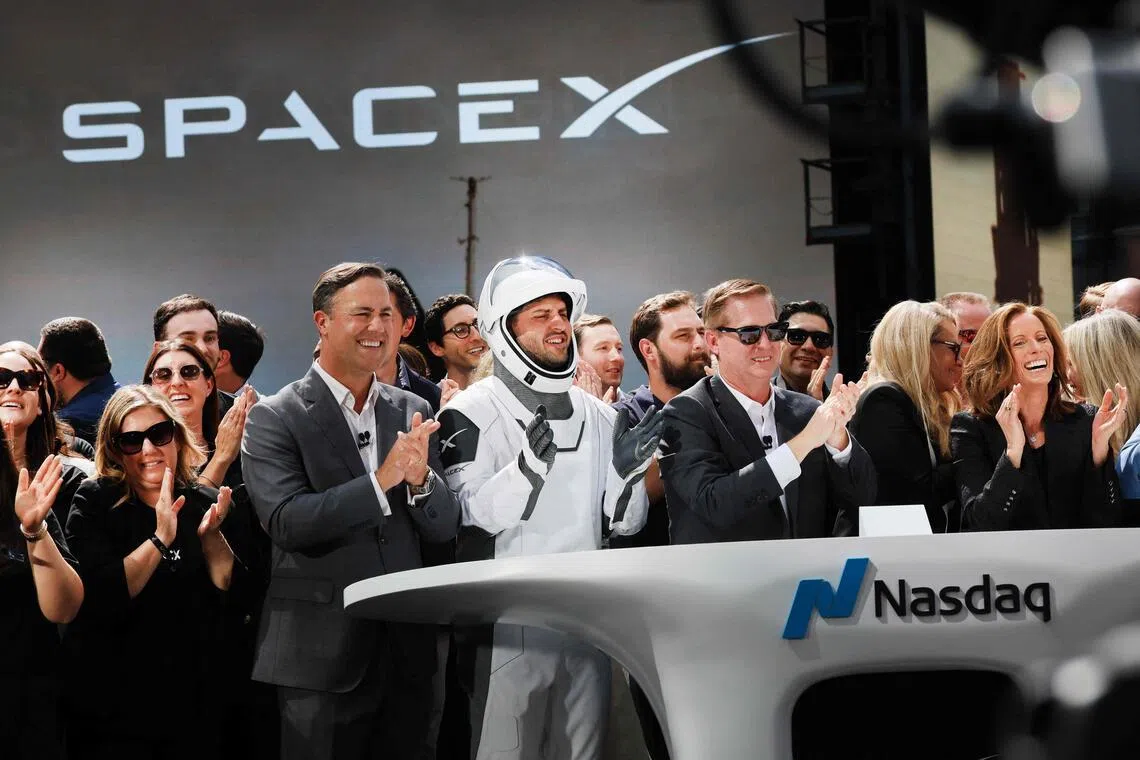
Photo: The Straits Times
SpaceX has officially entered the public markets, and the reaction has been nothing short of extraordinary. Following one of the most anticipated initial public offerings in recent history, the aerospace and satellite technology company delivered a powerful debut on the Nasdaq, instantly becoming one of the most talked-about stocks on Wall Street.
The company's public listing not only elevated founder Elon Musk's wealth to unprecedented levels but also sparked intense debate among investors, analysts, and market strategists about whether SpaceX represents the next generation of transformational technology companies or a stock whose future success is already reflected in its valuation.
While bullish investors see a company positioned at the center of multiple trillion-dollar industries, skeptics argue that expectations have reached levels that may be difficult to satisfy, even for one of the world's most innovative businesses.
A Blockbuster IPO Captures Investor Attention
SpaceX entered the public market with an offering price of $135 per share, but investor demand quickly pushed the stock significantly higher.
The shares closed their first major trading session at $161, representing a gain of roughly 19% above the IPO price and adding hundreds of billions of dollars in market value almost immediately.
The strong debut reflected extraordinary enthusiasm from both institutional and retail investors eager to gain exposure to a company that has transformed commercial spaceflight, satellite communications, launch services, and emerging space-based technologies.
Demand was particularly strong among individual investors, who poured substantial capital into the stock during its first days of trading.
The IPO's success also reinforced the broader trend of investors seeking exposure to companies linked to cutting-edge technologies such as artificial intelligence, advanced manufacturing, autonomous systems, next-generation communications, and space infrastructure.
Elon Musk's Vision Drives Massive Expectations
Much of the excitement surrounding SpaceX stems from Elon Musk's long-term vision for the company.
Over the years, Musk has repeatedly outlined ambitions that extend far beyond traditional aerospace operations. SpaceX's business model now spans reusable rockets, satellite internet services, national security contracts, lunar missions, and future plans for interplanetary transportation.
Investor optimism increased further after Musk suggested that SpaceX could potentially generate approximately $1 trillion in annual revenue by 2030. He also indicated that revenues could exceed that level by 2031 if the company successfully executes its growth strategy.
Such projections have fueled speculation that SpaceX could eventually become one of the largest companies in modern history.
However, those ambitious targets have also raised concerns among analysts who believe investors may now be pricing in years of near-perfect execution.
Analysts Warn Growth Expectations Are Extremely High
Several market experts have cautioned that SpaceX now faces enormous pressure to deliver exceptional financial results quarter after quarter.
According to some analysts, one of the biggest risks is that investor expectations have risen so rapidly that even strong performance may not be enough if it falls short of aggressive forecasts.
Retail investors have become a particularly important factor in the stock's performance. Their enthusiasm helped drive the IPO higher, but some analysts worry that sentiment could shift quickly if revenue growth slows or earnings miss expectations.
Public companies operating at premium valuations often face intense scrutiny from investors, especially when future growth assumptions become a major component of the stock price.
If SpaceX experiences delays, operational challenges, or slower-than-expected expansion in key business segments, market volatility could increase significantly.
The Valuation Debate Intensifies
One of the biggest points of contention among analysts is SpaceX's valuation.
Based on current market levels, the company is valued at approximately $1.75 trillion, placing it among the most valuable businesses in the world.
Critics argue that such a valuation assumes years of extraordinary growth and leaves little room for disappointment.
Some market strategists have described the stock as significantly overvalued relative to traditional financial metrics.
Using estimated earnings projections, analysts suggest SpaceX is effectively trading at valuation multiples approaching 100 times earnings, far above many established technology leaders.
For comparison, some of the world's largest and most profitable technology companies trade at substantially lower valuation multiples despite generating enormous revenues and cash flows.
This gap has fueled concerns that investors may be paying today for growth that has yet to materialize.
Why Bulls Believe SpaceX Deserves a Premium
Supporters of the company argue that traditional valuation models fail to capture the scale of SpaceX's long-term opportunity.
Unlike many technology companies that operate in a single market, SpaceX has exposure to multiple industries that could experience explosive growth over the coming decades.
These include:
- Commercial satellite communications
- Global broadband internet services
- Government and defense contracts
- Space exploration and transportation
- Lunar infrastructure projects
- Artificial intelligence-enabled space systems
- Deep-space logistics and future Mars missions
The company's Starlink satellite network alone has become one of the fastest-growing communications businesses in the world, serving millions of users across dozens of countries.
Meanwhile, its reusable rocket technology has dramatically reduced launch costs and established SpaceX as the dominant force in the global commercial launch market.
Supporters argue that if the company successfully monetizes these opportunities, today's valuation may eventually appear justified.
Morningstar and Other Analysts Remain Skeptical
Not everyone is convinced.
Several research firms have issued more cautious assessments, arguing that the stock price currently reflects extremely optimistic assumptions.
Some analysts have suggested that the market value has moved significantly ahead of the company's underlying fundamentals.
Bearish forecasts indicate that achieving the most optimistic scenarios would require sustained growth rates rarely seen in corporate history.
Even among analysts who admire SpaceX's technological leadership, there is recognition that execution risk remains substantial.
Building a trillion-dollar revenue business requires not only technological innovation but also consistent operational performance, regulatory approvals, international expansion, and continued customer adoption across multiple sectors.
The Leadership Factor
Despite concerns about valuation, many investors remain confident because of the leadership team behind the company.
Elon Musk's track record of disrupting established industries has helped build investor trust, while SpaceX President and Chief Operating Officer Gwynne Shotwell is widely regarded as one of the most effective executives in the aerospace industry.
Together, the leadership team has overseen achievements that many experts once considered impossible, including reusable orbital rockets, large-scale satellite deployment, and the rapid commercialization of private spaceflight.
Supporters argue that few management teams are better positioned to tackle the challenges ahead.
Their ability to consistently execute complex engineering projects has become one of the strongest arguments in favor of the company's long-term investment case.
Risks Investors Should Watch
Despite the excitement, investors face several important risks.
Revenue growth must continue at an exceptional pace to support current valuations. Any slowdown in launch activity, satellite subscriber growth, government contracts, or international expansion could impact investor confidence.
Competition is also increasing. Rival aerospace companies, satellite providers, and emerging space technology startups are investing heavily to capture market share in industries that SpaceX currently dominates.
Regulatory challenges, geopolitical developments, launch failures, supply chain disruptions, and broader economic conditions could also influence future performance.
For a company valued at nearly $2 trillion, expectations are exceptionally high.
The Long-Term Investment Case
The debate surrounding SpaceX ultimately comes down to one central question: can the company grow into the enormous expectations now embedded in its stock price?
Bears argue that much of the future success has already been priced in, leaving investors exposed to downside risks if growth slows.
Bulls counter that SpaceX is still in the early stages of transforming industries that could generate trillions of dollars in economic value over the coming decades.
What both sides agree on is that SpaceX is no ordinary public company.
Its combination of aerospace innovation, satellite communications, advanced technology, and ambitious long-term goals makes it one of the most fascinating investment stories in modern market history.
Whether the stock continues its ascent or faces periods of turbulence, SpaceX is likely to remain at the center of investor attention as it attempts to turn some of the world's most ambitious technological visions into a profitable reality.
.webp)
Popular articles



Subscribe to unlock premium content
The Secret Life of Pop-Up Luxury Restaurants in Paris

Speed, Luxury, and Adrenaline

From Wax to Wealth: Creative Candle-Making in the City

The Secret Life of Pop-Up Luxury Restaurants in Paris
Speed, Luxury, and Adrenaline
The Secret Life of Pop-Up Luxury Restaurants in Paris