
South Korea’s Kospi Pulls Back Sharply After Briefly Crossing Historic 8,000 Mark

South Korea’s Kospi Pulls Back Sharply After Briefly Crossing Historic 8,000 Mark
By
Leah Rosenfeld
Last updated:
May 15, 2026
First Published:
May 15, 2026

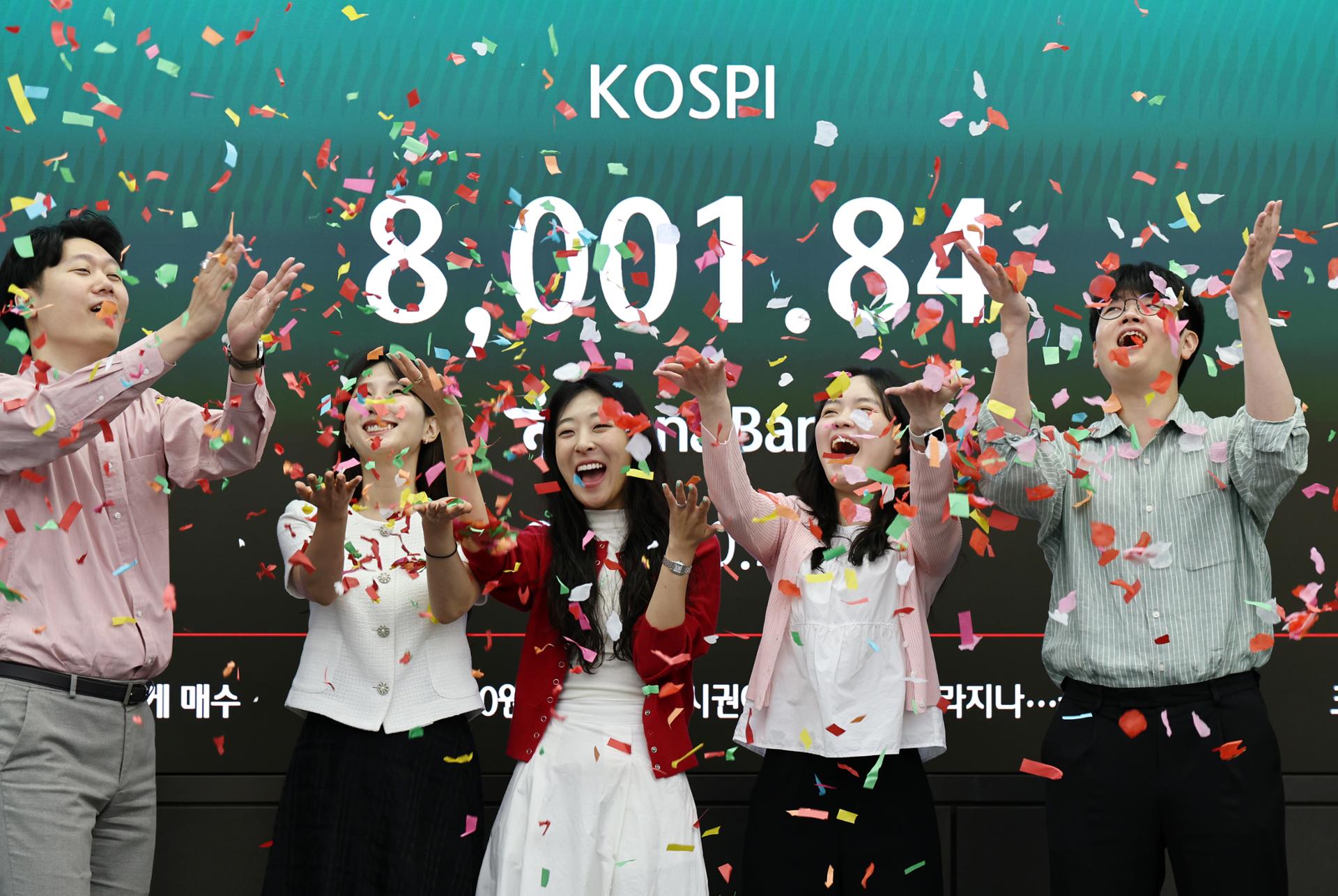
Photo: The Korea Times
South Korea’s benchmark KOSPI retreated sharply on Friday after briefly surging past the historic 8,000 level for the first time ever, as investors locked in profits and broader Asian markets weakened amid growing geopolitical uncertainty surrounding high level talks between the United States and China.
The index fell more than 3% after hitting a fresh intraday record in early trading, erasing gains fueled by optimism over the ongoing summit between U.S. President Donald Trump and Chinese President Xi Jinping in Beijing.
South Korea’s technology heavy small cap index, the KOSDAQ, also declined sharply, falling around 2.6% as investor sentiment across the region turned cautious.
The pullback came after weeks of extraordinary momentum in South Korean equities, driven largely by artificial intelligence optimism, semiconductor demand, and strong inflows into technology related stocks. The Kospi had already crossed the 7,000 milestone earlier this year after a massive rally led by chipmakers and AI linked companies.
Much of the market’s recent gains have been concentrated in a small number of heavyweight technology firms, raising concerns among analysts about overheating valuations and excessive market concentration.
According to data from Manulife Investment Management, Samsung Electronics and SK Hynix together accounted for more than 42% of the Kospi’s total weighting in May, the highest concentration level on record.
Investors had initially viewed the Trump-Xi summit as a possible catalyst for easing tensions around global trade, semiconductor exports, and technology restrictions. Any improvement in relations between Washington and Beijing could have major implications for Asian chipmakers, particularly South Korean firms deeply integrated into global semiconductor supply chains.
However, optimism faded as geopolitical risks resurfaced during the second day of negotiations.
Xi reportedly warned Trump that mishandling the Taiwan issue could trigger “clashes and even conflicts” between the world’s two largest economies. Chinese officials emphasized that Taiwan remains a red line for Beijing and warned that tensions over the island could severely damage bilateral relations.
The remarks injected fresh uncertainty into financial markets already grappling with concerns around global growth, supply chain security, and technology restrictions.
Taiwan remains one of the most sensitive geopolitical flashpoints in Asia due to its strategic importance in global semiconductor production. The island is home to Taiwan Semiconductor Manufacturing Company, the world’s largest contract chipmaker and a critical supplier for companies including Apple, Nvidia, AMD, and Qualcomm.
Any escalation in U.S.-China tensions involving Taiwan could significantly disrupt global technology supply chains and impact semiconductor manufacturing worldwide.
South Korean markets also faced additional pressure from labor tensions at Samsung Electronics.
Shares of Samsung fell more than 5% after the company’s labor union confirmed plans to move forward with an 18 day strike scheduled to begin on May 21. The strike is expected to involve more than 45,000 workers, potentially creating disruptions at one of the world’s largest semiconductor and electronics manufacturers.
Although Samsung has proposed restarting wage negotiations without preconditions, union representatives said they would only consider returning to talks after June 7 unless meaningful progress is made.
The labor dispute comes at a critical time for Samsung, which has been aggressively investing in advanced AI chips, memory semiconductors, and foundry operations to compete against rivals in the booming artificial intelligence sector.
Across the broader Asia-Pacific region, markets mostly traded lower.
Japan’s Nikkei 225 dropped around 1.1%, while the TOPIX edged slightly lower. Hong Kong’s Hang Seng Index fell nearly 0.9%, while mainland China’s CSI 300 remained relatively flat. India’s NIFTY 50 managed modest gains of approximately 0.2%.
Australia’s S&P/ASX 200 was largely unchanged as investors monitored developments from the Beijing summit and broader global market trends.
Despite weakness in Asia, Wall Street continued its record breaking rally overnight.
The Dow Jones Industrial Average climbed back above the psychologically important 50,000 level after strong earnings from Cisco Systems boosted investor confidence in the technology sector.
The Dow gained more than 370 points, while the S&P 500 and Nasdaq Composite both closed at fresh record highs.
Strong corporate earnings, enthusiasm surrounding artificial intelligence, and expectations for continued economic resilience have continued to support U.S. equities despite geopolitical tensions and elevated interest rates.
Meanwhile, business leaders from major American technology companies joined Trump during the Beijing summit, highlighting the growing intersection between geopolitics, trade negotiations, and the future of advanced technology industries.
Among those attending were Elon Musk, CEO of Tesla, and Jensen Huang, CEO of NVIDIA.
Analysts say both Washington and Beijing are attempting to stabilize economic relations temporarily while simultaneously reducing strategic dependence on each other in sensitive sectors such as semiconductors, artificial intelligence, rare earth minerals, and advanced manufacturing.
Although the summit has produced optimistic rhetoric and signs of cooperation, investors remain cautious about how much progress can realistically be achieved given the deep structural rivalry between the two superpowers.
For now, markets across Asia appear increasingly sensitive to every signal emerging from Beijing as traders weigh the balance between economic cooperation and escalating geopolitical risk.
.webp)
Popular articles



Subscribe to unlock premium content
AI-Curated Luxury Shopping Experiences Transform the Market

Limited-Run Anime Originals Redefining Global Entertainment

Micro-Vertical Farming Becomes Corporate Gold
.png)
AI-Curated Luxury Shopping Experiences Transform the Market
Limited-Run Anime Originals Redefining Global Entertainment
AI-Curated Luxury Shopping Experiences Transform the Market


