South Korean Prosecutors Push for Capital Punishment in Former President Yoon Martial Law Case

South Korean Prosecutors Push for Capital Punishment in Former President Yoon Martial Law Case
By
Junia Wells
Last updated:
January 14, 2026
First Published:
January 14, 2026

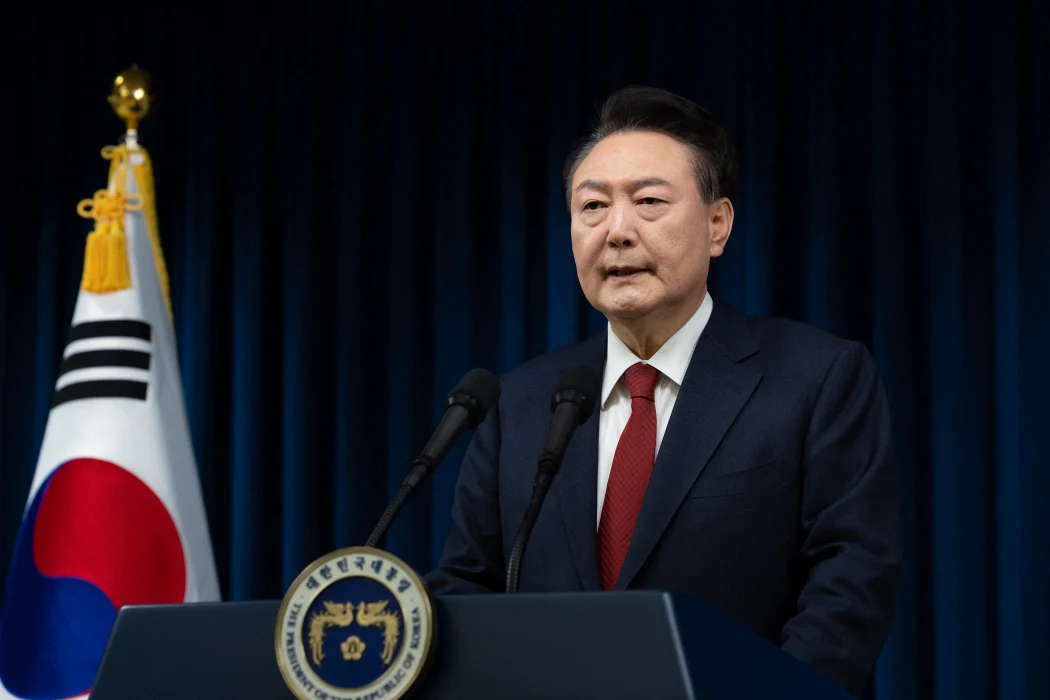
Photo: RNZ
South Korea’s political and legal establishment is facing one of its most consequential trials in decades, as a special prosecutor formally requested the death penalty for former President Yoon Suk Yeol over his brief declaration of martial law in 2024. The demand marks a dramatic escalation in a case that has shaken public trust and revived painful memories of the country’s authoritarian past.
The request was submitted as Yoon’s trial concluded late Tuesday. The court is expected to announce its verdict on Feb. 19, a decision that could have historic implications for South Korea’s justice system and democratic institutions.
Charges that override presidential immunity
Yoon has been charged with leading an insurrection, one of the few crimes under South Korean law that is not protected by presidential immunity. Prosecutors argue that the offense carries the maximum possible punishment, including the death penalty, due to the severity of the alleged attempt to undermine constitutional order.
If the sentence were ultimately carried out, it would be South Korea’s first execution in nearly 30 years. The country last executed prisoners in 1997, after which it effectively halted capital punishment despite retaining it in law.
Amnesty International classifies South Korea as “abolitionist in practice,” noting that while courts may still issue death sentences, none have been enforced for decades.
Prosecutors allege bid to entrench power
During the final hearing, the prosecution team led by special counsel Cho Eun-suk argued that Yoon’s declaration of martial law was not a security measure but a calculated attempt to retain power. According to South Korean media reports, prosecutors said the move was intended to seize control of both the judiciary and the legislature, thereby extending Yoon’s grip on the state.
The prosecution framed the case as an unprecedented threat to democratic governance in modern South Korea, emphasizing that the country’s post-1987 constitutional order was designed specifically to prevent such abuses.
Yoon denies wrongdoing
Yoon has consistently rejected the accusations, maintaining that his actions fell within the scope of presidential authority. He argued that the martial law declaration was intended to protect national sovereignty and safeguard democratic freedoms during a period of heightened political tension.
At the time of the declaration, Yoon accused the opposition Democratic Party of Korea of engaging in what he described as anti-state activities and alleged collusion with North Korean actors. Those claims were widely disputed and later rejected by opposition leaders and civil society groups.
How the crisis unfolded
On Dec. 3, 2024, Yoon announced martial law in a late-night televised address and ordered troops to the National Assembly. Soldiers blocked entrances to the building, leading to tense confrontations with protesters and lawmakers as special forces attempted to enter the chamber.
Despite the military presence, 190 of the 300 lawmakers managed to assemble inside the National Assembly within hours. In a unanimous vote, they overturned the martial law decree, forcing its repeal. Yoon formally lifted the order roughly six hours after it was announced, bringing the standoff to an end.
The speed with which lawmakers reversed the decree was widely credited with preventing a deeper constitutional crisis.
Historical echoes and legal precedent
The case has inevitably drawn comparisons to South Korea’s turbulent history of military rule. The country’s last successful coup occurred in 1979, when General Chun Doo-hwan seized power following the assassination of President Park Chung-hee.
Chun later expanded martial law nationwide in 1980, triggering the Gwangju uprising. The military crackdown on protesters in the southwestern city resulted in hundreds, and possibly thousands, of civilian deaths, according to official and independent estimates.
In 1996, Chun was sentenced to death for his role in the 1979 coup and subsequent actions, though the punishment was later commuted to life imprisonment. The precedent underscores both the severity of the current charges against Yoon and the rarity of such cases in South Korea’s modern democracy.
What comes next
The upcoming ruling will be closely watched at home and abroad. Legal experts say the court’s decision could redefine the boundaries of presidential power and set a lasting precedent for accountability at the highest level of government.
Regardless of the outcome, the case has already reignited debate over the death penalty, executive authority, and the resilience of South Korea’s democratic institutions nearly four decades after the end of military rule.
.webp)
Popular articles



Subscribe to unlock premium content
Iceland’s Geothermal Revolution

Bali’s Digital Detox Revolution

Step Into the Future of Art

Iceland’s Geothermal Revolution
Bali’s Digital Detox Revolution
Iceland’s Geothermal Revolution