SoftBank Loses $32 Billion in Market Value as AI Stock Selloff Sweeps Across Asia

SoftBank Loses $32 Billion in Market Value as AI Stock Selloff Sweeps Across Asia
By
Rachel Steinberg
Last updated:
November 5, 2025
First Published:
November 30, 2025

Getty Images
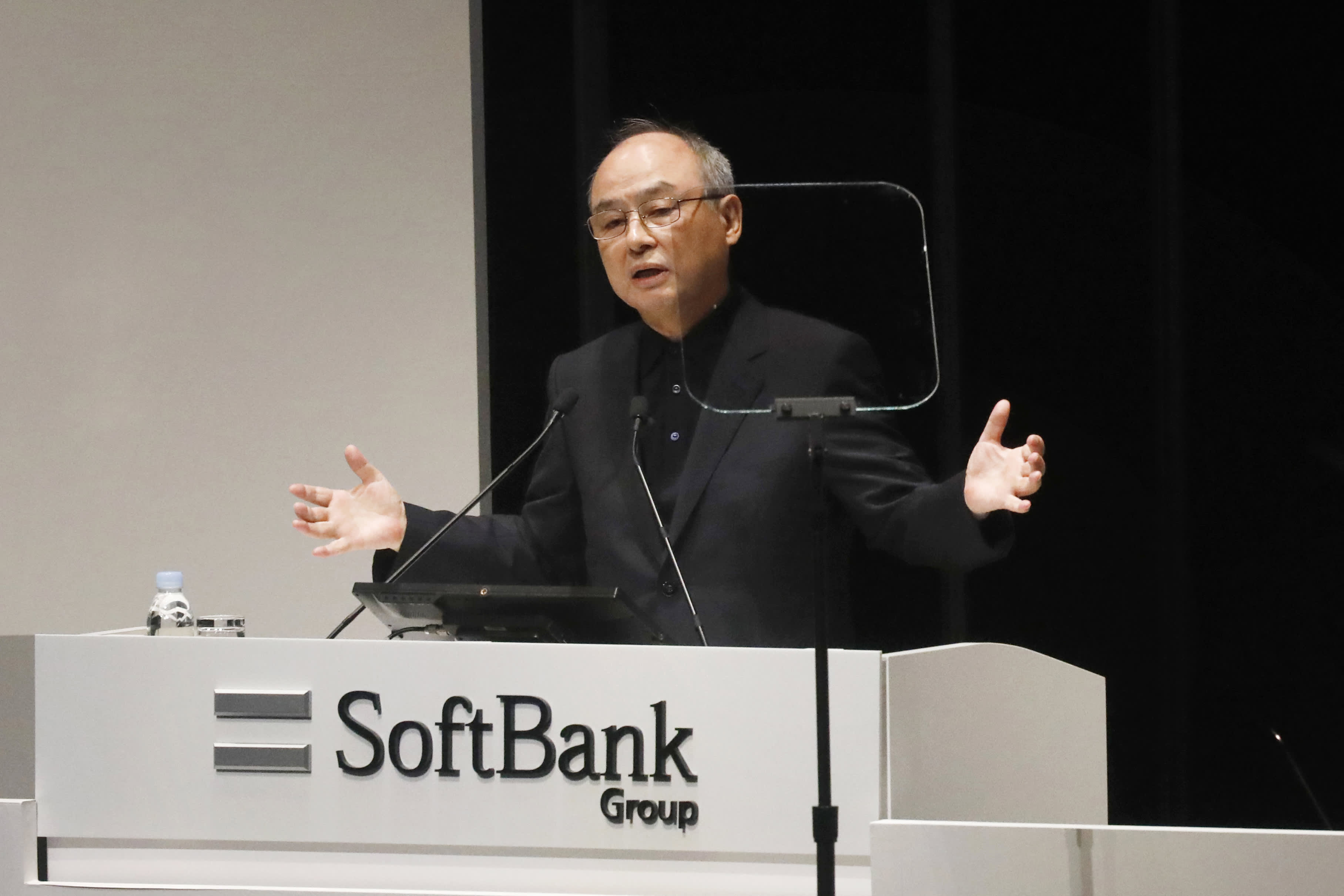
SoftBank Group shares plunged over 14% on Wednesday, wiping out roughly $32 billion in market capitalization as a wave of selloffs hit Asia’s AI and semiconductor stocks. The sharp decline reflects mounting investor concerns that the region’s red-hot AI sector may be entering a period of valuation correction after months of relentless gains.
The fall marks SoftBank’s worst single-day performance since August 2023, when shares tumbled more than 18%, according to LSEG data. Combined with Tuesday’s 7% drop, the Japanese investment giant has shed nearly $50 billion in market value over two trading sessions, underscoring how quickly sentiment can shift in a frothy market driven by AI hype.
The Broader AI Selloff Spreads Across Asia
SoftBank’s decline mirrored a broader selloff among Asian AI-linked firms. In Japan, semiconductor testing equipment maker Advantest slid over 8%, Renesas Electronics fell 5.5%, and Tokyo Electron lost more than 5%.
South Korea’s tech heavyweights Samsung Electronics and SK Hynix — which had previously powered the Kospi Index to record highs — dropped nearly 6% each. In Taiwan, TSMC, the world’s largest contract chipmaker, dipped 2%, while Chinese internet giants Alibaba and Tencent lost over 3% and 2%, respectively.
The selloff was triggered after U.S. tech and AI stocks also slumped overnight. Palantir Technologies plunged 8%, despite reporting better-than-expected quarterly earnings. Oracle fell 4%, AMD dropped nearly 4%, and both Nvidia and Amazon posted declines, signaling a shift in investor appetite for high-growth, high-valuation tech names.
Valuation Jitters Shake Confidence in AI Stocks
The recent downturn has fueled speculation that the global AI market may be entering a correction phase. The S&P 500’s forward price-to-earnings ratio now sits above 23, its highest level since the year 2000 — a period marked by the dot-com bubble.
Market strategist Louis Navellier warned in a recent note that an AI-led correction could have widespread ripple effects, saying, “If it comes, it will sweep the rest of the market with it due to the heavy weight of leading names.”
Similarly, Jared Bernstein, former chair of the U.S. Council of Economic Advisers, highlighted that current AI investment levels represent almost one-third more of the economy than during the late 1990s internet boom. “The gap between earnings potential and spending certainly looks bubbly,” he noted.
Adding to bearish sentiment, Michael Burry, famed for predicting the 2008 financial crisis, disclosed that his hedge fund Scion Asset Management has taken large short positions against Nvidia and Palantir, two of the most prominent players in the AI sector.
SoftBank’s Deep Exposure to AI Comes Under Scrutiny
SoftBank has been one of the most aggressive backers of the AI revolution. The company holds a majority stake in U.K.-based Arm Holdings, whose chip architecture powers nearly all modern smartphones and is increasingly used in AI processors. However, Arm’s shares fell 4.7% overnight on Nasdaq, adding to the pressure on SoftBank.
Beyond Arm, SoftBank has invested heavily in AI infrastructure and application startups, including Ampere Computing, a cloud server chipmaker it acquired earlier this year, and leading AI innovators such as OpenAI, OpusClip, and Tempus AI. While these investments have positioned SoftBank as a dominant AI investor, they also expose the conglomerate to heightened volatility during periods of market revaluation.
Analysts See Short-Term Volatility, Long-Term Opportunity
Despite the turbulence, some analysts believe the current selloff may be temporary. Dan Ives, Managing Director at Wedbush Securities, described the downturn as a “risk-off” event driven more by short-term panic than by fundamental weakness.
“In my view, this selloff is short-lived. I don’t believe it signals a structural collapse,” Ives said. “There’s been a lot of nervous energy across markets — between the crypto dip, U.S. tech pullbacks, and valuation fears — but the long-term AI growth story remains intact.”
Outlook: Cooling Hype, Not a Collapse
The recent correction underscores a growing divide between AI’s long-term potential and short-term investor expectations. While the sector remains a cornerstone of future innovation, market participants appear increasingly cautious about how quickly profits can catch up to valuations.
For now, SoftBank’s staggering $32 billion loss in market cap serves as a reminder that even the most promising technologies can face volatility when investor optimism outpaces fundamentals. Whether this marks the beginning of a sustained pullback or merely a pause in the AI rally will depend on how earnings, adoption, and real-world applications evolve in the coming quarters.
.webp)
Popular articles



Subscribe to unlock premium content
Pedal in Style in Amsterdam

From Bean to Boutique: Ghana’s Cocoa Revolution

Green Escapes in the Heart of London

Pedal in Style in Amsterdam
From Bean to Boutique: Ghana’s Cocoa Revolution
Pedal in Style in Amsterdam