Rubio Clarifies U.S. Strategy for Venezuela After Maduro’s Capture

Rubio Clarifies U.S. Strategy for Venezuela After Maduro’s Capture
By
Rachel Steinberg
Last updated:
January 5, 2026
First Published:
January 5, 2026

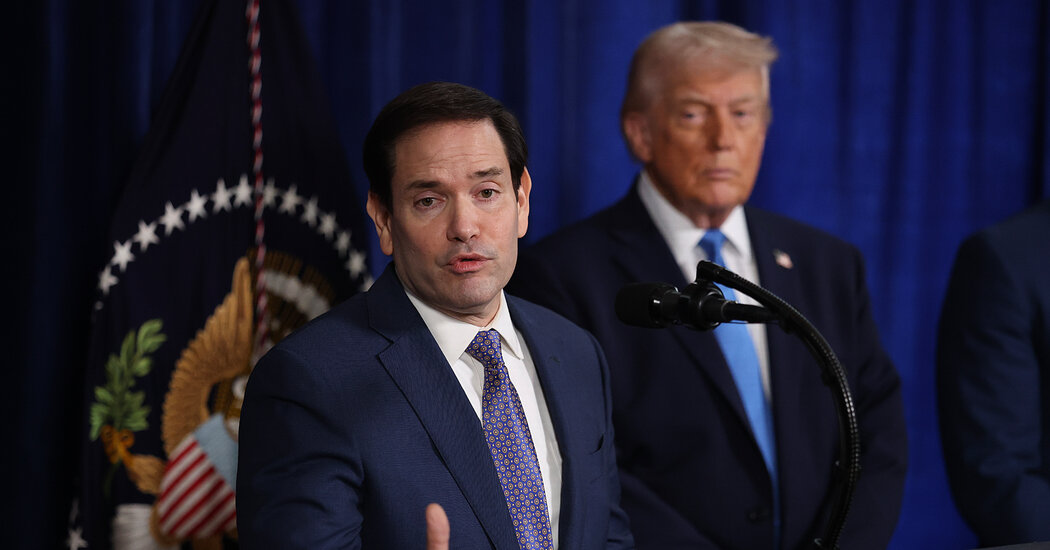
Photo: The New York Times
Washington Walks Back “Running Venezuela” Claims
U.S. Secretary of State Marco Rubio has moved to clarify President Donald Trump’s remarks suggesting the United States would “run” Venezuela following the capture of President Nicolás Maduro. Speaking in a series of Sunday television interviews, Rubio emphasized that Washington’s approach centers on applying economic and strategic pressure rather than directly governing the country.
The clarification came one day after U.S. forces detained Maduro and transferred him to the United States, a dramatic escalation in Washington’s long-running confrontation with the Venezuelan government.
Leverage Through Oil and Military Pressure
Rubio said the United States intends to use leverage gained from an oil blockade and an expanded regional military presence to influence Venezuela’s political and economic direction. He stopped short of endorsing any form of U.S.-led administration in Caracas.
According to U.S. officials, recent measures have included the seizure of tankers linked to Venezuelan oil exports and the deployment of naval vessels and military aircraft to the Caribbean. These steps are designed to restrict revenue flows from oil, which historically accounts for more than 90 percent of Venezuela’s export earnings.
Rubio described the strategy as a form of economic quarantine, arguing that Venezuela’s economy cannot stabilize or grow unless conditions set by Washington are met.
Policy Direction, Not Direct Control
Pressed on whether the United States is effectively governing Venezuela, Rubio drew a clear distinction between influence and control. He said the objective is to steer policy outcomes, not to administer the country.
President Trump, however, had earlier said the U.S. would oversee Venezuela during a transitional period to ensure stability and security. Those remarks triggered sharp backlash from critics who warned against a prolonged nation-building effort.
Political Backlash and Fears of Nation-Building
Trump’s comments drew criticism from both political opponents and some allies. Senate Democratic Leader Chuck Schumer warned that U.S.-led regime change efforts historically carry heavy costs, both financially and in terms of human lives.
The debate has revived memories of past U.S. interventions in Latin America and the Middle East, where extended involvement often proved costly and controversial.
Leadership Change in Caracas
Following Maduro’s capture, Venezuelan Vice President Delcy Rodríguez was sworn in as president. Maduro and his wife, Cilia Flores, were flown to New York, where they are expected to face charges related to drug trafficking.
Rubio’s remarks suggested the U.S. is now focused on shaping outcomes through pressure and negotiations rather than installing a governing authority. He also noted that President Trump retains the option to escalate militarily if U.S. objectives are not met.
Venezuela’s Oil at the Center of U.S. Strategy
Energy policy remains central to Washington’s approach. Venezuela holds the largest proven oil reserves in the world, estimated at more than 300 billion barrels, yet years of sanctions, underinvestment, and mismanagement have severely damaged production capacity.
Trump has said major U.S. oil companies could eventually invest billions of dollars to repair and modernize Venezuela’s oil infrastructure. Rubio echoed that view but stressed that the goal is not to seize oil fields.
Instead, he said the U.S. wants to prevent sanctioned oil from entering global markets until Venezuela reforms governance of its energy sector. He argued that private investment from Western companies, rather than state-backed firms from sanctioned countries, would ultimately benefit Venezuelan citizens.
Potential Interest From U.S. Energy Companies
Rubio said he has not yet held direct talks with U.S. oil companies, though Chevron remains the only American firm currently operating in Venezuela. He predicted strong interest from Western energy companies if sanctions are eased under a restructured political framework.
Interior Secretary Doug Burgum and Energy Secretary Chris Wright are expected to assess the situation and engage with potential investors as part of the administration’s next steps.
A High-Stakes Transition Ahead
Rubio’s comments point to a U.S. strategy built around economic pressure, controlled engagement, and conditional investment rather than direct rule. With Venezuela’s economy in deep crisis and its energy sector central to any recovery, the coming months are likely to test whether leverage alone can deliver the political transition Washington is seeking.
.webp)
Popular articles



Subscribe to unlock premium content
Pedal in Style in Amsterdam

From Bean to Boutique: Ghana’s Cocoa Revolution
Green Escapes in the Heart of London

Pedal in Style in Amsterdam
From Bean to Boutique: Ghana’s Cocoa Revolution
Pedal in Style in Amsterdam