Neura Robotics Secures Up to $1.4 Billion Backing From Nvidia, Amazon and Global Giants as Humanoid AI Race Accelerates

Neura Robotics Secures Up to $1.4 Billion Backing From Nvidia, Amazon and Global Giants as Humanoid AI Race Accelerates
By
Rachel Steinberg
Last updated:
June 11, 2026
First Published:
June 11, 2026

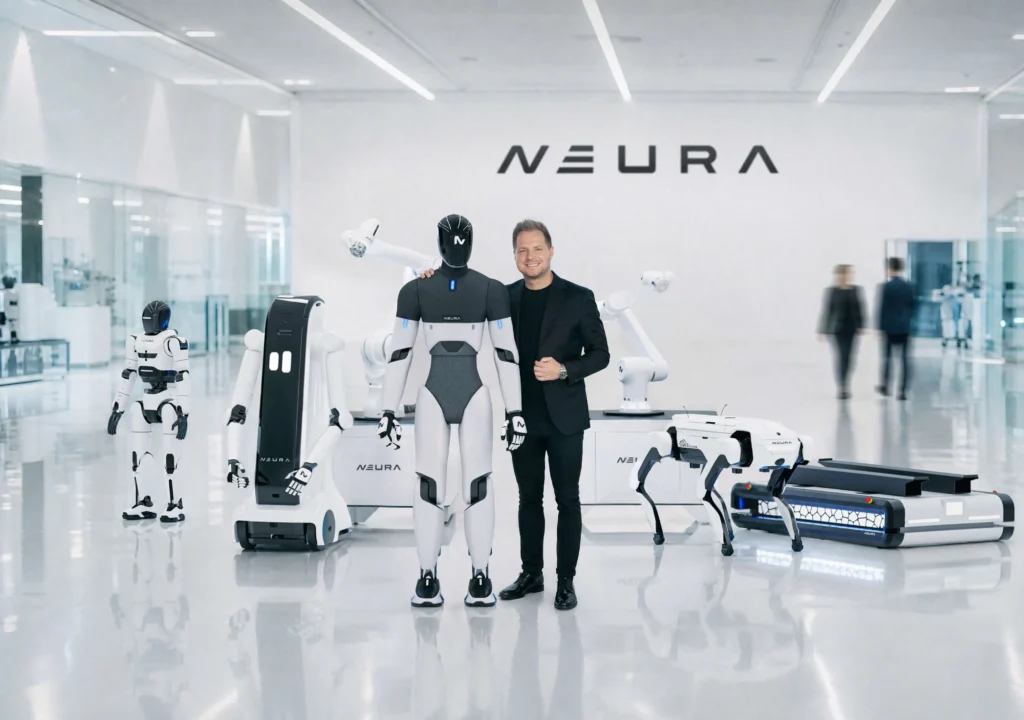
Photo: Neura Robotics
German robotics company Neura Robotics has raised up to $1.4 billion in a major Series C financing round, backed by some of the world’s most influential technology and industrial players, as the global race to build humanoid robots intensifies.
The funding round includes participation from major U.S. technology firms such as Nvidia, Amazon, and Qualcomm, alongside European industrial leaders Bosch and Schaeffler, as well as the European Investment Bank.
The deal underscores a growing shift in artificial intelligence investment: moving beyond software and digital models into physical AI systems capable of operating in the real world.
One of Europe’s Largest Robotics Funding Rounds
The financing values Neura Robotics at approximately $7 billion, according to sources familiar with the transaction, placing it among the most highly valued robotics startups in Europe.
The total funding is structured as a milestone-based round, meaning the full $1.4 billion will only be deployed if the company meets specific performance and development targets tied to its humanoid robotics roadmap.
The company declined to comment on valuation specifics or milestone conditions.
This structure reflects a growing trend in deep-tech financing, where investors are increasingly tying capital deployment to engineering progress, production scalability, and commercialization milestones rather than purely financial metrics.
AI Moves From Digital Systems to Physical Machines
At the core of Neura Robotics’ strategy is the development of humanoid and cognitive robotics systems designed to operate in real-world environments.
Founder and CEO David Reger emphasized that artificial intelligence is entering a new phase where it is no longer confined to software interfaces or cloud systems, but is instead being embedded into machines capable of movement, interaction, and autonomous learning.
The company positions its technology as part of the next generation of AI infrastructure, where robots will perform tasks in manufacturing, logistics, healthcare, and household environments.
This shift is driving renewed investor interest across the robotics sector, as firms attempt to bridge the gap between large language models and physical automation systems.
Robotics Funding Hits Record Levels Globally
Investment activity in robotics has accelerated sharply over the past year.
According to industry data provider Dealroom, global robotics startups have raised approximately $55.8 billion so far in 2026, marking a record high and nearly doubling the previous year’s total.
The majority of capital continues to flow into companies based in the United States and China, where large-scale manufacturing ecosystems and AI infrastructure provide strong support for robotics development.
However, Europe is increasingly emerging as a competitive player in the sector, with Germany and the United Kingdom producing a growing number of robotics startups focused on industrial automation and humanoid systems.
Other notable European companies in the space include Agile Robots, which has backing from SoftBank, and UK-based humanoid robotics startups working on next-generation AI-driven machines.
Big Tech and Industrial Giants Enter the Robotics Race
The participation of global technology leaders in Neura Robotics’ funding round highlights how strategically important humanoid robotics has become.
Companies like Nvidia and Amazon are increasingly investing in robotics not just as hardware platforms, but as extensions of their broader AI ecosystems.
For semiconductor and cloud computing firms, robotics represents a downstream application of AI infrastructure, requiring high-performance chips, edge computing systems, and real-time data processing capabilities.
Industrial companies such as Bosch and Schaeffler are also playing a key role, reflecting the manufacturing sector’s growing interest in automation and labor augmentation technologies.
This convergence of AI, cloud computing, and industrial engineering is accelerating the development timeline for humanoid robotics at a global scale.
Leadership Vision: AI Beyond Screens
Reger described the company’s mission as building AI systems that exist beyond digital environments.
The central idea is that artificial intelligence will increasingly take physical form, enabling machines to collaborate with humans in everyday environments rather than operating solely as software tools.
The company argues that robotics represents the next major phase of AI evolution, moving from language-based intelligence to embodied intelligence.
This vision aligns with broader industry trends where leading AI firms are exploring robotics, autonomous systems, and physical automation as the next frontier of growth.
Valuation Surge Reflects Investor Confidence in Physical AI
Neura’s valuation of around $7 billion reflects strong investor conviction that humanoid robotics could become one of the largest new technology markets of the next decade.
Unlike traditional industrial robots, humanoid systems are designed to operate in unstructured environments, interacting directly with humans and adapting to complex tasks without fixed programming.
This flexibility makes them particularly attractive for industries facing labor shortages, rising operational costs, and increasing demand for automation.
However, analysts note that commercialization timelines remain uncertain, and widespread adoption will depend on breakthroughs in safety, cost efficiency, and real-world reliability.
Europe’s Position in the Global Robotics Race
The funding round also highlights Europe’s ambition to remain competitive in advanced manufacturing and AI-driven robotics.
While Silicon Valley and Chinese tech hubs dominate AI software development, European firms are carving out a niche in industrial robotics, engineering precision systems, and hardware-integrated AI solutions.
Government-backed institutions such as the European Investment Bank are increasingly supporting deep-tech startups, signaling policy-level commitment to maintaining competitiveness in strategic technologies.
Germany, in particular, continues to play a central role due to its strong industrial base and engineering expertise.
The Bottom Line
The $1.4 billion funding round for Neura Robotics marks a major milestone in the global race to develop humanoid AI systems.
Backed by some of the world’s largest technology and industrial players, the company’s rise reflects a broader shift in artificial intelligence—from digital-only platforms to embodied machines capable of interacting with the physical world.
As global robotics investment hits record levels and competition intensifies across the U.S., Europe, and China, humanoid robotics is rapidly emerging as one of the most strategically important frontiers in the next phase of the AI economy.
.webp)
Popular articles



Subscribe to unlock premium content
From Bean to Buzz in Thailand

The Rise of Celebrity-Curated Designer Board Games

Iceland’s Geothermal Revolution

From Bean to Buzz in Thailand
The Rise of Celebrity-Curated Designer Board Games
From Bean to Buzz in Thailand
.png)