Inside Bloom Energy’s Surge as AI Data Center Power Demand Ignites a Volatile Stock Rally

Inside Bloom Energy’s Surge as AI Data Center Power Demand Ignites a Volatile Stock Rally
By
Rachel Steinberg
Last updated:
January 12, 2026
First Published:
January 12, 2026

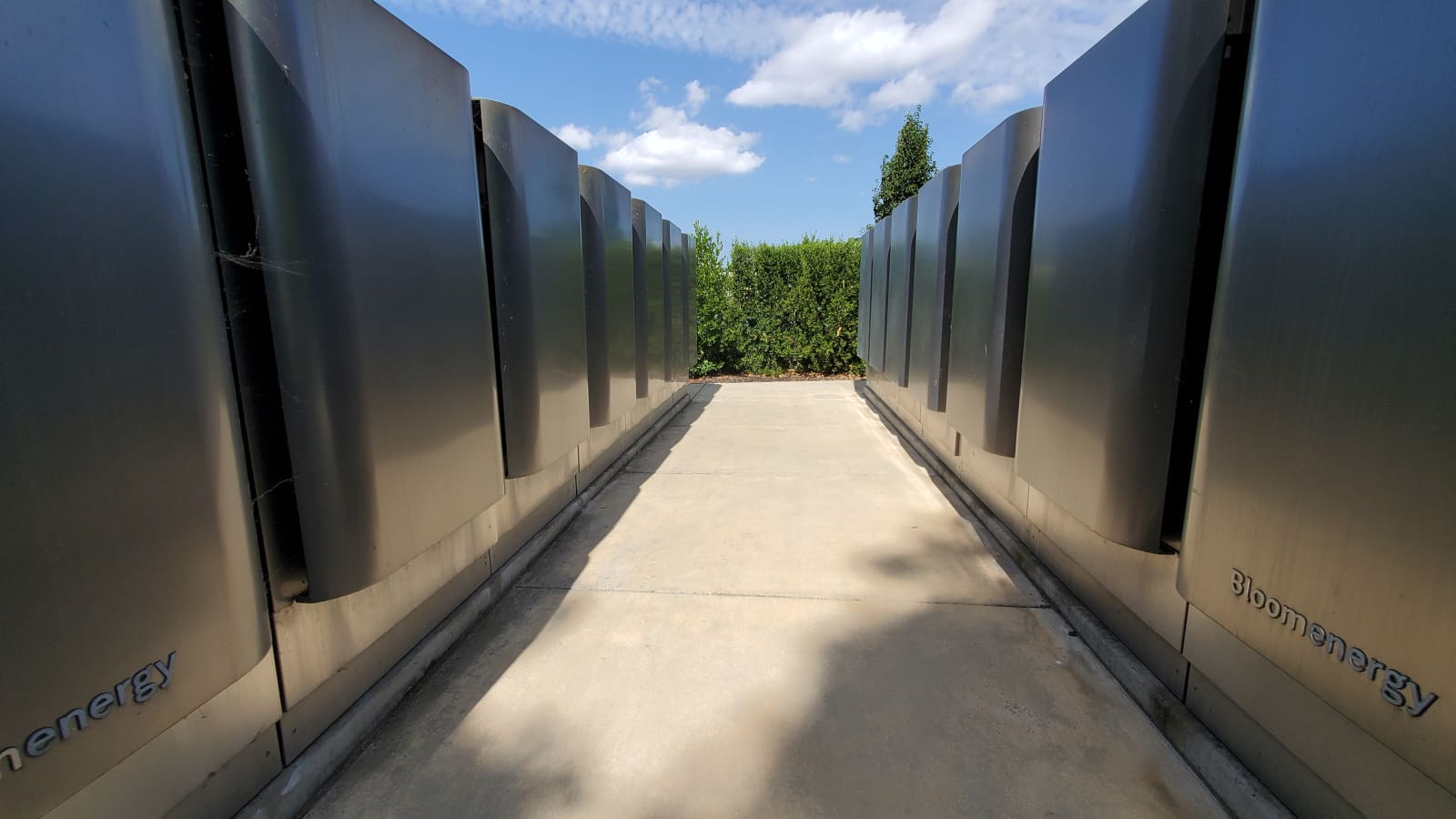
Bloom Energy power storage equipment, San Ramon, California.
Smith Collection | Gado | Archive Photos | Getty Images
Talk of an artificial intelligence bubble has become nearly unavoidable on Wall Street, especially as trillions of dollars pour into data centers to support generative AI. While much of the debate focuses on mega-cap technology companies, a clearer picture of how AI volatility plays out can be seen in adjacent industries—particularly energy. Few companies illustrate that dynamic better than Bloom Energy.
Founded more than 20 years ago, Bloom Energy was once a Silicon Valley clean-energy darling, backed by early enthusiasm for alternative power solutions. Despite landing blue-chip customers like Google and Walmart, the company struggled financially for years and failed to generate sustained shareholder returns after its 2018 IPO at $15 per share. That changed dramatically over the past year.
Bloom’s stock has surged roughly 400% as demand for its onsite fuel-cell systems has exploded, driven by AI data centers hungry for reliable, always-on power. The rally has transformed Bloom from a long-overlooked renewable energy player into one of the market’s most closely watched—and debated—AI-adjacent stocks.
From Startup Hype to AI Power Play
Bloom’s technology centers on solid oxide fuel cells that generate electricity onsite, primarily using liquefied natural gas, but also biogas and hydrogen. These systems bypass congested utility grids and provide uninterrupted power, a critical advantage for AI data centers that cannot tolerate downtime.
For years, Bloom’s business model struggled to scale. After going public, its shares hovered near IPO levels as losses mounted and investor patience wore thin. As recently as April of last year, the stock was still trading around $15.
The inflection point came when hyperscale data center operators began searching for immediate power solutions amid unprecedented AI-driven demand. With public grids under strain and permitting delays slowing new power plants, Bloom’s “speed-to-power” offering suddenly became indispensable.
A Stock Chart Fueled by AI Demand
Bloom’s valuation now reflects that shift. At roughly 125 times forward earnings, it is among the most richly valued energy stocks in the market. Its share price peaked near $148 in November following strong third-quarter earnings and a major partnership with American Electric Power, before pulling back and resuming its familiar volatility.
The latest rally came after regulatory approval for a massive Wyoming data center project. The 1.8-gigawatt facility is expected to deploy roughly 900 megawatts of Bloom fuel cells, translating into an estimated $3 billion in future revenue. A related $2.65 billion transaction by AEP to acquire Bloom systems for an unnamed customer further reinforced investor enthusiasm.
After a two-day surge, Bloom’s market capitalization climbed to roughly $32 billion, with shares closing above $134 by the end of the week.
Financial Growth, Still Modest Profits
Despite eye-catching stock performance, Bloom’s profitability remains in its early stages. In the third quarter, the company reported revenue of $519 million, up 57% year over year. Net income reached $7.8 million, a notable improvement from a $9.7 million loss in the same period last year, but still small relative to the company’s valuation.
That gap between revenue momentum and bottom-line scale sits at the heart of the bull-versus-bear debate. Among the 26 analysts covering Bloom, a minority maintain sell or strong sell ratings, arguing that expectations may be running ahead of execution. Average price targets remain elevated, though some bearish forecasts sit far below current trading levels.
Why Power Is the Real AI Bottleneck
The broader investment case for Bloom is rooted in a structural shift: power availability is emerging as the primary constraint on AI expansion. Industry estimates suggest global data center investment could reach $3 trillion to $5 trillion by 2030, while U.S. electricity demand is projected to grow at roughly 2.5% annually—five times the pace of the past decade.
Bloom has installed fuel cells at more than 1,200 sites worldwide across industries ranging from retail and manufacturing to healthcare and telecom. Its move into AI accelerated in mid-2024, when cloud computing firm CoreWeave became its first dedicated AI data center customer. Since then, Oracle, Equinix, and AEP have followed.
More than 400 megawatts of Bloom’s deployed capacity now serve data centers, out of approximately 1.5 gigawatts installed globally.
Scaling Up to Meet Explosive Demand
Bloom currently produces about 1 gigawatt of fuel cell capacity annually at its Fremont, California facility, with plans to double output to 2 gigawatts by late 2026. Management says the site could eventually support up to 5 gigawatts, though expansion will depend on firm orders.
The company has strengthened its balance sheet to support growth, securing a $600 million multi-currency credit facility and maintaining nearly $600 million in cash reserves. Executives argue that capital constraints will not limit near-term expansion, citing diversified raw material sourcing and declining unit costs.
Analysts note that Bloom has reduced costs by roughly 10% annually and has yet to fully benefit from economies of scale, suggesting potential margin expansion as production ramps.
Strategic Partnerships and Long-Term Bets
One of Bloom’s most significant endorsements came with a $5 billion strategic partnership with Brookfield Asset Management, one of the world’s largest AI infrastructure investors. The agreement positions Bloom as a preferred onsite power provider across Brookfield’s global portfolio and offers customers flexible financing options.
Market observers see the partnership as validation of Bloom’s role in AI infrastructure, emphasizing that speed and reliability of power delivery are becoming decisive competitive advantages.
Risks, Volatility, and the Bubble Question
Still, skepticism remains. Some analysts caution that markets may be pricing in near-perfect execution over several years, treating customer announcements as guaranteed revenue rather than phased deployments. Bloom’s stock has recorded more than 70 price moves exceeding 5% in the past year, underscoring its volatility.
Competition is also evolving. While Bloom is currently seen as the leading standalone power solution for data centers, rivals are investing in alternative technologies, including turbines and next-generation fuel cells. Longer term, nuclear, renewables paired with storage, and even experimental concepts could reshape the energy mix for data centers.
Those options, however, remain years from widespread deployment.
A High-Conviction Investment Story
For now, Bloom occupies a critical niche in an AI-driven energy crunch. Its technology addresses an immediate problem with few near-term substitutes, giving the company a first-mover advantage as data center construction accelerates.
For investors, the stock represents a high-risk, high-reward wager on continued AI infrastructure expansion. The fundamentals point to rapid revenue growth, but valuation and volatility demand conviction.
As one analyst put it, Bloom Energy is not a stock for the faint of heart—but for believers in AI’s power-hungry future, it may be one of the most direct ways to invest in the grid behind the algorithms.
.webp)
Popular articles



Subscribe to unlock premium content
Iceland’s Geothermal Revolution

Bali’s Digital Detox Revolution

Step Into the Future of Art

Iceland’s Geothermal Revolution
Bali’s Digital Detox Revolution
Iceland’s Geothermal Revolution