From Dust to Data Centers: How AI Giants and Billions in Debt Are Reshaping America

From Dust to Data Centers: How AI Giants and Billions in Debt Are Reshaping America
By
Rachel Steinberg
Last updated:
January 1, 2026
First Published:
January 1, 2026

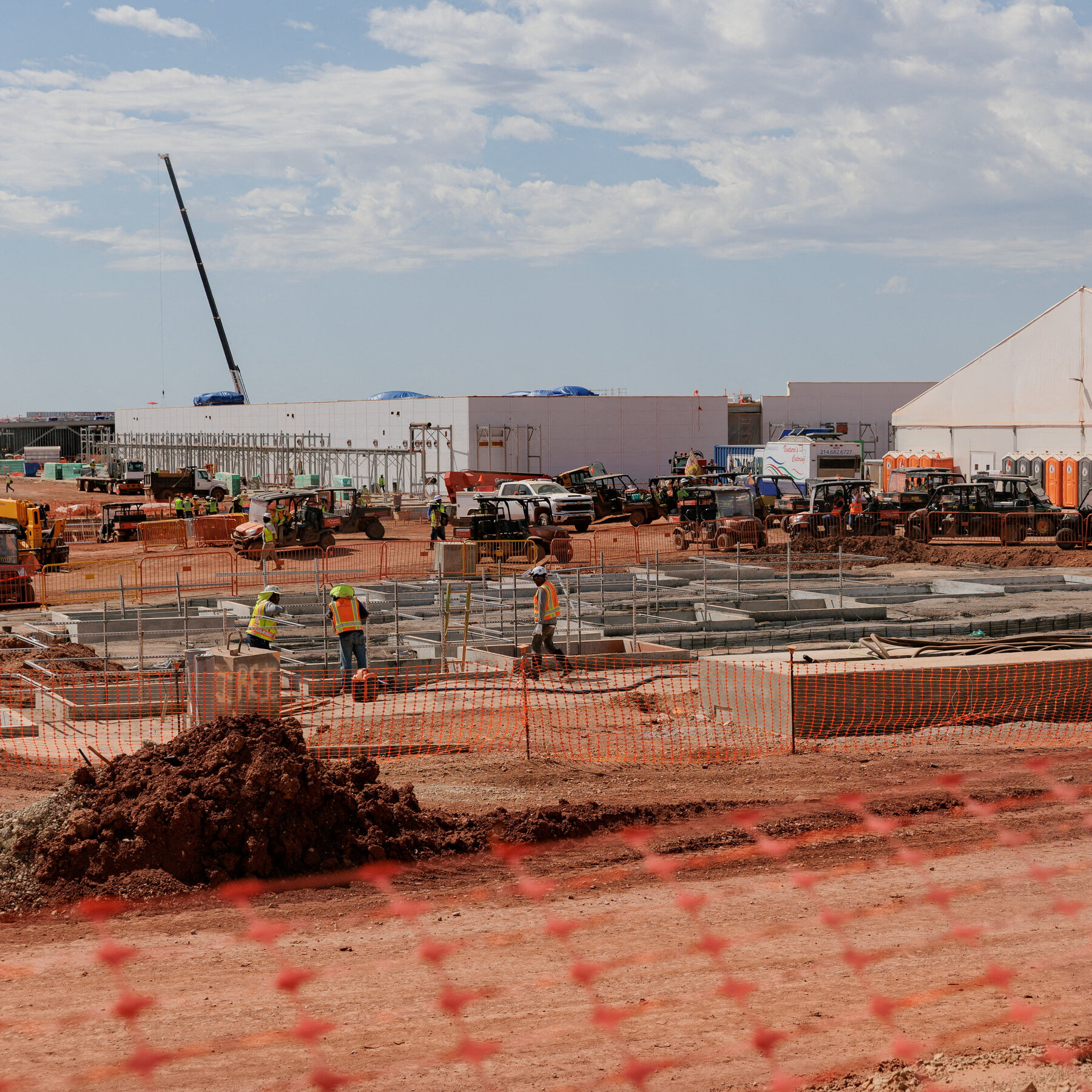
Photo: The New York Times
The New American Landscape of AI
Across the American heartland, once-quiet farmland and abandoned industrial sites are transforming into sprawling data campuses. Meta, Google, OpenAI, Microsoft, Amazon, and xAI are constructing hyperscale facilities the size of small cities, each requiring gigawatts of electricity to power the AI revolution.
OpenAI’s Stargate project in West Texas exemplifies the scale. With $50 billion invested per site and a network totaling roughly $850 billion, the Abilene campus alone will eventually demand enough electricity to power 750,000 homes—equivalent to Seattle and San Francisco combined. Microsoft, Amazon, and Meta are building similar megastructures, consuming billions in capital expenditure while racing to meet projected AI demand.
Debt-Fueled Expansion
The surge in AI infrastructure is being funded primarily through debt, not cash. In 2025, U.S. hyperscalers issued $121 billion in new debt—four times the five-year annual average. Meta alone raised $30 billion, Alphabet $25 billion, and Oracle $18 billion. Analysts project that AI’s buildout could drive $900 billion to $1.5 trillion in new borrowing in 2026 and beyond.
Credit markets have taken notice. Credit-default swaps for major tech firms are widening, signaling caution as investors weigh the risk of overextension. Analysts compare the boom to the fiber expansion of the dot-com era, warning that debt-fueled overreach could lead to bankruptcies or equity wipeouts if demand fails to meet expectations.
The Web of AI Partnerships
At the center of the AI infrastructure race sits OpenAI, orchestrating a network of deals with Nvidia, AMD, Oracle, Broadcom, AWS, and SoftBank. The arrangement has been described as a “circular economy,” where capital, hardware, and revenue recycle among a small group of companies.
OpenAI’s deals include $100 billion with Nvidia for next-generation chips, a stake in AMD to deploy Instinct GPUs, and multi-gigawatt supply agreements with Broadcom and AWS. This interconnected approach allows OpenAI and its partners to rapidly scale, but it also amplifies systemic risk if one link falters.
Scaling Beyond the Cloud
Other tech giants are following suit. Meta’s Hyperion in northeast Louisiana will consume more electricity than New Orleans, covering four million square feet. Google’s campus in West Memphis, Arkansas, represents the largest private investment in the state’s history, while Elon Musk’s Colossus in South Memphis and Microsoft’s $7 billion Wisconsin facility exemplify the geographic spread of AI infrastructure.
Amazon’s Project Rainier in Indiana converted 1,200 acres of farmland into a dedicated AI training center for Anthropic, demonstrating how hyperscalers are turning rural America into compute corridors.
The Bottleneck Is Power
Despite abundant investment, energy remains the critical constraint. Data centers require uninterrupted power, and renewable sources alone cannot meet the scale. Companies are tapping gas, nuclear, and utility grids, while lobbying for favorable policies, including expanded tax credits under the CHIPS Act. OpenAI CFO Sarah Friar emphasizes that the true challenge is not financing, but securing enough energized real estate to sustain expansion.
The Stakes and the Risks
Industry leaders are betting that exponential AI growth will justify the massive infrastructure spend. Anthropic’s revenue has jumped tenfold annually over the past three years, while OpenAI continues to project trillion-dollar scale ambitions.
Yet skeptics warn the rapid, debt-backed expansion mirrors past tech bubbles. Oracle stock fell 23% in November amid overhyped AI contract expectations. Credit investors caution that overbuilding and mismanaged capacity could lead to a cascade of losses across the sector.
The Future of AI Infrastructure
The AI arms race is reshaping not just technology, but geography and capital markets. Dusty fields in Texas, Louisiana, and Indiana now host towering data centers, signaling a new industrial age. As AI moves from lab to real-world applications, the payoff could be transformative—but the path is fraught with financial, operational, and regulatory challenges.
For now, construction continues. Trucks kick up dust, transformers hum, and the heartland is quietly becoming the backbone of a trillion-dollar AI revolution.
.webp)
Popular articles



Subscribe to unlock premium content
Iceland’s Geothermal Revolution
Bali’s Digital Detox Revolution

Step Into the Future of Art

Iceland’s Geothermal Revolution
Bali’s Digital Detox Revolution
Iceland’s Geothermal Revolution