China Sets Its Most Modest Economic Growth Target in Decades
By
Augusta Parker
Last updated:
March 6, 2026
First Published:
April 25, 2026

Getty Images
Beijing Adjusts Growth Expectations Amid Global Uncertainty
China has set its lowest economic growth target in decades, signaling a more cautious outlook as policymakers confront mounting domestic challenges and rising geopolitical risks.
The Chinese government announced that it aims for gross domestic product growth of 4.5% to 5% in 2026, marking the most conservative target since the early 1990s. The shift reflects a growing recognition within Beijing that the country’s economy is entering a more complex and unpredictable phase.
Officials say the new target gives policymakers greater flexibility to respond to global developments that could disrupt China’s growth trajectory. Economic planners noted that uncertainty in international markets, geopolitical tensions, and energy supply risks have increased significantly in recent months.
By setting a lower benchmark, the leadership hopes to maintain credibility and avoid missing overly ambitious goals.
Many analysts say the strategy reflects a broader policy philosophy emerging in Beijing: achieving stable, realistic growth rather than chasing aggressive expansion targets that may prove difficult to meet.
Global Conflicts and Energy Risks Add Pressure
China’s decision comes as global geopolitical tensions intensify, particularly in the Middle East where ongoing conflict involving Iran threatens oil supplies.
China is the world’s largest crude oil importer, purchasing more than 11 million barrels per day, and Iran has historically been an important supplier. Disruptions in that region could significantly impact energy security for the Chinese economy.
Compounding the challenge is political instability in other key energy partners. Venezuela, another major oil supplier to China, has also faced leadership upheaval that could affect production and exports.
As a precaution, Chinese authorities have reportedly instructed several large state-owned refiners to temporarily suspend exports of diesel and gasoline, ensuring that domestic energy supplies remain stable in case international shipments become constrained.
These measures highlight Beijing’s concern about maintaining sufficient fuel reserves during a period of heightened geopolitical tension.
At the same time, diplomatic relations between Washington and Beijing remain delicate. The evolving conflict in the Middle East has raised questions about whether a planned meeting between U.S. President Donald Trump and Chinese President Xi Jinping will proceed as scheduled.
Domestic Economic Headwinds Remain Significant
While global instability plays a role, the more pressing reason behind China’s lower growth target lies within its own economy.
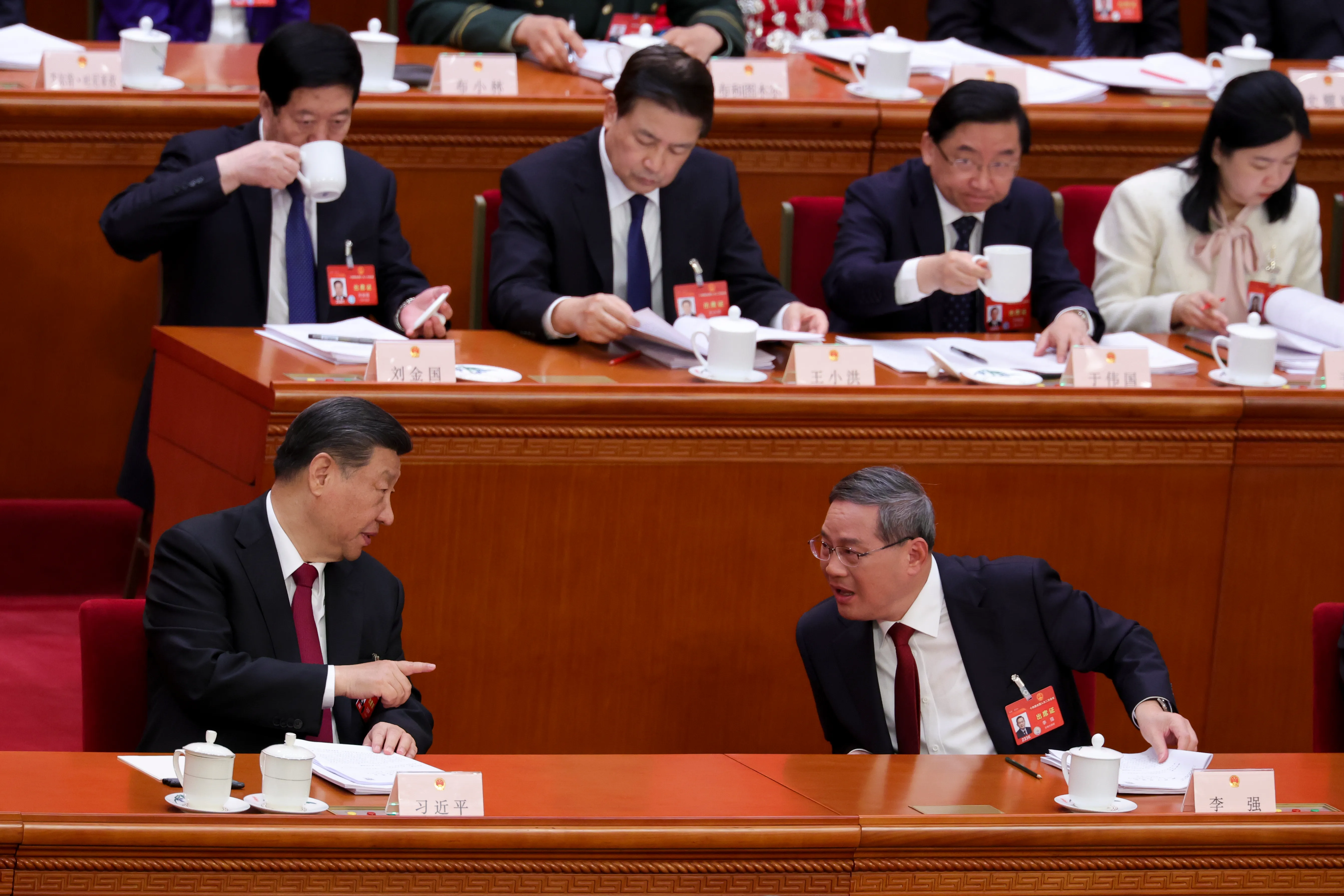
During the announcement of the new economic plan, Chinese Premier Li Qiang acknowledged the impact of external trade pressures, including tariffs and restrictions imposed by the United States.
He also highlighted structural problems that have slowed economic momentum across several sectors.
Weak consumer spending has been a major concern. Household confidence has struggled to recover following years of pandemic disruptions, property market instability, and slower wage growth.
Consumer price inflation remained essentially flat last year, far below Beijing’s long-standing target of about 2% annual inflation, reinforcing concerns about potential deflation.
Local governments are also under financial strain. Many municipalities accumulated large debts through infrastructure spending and property development over the past decade. In some regions, fiscal stress has reportedly led to delays in salary payments for public sector employees.
These pressures have weighed heavily on investment and economic activity, forcing policymakers to rethink their approach to growth management.
Employment and Household Concerns Take Center Stage
For many Chinese households, employment remains the most immediate economic concern.
China’s youth unemployment rate reached 16.3% in January, highlighting the difficulty many young graduates face when entering the labor market. By comparison, youth unemployment in the United States stood at around 9% during the same period.
Overall urban unemployment in China averaged 5.2% last year, and Beijing has set a new target of keeping the rate near 5.5% in 2026.
The government has pledged to create approximately 12 million new urban jobs this year to help stabilize the labor market.
However, detailed plans explaining how those jobs will be generated have not yet been released, leaving economists uncertain about how the target will be achieved.
Property Market Troubles Continue
Another major drag on China’s economy remains the prolonged downturn in the real estate sector.
For years, property development accounted for as much as 25% to 30% of China’s economic activity when related industries such as construction, steel, cement, and home appliances were included.
However, the sector has been under severe stress since the government began tightening borrowing rules for developers in 2020. Several large property companies have defaulted on debt, leaving unfinished housing projects and weakening consumer confidence.
Despite the seriousness of the downturn, Beijing’s latest economic plan introduced only modest adjustments to property policies. Officials described previous stabilization efforts as “effective” and largely maintained last year’s approach.
Some economists argue that stronger intervention may be necessary to fully stabilize the sector and restore buyer confidence.
Beijing Prioritizes Technology and Innovation
While property development struggles, China’s leadership continues to focus heavily on building strength in advanced technology industries.
The government’s long-term strategy emphasizes technological self-sufficiency, particularly in areas such as artificial intelligence, semiconductors, robotics, and electric vehicles.
Beijing has pledged to increase funding for scientific research and expand programs designed to support innovation-driven companies.
The upcoming five-year policy framework is expected to include major investments in research infrastructure, talent development, and high-tech manufacturing capacity.
However, analysts note that these new sectors have not yet generated enough economic momentum to fully offset losses from traditional industries.
Between 2023 and 2025, emerging industries including AI, robotics, and electric vehicles contributed roughly 0.8 percentage points to GDP growth. During the same period, declining activity in traditional sectors such as real estate reduced overall growth by about 6 percentage points, according to economic research estimates.
Export Performance Will Shape Policy Response
Exports remain one of the most important variables influencing China’s economic outlook.
China remains the world’s largest manufacturing exporter, shipping goods worth more than $3.5 trillion annually to markets across North America, Europe, and Asia.
Strong export performance could help offset weak domestic consumption and reduce the need for aggressive stimulus measures.
However, if global demand weakens or trade tensions escalate, policymakers may be forced to introduce additional economic support programs.
In preparation for potential shocks, Beijing plans to issue 1.3 trillion yuan (about $188 billion) in ultra-long-term special treasury bonds in 2026. These funds are expected to support infrastructure development and strategic industrial investment.
The government also intends to allocate 250 billion yuan to consumer trade-in programs encouraging households to upgrade appliances, vehicles, and electronic devices.
A Strategy Focused on Stability
Despite the lowered growth target, China remains on track to achieve one of its most ambitious long-term goals: doubling the size of its economy by 2035 compared with 2020 levels.
Economists estimate that maintaining average annual growth of roughly 4.17% over the next decade would be sufficient to meet that objective.
By setting the 2026 target slightly above that threshold, policymakers are effectively creating a buffer while maintaining progress toward long-term development plans.
Many analysts believe the strategy reflects a pragmatic shift in Beijing’s economic management style.
Rather than pursuing overly optimistic targets, China’s leadership appears focused on maintaining stability during a period of structural transformation and global uncertainty.
In other words, policymakers may prefer to exceed modest expectations rather than risk falling short of bold promises.
.webp)
Popular articles



Subscribe to unlock premium content
The Market for Renting Private Libraries Where Only Rare, Unpublished Manuscripts Exist

Living Underwater in the Heart of the City

Frozen Luxury in Europe

The Market for Renting Private Libraries Where Only Rare, Unpublished Manuscripts Exist
Living Underwater in the Heart of the City
The Market for Renting Private Libraries Where Only Rare, Unpublished Manuscripts Exist