China Moves Ahead of Silicon Valley in the Race to Put Humanoid Robots to Work

China Moves Ahead of Silicon Valley in the Race to Put Humanoid Robots to Work
By
Junia Wells
Last updated:
December 30, 2025
First Published:
December 30, 2025

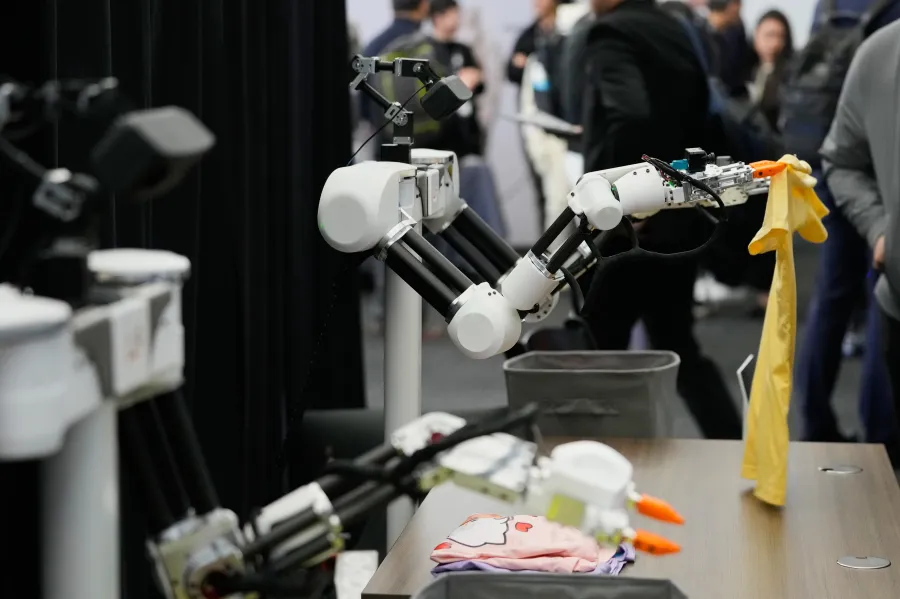
A Vision Popularized in the West, Executed in the East
Humanoid robots have become one of the most ambitious promises of the artificial intelligence era. Elon Musk has placed them at the center of Tesla’s long-term vision, arguing that humanoids could ultimately be worth tens of trillions of dollars and reshape the global economy. Yet despite the attention, Tesla has not sold a single unit of its Optimus robot.
Instead, momentum is building thousands of miles away. China is positioning itself to become the first country to commercialize humanoid robots at scale, with domestic companies preparing to ramp up production as early as 2026. Backed by industrial capacity, government policy, and deep supply chains, Chinese firms appear poised to turn a futuristic concept into an industrial reality.
Why Humanoid Robots Matter
Humanoid robots are designed to replicate human form and movement, allowing them to operate in environments built for people rather than machines. Powered by advanced AI models, sensors, semiconductors, and complex mechanical systems, they promise flexibility across factories, warehouses, hospitals, retail spaces, and eventually private homes.
Supporters argue that humanoids could address labor shortages, improve productivity, and unlock new forms of automation that traditional industrial robots cannot handle. In China’s case, the technology also represents a strategic opportunity to leap ahead in applied artificial intelligence.
Beijing Makes Robotics a Strategic Priority
China’s push into humanoid robotics is not accidental. Over the past several years, Beijing has elevated robotics to a national priority, embedding it into long-term economic planning.
In October, China’s top leadership released proposals linked to the upcoming 15th five-year plan, explicitly referencing “embodied artificial intelligence,” a category that includes humanoid robots, autonomous vehicles, and AI-powered machinery. The message was clear: physical AI systems are expected to drive the next phase of industrial growth.
For China, humanoid robots serve multiple goals at once. The country is facing demographic pressure from an aging population and declining birth rates, which are shrinking the workforce and pushing labor costs higher. Robots offer a way to sustain output without relying solely on human labor. At the same time, robotics has become another front in China’s broader technology rivalry with the United States.
Chinese Companies Race Toward Mass Production
Analysts increasingly believe China is ahead in early commercialization. While both China and the U.S. are expected to develop massive humanoid robot markets over time, China is scaling faster in the initial phase.
Some of the country’s leading players are already moving beyond prototypes. Unitree, one of China’s most closely watched robotics firms, is preparing for a potential IPO that could value it around $7 billion. The company has unveiled multiple humanoid models, including its latest version capable of complex movements such as coordinated dancing.
UBTech Robotics is another major contender. Its humanoid robots are already being deployed in factories and commercial environments, including as guides in public venues. Its flagship industrial humanoid can replace its own battery, allowing it to operate continuously around the clock. UBTech recently raised roughly $400 million through a share placement and plans to scale deliveries from hundreds of units this year to several thousand annually by 2026, with further expansion planned in 2027.
AgiBot has also crossed key milestones, announcing that its 5,000th humanoid robot has rolled off the production line. Meanwhile, electric vehicle maker Xpeng has entered the field with its second-generation humanoid robot, Iron, and plans to begin mass production next year.
Altogether, China now hosts more than 150 humanoid robotics companies, making it the world’s most crowded and competitive market for the technology.
Manufacturing Strength Gives China an Edge
China’s advantage lies less in flashy demonstrations and more in industrial execution. The country’s manufacturing ecosystem, refined through decades of producing electronics, smartphones, and electric vehicles, enables faster iteration and lower costs.
Analysts estimate that Chinese humanoid robot makers can reduce production costs by 20 to 30 percent per year as scale increases. Local governments are also offering subsidies and incentives to support robotics development, further accelerating commercialization.
By contrast, U.S. companies are focusing on vertical integration, aiming to control critical components such as actuators and AI software to build defensible intellectual property. While this approach may deliver superior performance over time, it often comes at higher upfront costs and slower scaling.
A Global Market Taking Shape
Long-term projections for humanoid robots are enormous. Some analysts estimate the global total addressable market could reach $9 trillion by 2050, with China accounting for more than 60 percent of early demand.
In the near term, China’s market is expected to outpace the U.S. due to earlier industrial adoption. Over the longer horizon, both countries are likely to converge toward similarly large markets, with mass adoption in households not expected until after 2040.
Technical and Economic Bottlenecks Remain
Despite the momentum, humanoid robotics is far from a solved problem. One major challenge is access to advanced chips, with Chinese firms still heavily reliant on U.S.-designed processors for AI workloads. Export restrictions could slow progress or raise costs.
There are also technical limitations. Humanoids struggle in unpredictable real-world environments, and replicating the dexterity of human hands remains one of robotics’ hardest problems. Most robotic hands still lack the degrees of freedom needed for fine manipulation, limiting their usefulness in many tasks.
Cost is perhaps the biggest hurdle. Today’s advanced humanoid prototypes can cost between $150,000 and $500,000 per unit. To compete directly with human labor, prices will likely need to fall to the $20,000 to $50,000 range, a gap that will take years of engineering and scale to close.
Bubble Warnings From Beijing
Even as China promotes robotics, regulators are urging caution. The National Development and Reform Commission has warned of bubble-like conditions forming in the humanoid robot sector, citing the rapid growth in the number of companies and the similarity of many products.
China has experienced boom-and-bust cycles before in strategically favored sectors, including electric vehicles. Officials are wary of excessive capital chasing unproven business models. Analysts also caution that highly polished demo videos can exaggerate real-world capabilities, widening the gap between perception and reality.
If expectations rise too quickly, a market correction could slow funding and delay commercialization, even as the underlying technology continues to improve.
From Vision to Reality
Elon Musk may have captured global attention by framing humanoid robots as the future of work and value creation. But it is China that is currently translating that vision into factories, production lines, and early deployments.
Whether China can maintain its lead will depend on overcoming technical constraints, managing costs, and avoiding speculative excess. What is increasingly clear, however, is that the first large-scale humanoid workforce is more likely to emerge from Chinese industrial zones than from Silicon Valley labs.
.webp)
Popular articles



Subscribe to unlock premium content
Iceland’s Geothermal Revolution

Bali’s Digital Detox Revolution

Step Into the Future of Art
Iceland’s Geothermal Revolution
Bali’s Digital Detox Revolution
Iceland’s Geothermal Revolution