China Lowers Economic Growth Target to 4.5 Percent–5 Percent Amid Deflation Pressures

China Lowers Economic Growth Target to 4.5 Percent–5 Percent Amid Deflation Pressures
By
Augusta Parker
Last updated:
March 5, 2026
First Published:
April 25, 2026

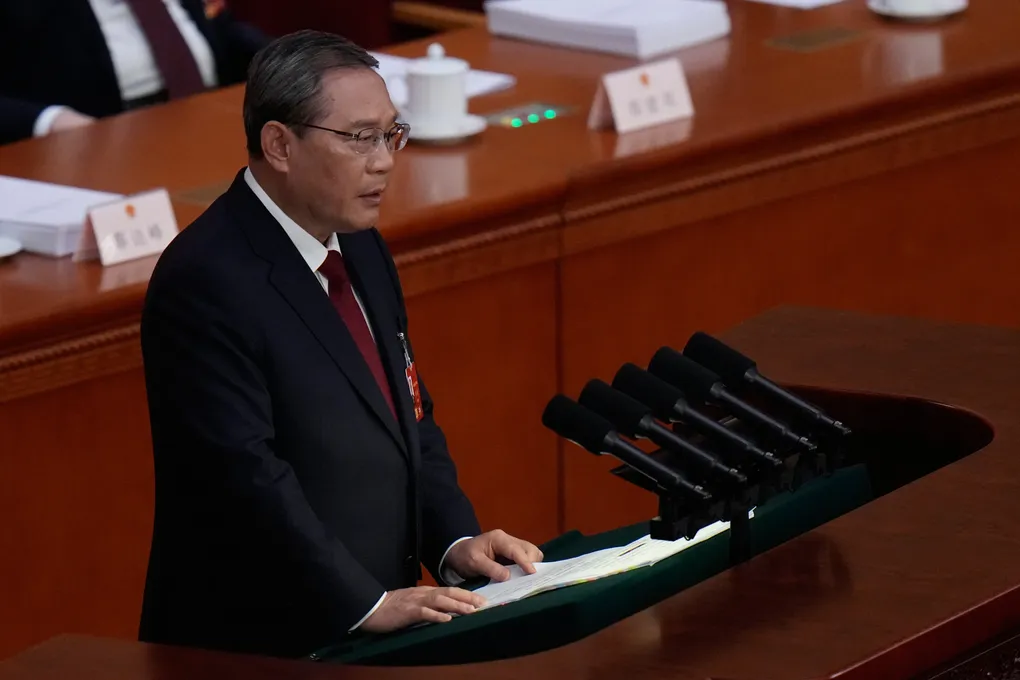
Photo: The Seattle Times
China Adopts Its Most Conservative Growth Target in Decades
China has set its economic growth target for 2026 at between 4.5 percent and 5 percent, marking the lowest official target recorded since the early 1990s. The goal reflects Beijing’s attempt to navigate a complex economic environment shaped by persistent deflationary pressures, fragile consumer confidence, and ongoing trade tensions with the United States.
The new target was outlined in the government’s annual work report presented during the country’s parliamentary gathering in Beijing. For the past three years, China had maintained a growth target of around 5 percent. The new range represents a subtle but significant adjustment in expectations as policymakers acknowledge the structural challenges facing the economy.
The only recent exception to China’s practice of setting a formal growth target occurred in 2020, when the government refrained from announcing one due to the uncertainty created by the global pandemic.
Fiscal Strategy Remains Supportive but Controlled
Alongside the revised growth target, Chinese authorities confirmed that the national budget deficit will remain at around 4 percent of gross domestic product. This level was first introduced in 2024 and represents the highest deficit target recorded since at least 2010.
The previous peak deficit ratio had been approximately 3.6 percent in 2020 during the height of pandemic-related economic disruptions. By maintaining a deficit near 4 percent, Beijing is signaling that it will continue using fiscal tools to support the economy while avoiding aggressive stimulus measures that could increase financial risks.
The government also reiterated its consumer inflation target of roughly 2 percent for the year. Introduced in 2025, this is the lowest inflation goal China has set in more than two decades.
However, the inflation benchmark functions more as a ceiling than a target the government expects to reach. China’s inflation rate has remained extremely subdued. For the full year 2025, overall consumer prices were essentially flat, while core inflation excluding food and energy rose just 0.7 percent, reflecting weak consumer demand across the economy.
Structural Challenges Continue to Weigh on Growth
Chinese Premier Li Qiang acknowledged in the government report that the economy is confronting multiple structural challenges. Among them are a changing global trade environment, long-standing structural imbalances, and declining momentum in both consumption and investment.
Weak consumer spending remains one of the most persistent problems. Years of uncertainty in the property market, coupled with slower wage growth and rising household caution, have reduced the pace of retail expansion. Retail sales in 2025 grew by only 3.6 percent, far below the rates seen during China’s earlier growth cycles.
Meanwhile, deflationary pressures continue to affect the industrial sector. China’s factory-gate prices fell by about 2.6 percent year over year in 2025, extending a prolonged period of producer price declines that reflects soft demand and excess manufacturing capacity in certain industries.
Economists increasingly view these conditions as evidence that China is transitioning from an investment-driven growth model toward a slower but more stable economic structure.
Policymakers Shift Focus Toward “Quality Growth”
Analysts believe the new growth target signals an important change in Beijing’s economic philosophy.
Rather than prioritizing rapid headline growth numbers, policymakers appear to be emphasizing the quality and sustainability of expansion. Experts say this approach reflects concerns that excessively high growth targets can encourage local governments to pursue unproductive infrastructure projects or inflate economic statistics to meet official benchmarks.
By adopting a more realistic target, Beijing may be attempting to reduce pressure on regional officials while promoting structural reforms and long-term economic stability.
The shift also reflects recognition that China’s economy has matured significantly. With a GDP exceeding $18 trillion and a slowing labor force, maintaining the double-digit growth rates seen in earlier decades is no longer feasible.
Labor Market and Employment Targets
Maintaining employment stability remains a central priority for Chinese policymakers.
The government has set a target urban unemployment rate of around 5.5 percent for the year. Last year, the urban jobless rate stood at approximately 5.2 percent. Authorities also plan to create roughly 12 million new jobs in urban areas in 2026 in order to absorb new graduates and migrant workers entering the labor market.
Job creation has become increasingly important as China’s services sector grows and the manufacturing sector undergoes technological transformation.
Fiscal Stimulus Through Infrastructure and Consumer Support
Although the overall fiscal stance remains relatively measured, Beijing is deploying several targeted stimulus measures to support economic activity.
The government plans to issue approximately 1.3 trillion yuan, or about $188 billion, in ultra-long-term special treasury bonds this year. This amount matches the issuance level seen in 2025 and will primarily fund infrastructure and strategic development projects.
Authorities have also allocated about 250 billion yuan to expand consumer trade-in programs that encourage households to replace older appliances and electronics with newer, more energy-efficient models.
Another 300 billion yuan has been earmarked to strengthen the capital positions of major state-owned commercial banks. The measure is intended to ensure that large lenders maintain strong balance sheets and continue providing credit to businesses and households.
In addition, China plans to issue roughly 4.4 trillion yuan in local government special-purpose bonds. These bonds are widely used to finance infrastructure projects such as transportation networks, renewable energy installations, and urban development initiatives.
The program also serves as a tool to alleviate financial stress among local governments that accumulated large amounts of debt during earlier stimulus campaigns.
Monetary Policy Expected to Remain Supportive
China’s central bank is expected to maintain an accommodative monetary stance throughout the year to support economic recovery.
Officials have signaled that interest rate cuts remain possible, along with reductions to banks’ reserve requirement ratios. Lower reserve ratios allow banks to lend more money to businesses and consumers, potentially stimulating economic activity.
Authorities also plan to expand the use of targeted policy tools designed to channel credit toward strategic sectors such as advanced manufacturing, green energy, and high-tech innovation.
These structural monetary tools are increasingly becoming a central component of China’s economic management strategy.
Real Estate Slump Continues to Drag on Growth
One of the largest headwinds facing China’s economy remains the ongoing slowdown in the property sector.
Real estate investment dropped by about 17.2 percent in 2025, reflecting a prolonged downturn that began several years earlier when heavily indebted developers struggled to complete projects and repay loans. The sector had historically accounted for a substantial portion of China’s economic activity, influencing construction, materials, consumer spending, and local government finances.
Fixed-asset investment overall declined by about 3.8 percent last year, marking the first annual drop in decades and highlighting the scale of the slowdown in property development.
Stabilizing the real estate market remains a critical challenge for policymakers as they attempt to restore confidence among both developers and homebuyers.
Trade Tensions and Global Risks Add Uncertainty
China’s economic outlook is also being shaped by geopolitical developments and international trade disputes.
The country has spent much of the past year navigating an intense trade confrontation with the United States, which has resulted in new tariffs and export restrictions affecting several sectors. In response, Chinese companies have accelerated efforts to diversify their export markets, shifting more shipments toward Europe, Southeast Asia, and emerging economies.
Government officials acknowledged that tariff pressures from the United States have had a measurable impact on trade flows, although domestic stimulus measures helped cushion the economic impact.
At the same time, rising geopolitical tensions in the Middle East have added another layer of uncertainty to global markets, potentially affecting energy prices, shipping routes, and international investment flows.
Chinese leaders have also taken an active diplomatic role in recent international developments, calling for de-escalation and renewed diplomatic dialogue in regional conflicts.
Outlook for China’s Economic Strategy
China’s decision to set a lower growth target reflects the complex reality facing the world’s second-largest economy. Slower growth, weak inflation, and structural adjustments are shaping a new phase of development for the country.
Rather than pursuing rapid expansion at any cost, policymakers appear to be focusing on long-term economic resilience, financial stability, and technological advancement.
If successful, this strategy could allow China to transition toward a more sustainable growth model, even as it navigates global trade tensions, domestic economic restructuring, and shifting geopolitical dynamics.
.webp)
Popular articles



Subscribe to unlock premium content
Remote Himalayan Villages Transforming Ancient Traditions into Lucrative Wellness Ventures

Gilded Holidays in Fashion

Frozen Frontiers of Luxury

Remote Himalayan Villages Transforming Ancient Traditions into Lucrative Wellness Ventures
Gilded Holidays in Fashion
Remote Himalayan Villages Transforming Ancient Traditions into Lucrative Wellness Ventures