Big Pharma Accelerates Biotech Dealmaking as a $170 Billion Patent Cliff Nears

Big Pharma Accelerates Biotech Dealmaking as a $170 Billion Patent Cliff Nears
By
David Goldfarb
Last updated:
January 9, 2026
First Published:
January 9, 2026

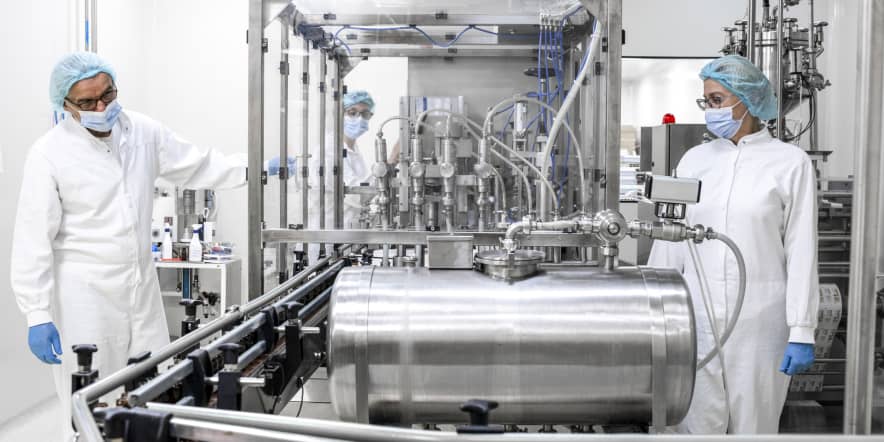
Two employees in pharmaceutical industry wearing protective gloves, mask, cap and white suit seen standing by the machine that is the part of the medicaments production during the working hours in a pharmaceutical manufacturing.
Extreme-photographer | E+ | Getty Images
A Revenue Reckoning Is Approaching
The global pharmaceutical industry is entering a critical period as some of the world’s top-selling drugs approach the end of their patent protection. Known across the sector as the “patent cliff,” this wave of expirations threatens to erode a massive share of industry revenue over the coming years.
By 2032, loss of exclusivity on major branded drugs is expected to put at least $173.9 billion in annual sales at risk, based on industry estimates. When smaller brands are included, analysts project the total revenue exposure could range from $200 billion to as much as $350 billion. For large pharmaceutical companies, the message is clear: replenish pipelines or risk sustained top-line pressure.
This looming challenge is colliding with a revived biotech sector, creating the conditions for a powerful surge in mergers, acquisitions, partnerships, and licensing deals.
Biotech Reawakens After a Long Slump
After years of depressed valuations following the post-pandemic healthcare investment boom, biotech is showing clear signs of recovery. Deal activity accelerated sharply in September and October 2025 after a sluggish start to the year, as several policy and macroeconomic overhangs began to lift.
Improved clarity around U.S. drug pricing policy, a pullback from threats of punitive sector tariffs, and the start of an interest-rate cutting cycle have all helped revive investor confidence. At the same time, a series of strong clinical trial readouts has restored credibility to biotech balance sheets and pipelines.
For Big Pharma, the timing is critical. Companies are being forced to act in a market that is no longer cheap, while competition for the best assets is intensifying.
Filling the Pipeline Gap
Unlike most industries, biopharma operates on a predictable but unforgiving lifecycle. Every decade or so, flagship drugs lose patent protection, opening the door to generics and biosimilars and triggering sharp revenue declines.
This dynamic has made external innovation a cornerstone of pharmaceutical strategy. Over the past decade, roughly half of all blockbuster drugs approved globally were acquired rather than developed internally. Eli Lilly and AstraZeneca stand out among large-cap peers, acquiring eight and five blockbuster medicines respectively between 2014 and 2023.
Major upcoming patent expirations include Bristol Myers Squibb’s Eliquis, Merck’s Keytruda, and Novo Nordisk’s Ozempic, putting additional urgency behind dealmaking efforts across the sector.
Why Pharma Keeps Buying Biotech
Biotech companies have increasingly become the innovation engine of modern healthcare, producing advanced therapies such as monoclonal antibodies, mRNA-based treatments, and gene therapies. While traditional pharmaceutical companies historically focused on small-molecule drugs, the line between pharma and biotech has largely disappeared.
Large drugmakers now rely heavily on biotech-originated science, either through acquisitions or long-term partnerships. Industry leaders describe business development as a competitive and relationship-driven process, where the best assets often attract multiple bidders.
Rather than betting solely on early-stage science, many pharmaceutical companies prefer assets with validated biology and mid-stage clinical data. These “sweet spot” deals typically fall in the $1 billion to $2 billion range, offering meaningful upside without the extreme uncertainty of earlier research.
Competition Heats Up for Prime Assets
As valuations recover, competition for top-tier biotech assets has intensified. One of the most striking examples came in late 2025, when Pfizer and Novo Nordisk engaged in a rare public bidding war over Metsera, a clinical-stage biotech focused on next-generation weight loss drugs.
Pfizer ultimately prevailed in a deal valued at up to $10 billion, underscoring both the strategic urgency facing large drugmakers and the renewed confidence in high-growth therapeutic areas. Public bidding contests are unusual in biotech, as failed bids can carry reputational risk, but the episode highlighted just how aggressive the environment has become.
Analysts say these dynamics reflect companies racing to replace revenue before patent expirations hit full force.
GLP-1 Drugs and Beyond
The obesity and metabolic disease market has emerged as one of the most competitive battlegrounds in global pharma. More than 120 metabolic drug candidates are currently in development across roughly 60 companies, creating a deep pool of potential acquisition targets.
As reimbursement support expands and regulatory pathways become clearer, competition is expected to intensify further, particularly as differentiation between drug candidates narrows.
However, the M&A boom is not confined to weight loss therapies. Oncology, neurology, immunology, and inflammation remain highly active areas, as companies prioritize assets that can deliver revenue quickly and at scale.
Lessons From the Pandemic Boom and Bust
During the Covid-19 pandemic, biotech became one of the hottest areas in global markets. Easy funding, low interest rates, and unprecedented scientific attention drove valuations to record highs and fueled a wave of IPOs and acquisitions.
The subsequent market correction hit biotech particularly hard, as capital-intensive research models struggled in a risk-off environment. Many early-stage firms were forced to cut costs or seek strategic alternatives.
By mid-2025, sentiment began to shift. Strong clinical data, improving funding conditions, and renewed acquisition interest helped stabilize valuations. As confidence returned, investors began rewarding positive developments rather than using them as exit opportunities.
A Deal-Rich Outlook for 2026
Looking ahead, analysts expect deal activity to accelerate further in 2026. Clearing policy uncertainty, additional interest-rate cuts, and mounting patent expirations are creating what many describe as one of the most attractive environments for biotech investing in decades.
Pharmaceutical companies are increasingly deploying capital into U.S. manufacturing and R&D, benefiting from clearer regulatory signals and incentives. This backdrop is supporting both large-scale acquisitions and early-stage biotech funding.
At the same time, new pressures loom. Drug prices for certain blockbuster medicines are set to decline under the U.S. Inflation Reduction Act starting in 2026, while biosimilars may reach the market faster if updated regulatory guidance is finalized. These factors could accelerate revenue erosion beyond historical norms, particularly for biologics.
The Strategic Imperative
For Big Pharma, the message is unmistakable. The patent cliff is no longer a distant risk but an approaching reality. With hundreds of billions of dollars in sales at stake, companies are moving decisively to secure innovation wherever it exists.
As competition intensifies and valuations rise, the winners are likely to be those that strike the right balance between speed, discipline, and strategic fit. The current surge in biotech dealmaking is not just a cyclical rebound, but a structural response to one of the largest revenue transitions the pharmaceutical industry has ever faced.
.webp)
Popular articles



Subscribe to unlock premium content
Iceland’s Geothermal Revolution

Bali’s Digital Detox Revolution

Step Into the Future of Art

Iceland’s Geothermal Revolution
Bali’s Digital Detox Revolution
Iceland’s Geothermal Revolution